
NFTs no longer function as speculative collectibles. They have evolved into digital assets, and increasingly into in-game assets with clear utility.
Ethereum-based collections dominate headlines with high-value trades and large aggregate volumes. This focus makes NFTs seem like speculative assets tied to broader crypto market cycles, but price shows only part of the market.
When you measure transaction activity, asset usage, and behavioral patterns, a different structure appears.
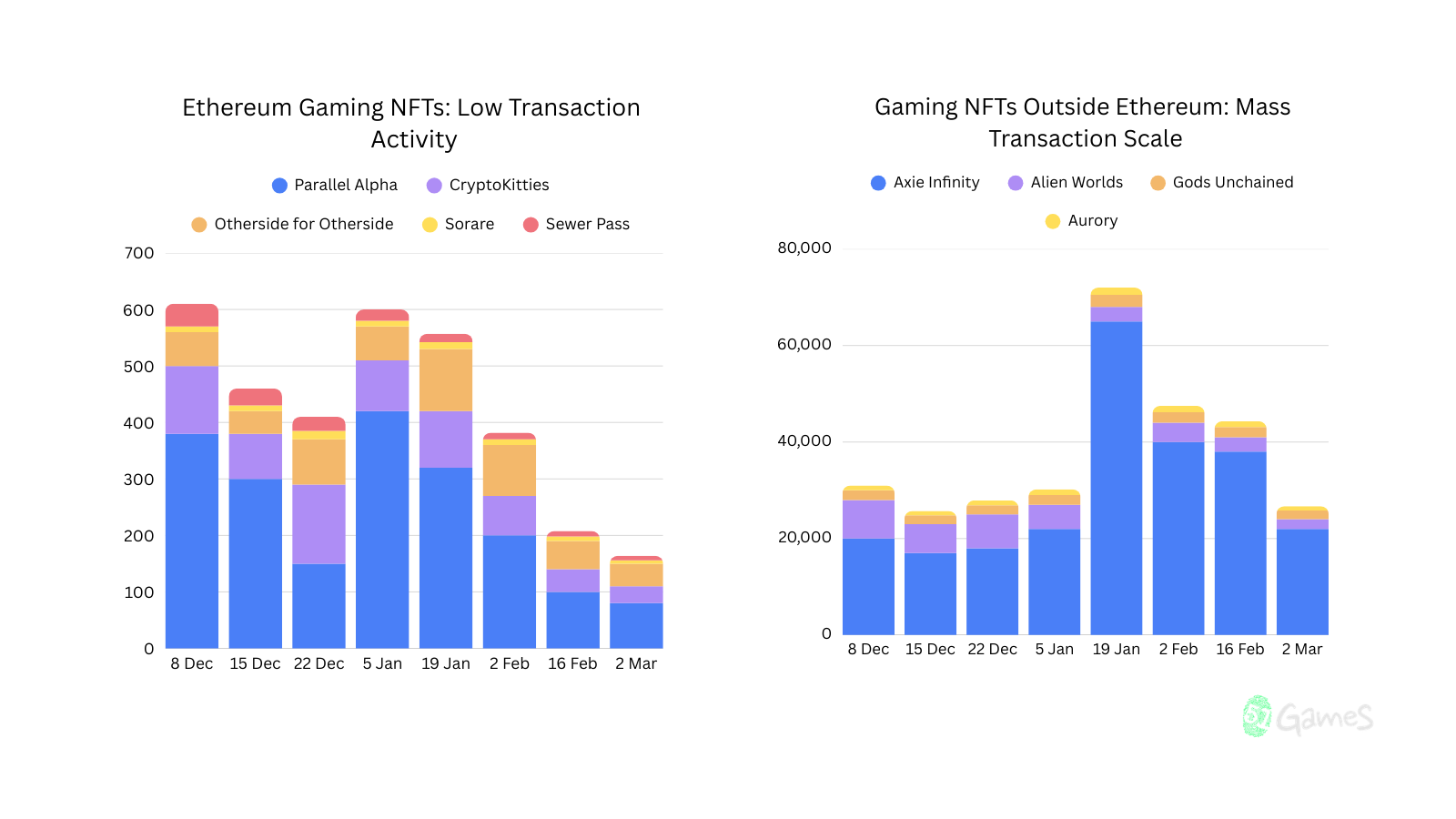
The 51 Games team collected and analyzed the data, and the results show that gaming NFT ecosystems – mostly operating on non-Ethereum chains generate 80-100 times more transactions than Ethereum-based NFTs.

Source: The Block
This gap does not come from scale alone, it reflects a fundamental difference in how these systems operate. The NFT market has evolved into two distinct economies: a low-frequency, high-value layer and a high-frequency, utility-driven layer.
Structural Split: Premium vs Utility Economies
The data reveals a clear split between Ethereum and non-Ethereum NFT activity. Ethereum still dominates total trading volume and has historically accounted for more than 50% of the market.

This dominance comes from premium, collectible assets, which typically involve:
- higher prices
- lower transaction frequency
- investor- and collector-driven demand
Gaming NFT ecosystems – mostly outside Ethereum – follow a different pattern:
- lower asset prices
- significantly higher transaction frequency
- player-driven activity
Analysis shows that non-Ethereum gaming NFT activity is 4-6 times higher than Ethereum gaming volume.

Source: The Block
This data points to a clear functional split:
- Ethereum → speculative / collectible layer
- Gaming ecosystems → operational economic layer
Transaction Intensity as a Primary Indicator
Transaction volume highlights the strongest difference between these systems.
Gaming NFT ecosystems operate at a much higher level of activity than Ethereum NFTs, driven by continuous in-game interactions rather than occasional trades.
In gaming environments, NFTs act as transactional primitives. Players constantly buy, sell, upgrade, and exchange assets as part of gameplay, which creates ongoing economic activity.
Ethereum NFTs follow a different pattern. Users acquire assets, hold them, and trade them occasionally, often in response to market signals rather than ongoing usage.
As a result:
- Ethereum concentrates value per transaction
- Gaming ecosystems maximize transaction throughput
Market Structure: From Fragmentation to Reconcentration
The 51 Games dataset also tracks how the NFT market structure has changed over time.
- 2021 → high concentration in a small number of collections
- 2022–2024 → fragmentation across a wider set of projects
- 2025–2026 → renewed reconcentration, now led by utility-driven ecosystems
Today, 6 out of the top 11 NFT collections are gaming-related, compared to 1 out of 5 in 2021 and 3 out of 11 in 2024.

This shift shows that:
- users increasingly prefer assets with real utility
- successful projects integrate NFTs into broader ecosystems
At the same time, several established NFT brands have expanded into gaming models, reinforcing this direction.
Chain-Level Divergence
Ethereum still serves as the main infrastructure for high-value NFT transactions. But it no longer dominates gaming activity.
Analysis shows that non-Ethereum chains, including gaming-focused ecosystems like Ronin capture the majority of gaming NFT transactions and volume.
This split reflects different system requirements:
- Ethereum supports high-value, low-frequency transactions
- Gaming ecosystems require low-cost, scalable environments that support continuous activity
As a result, NFT activity now spreads across specialized infrastructures designed for specific use cases.
Divergent Responses to Market Conditions
The two NFT economies respond differently to market cycles. Premium NFTs on Ethereum track the broader crypto market. When market capitalization rises, demand for high-value assets increases. Users feel wealthier and allocate more capital to speculative purchases.
Gaming NFT ecosystems behave differently.
Data shows that activity in gaming NFTs often increases during market downturns. Users shift toward systems that provide ongoing engagement and more predictable value through usage.
This creates a clear contrast:
- premium NFT demand depends on capital
- gaming NFT activity depends on engagement
Economic Implications
The data shows that the NFT market no longer functions as a single system, instead, it operates as two parallel economies:
- A speculative asset layer, where scarcity, branding, and market sentiment drive value
- A utility-driven economy, where continuous interaction and participation generate value
These systems differ across key dimensions:
- transaction frequency
- user behavior
- volatility patterns
- infrastructure requirements
High transaction volume in gaming ecosystems signals active, functioning economies, not passive asset markets.
Sum Up
The dominant narrative around NFTs focuses on declining prices and reduced speculative interest, that view captures only part of the market.
The 51 Games team’s data shows that while premium NFT activity remains concentrated on Ethereum, most transaction activity has shifted to gaming ecosystems on alternative chains. This shift marks a transition from ownership-based models to usage-driven systems, where NFTs function as components inside digital economies.
The NFT market has not contracted, it has reorganized. One segment operates as a high-value, low-frequency market tied to capital flows. The other operates as a high-frequency, utility-driven system embedded in user behavior.
To understand where real activity, and long-term value exists, you need to look beyond price- you need to look inside games.