
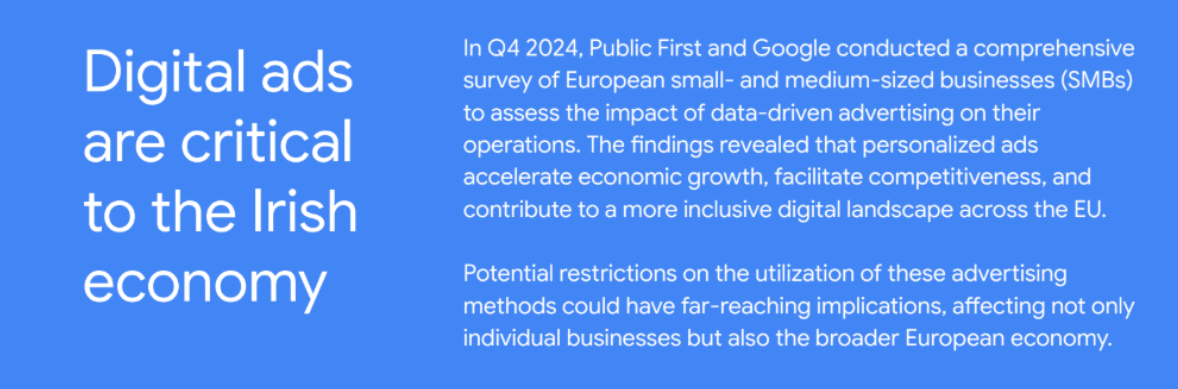
A new study by the Centre for Information Policy Leadership (CIPL), based on research by Public First, reveals the crucial role of personalised digital advertising in supporting the competitiveness and growth of small and medium-sized enterprises (SMBs) across Europe with a key focus on Ireland. The report, commissioned by Google, surveyed over 4,287 SMBs across the EU (including 263 in Ireland) and highlights the significant benefits of personalised digital advertising for SMBs, as well as the potential negative consequences of restricting its use.
Key Findings:
-
Competitive Advantage: 76% of small businesses in the EU say personalised digital advertising enables them to compete with larger businesses. In Ireland this number is even higher with 96% agreeing that personalised digital advertising helps level the playing field, allowing them to reach specific audiences with limited marketing budgets.
-
Revenue Growth: 96% of Irish SMBs report increased overall revenue over the past year, and stated that this growth can be directly attributed to personalised digital advertising.
-
Customer Acquisition: 62% of Irish SMBs believe that finding new customers would be ‘difficult or impossible’ without personalised digital advertising, underscoring its critical role in expanding their customer base. 41% of SMBs in Ireland report that digital advertising has allowed them to find new customers.
-
Access to New Markets: A third of Irish SMBs (32%) reported that digital advertising helps them to market their products or services in new markets or regions.
The Importance of Personalised Digital Advertising for SMBs
SMBs often have very specific audiences and operate with limited marketing budgets. Personalised digital advertising allows them to reach their customers more effectively, expand into new markets, and compete with larger businesses. By tailoring advertisements to individual interests based on browsing history or set preferences, SMBs can achieve a higher return on investment compared to contextual advertising. 44% of Irish SMBs surveyed reported personalised digital advertising to be more effective at reaching their relevant audience, and 41% reported it as more effective at improving their return on ad spend, when compared to contextual advertising.
The Impact of Limiting Personalised Advertising
The study also examined the potential consequences of restricting or eliminating personalised digital advertising. The findings indicate significant negative impacts on SMBs in Ireland and across the broader European economy:
-
Higher Costs and Lower Revenue: If personalised digital ads were no longer permitted, 41% of SMBs in Ireland anticipate increased marketing costs, and 37% anticipated decreased revenue.
-
Price Increases: 57% of SMBs surveyed in Ireland claim that they would increase the prices of their products/services if they could no longer use personalised ads.
-
Difficulty Reaching Customers: 62% of SMBs believe that it would be difficult or even impossible to find the customers their business needs without personalised digital advertising.
-
Job Losses and Relocation: 30% of surveyed SMBs in Ireland cited reducing staff as one of the ways their business would cut costs if they could no longer use personalised digital ads with 20% indicating they would relocate or reduce offices and facilities to reduce costs if they could no longer use personalised digital ads.
Suzanne McElligott, CEO of IAB Ireland said:
“IAB Ireland’s members collaborate to help advertisers drive growth through digital advertising. Our engagement with Irish SMEs has grown dramatically over recent years reflecting SMEs’ increasing reliance on digital advertising as a business driver. The CIPL study’s evidence-based findings with 96% of SMEs attributing their revenue growth to personalised advertising, reflect our experience. SMEs are a major contributor to Ireland’s economy and as we seek to protect Ireland’s competitiveness and foster economic growth, it is important that our regulatory environment facilitates Irish businesses embracing the benefits of digital advertising.”
Report Recommendations
The report emphasises the need for a balanced approach that supports innovation and protects fundamental rights. Policymakers should ensure that new legislative initiatives build on existing frameworks and avoid creating additional complexity. Extensive impact assessments should be conducted to evaluate the potential economic and compliance burdens for all market players. The focus must be on simplification: streamlining existing rules, ensuring legal certainty, and removing redundant or conflicting obligations. Organisations should proactively implement robust accountability measures and demonstrate how they safeguard individual rights when deploying digital advertising. Privacy Enhancing Technologies (PETs) and Privacy-Preserving Technologies (PPTs) can be deployed to enable businesses to deliver targeted advertising while minimising data exposure and enhancing user trust.
Bojana Bellamy, President, CIPL said:
“Our research shows that digital advertising, particularly personalised digital advertising, plays a crucial role in Europe’s digital economy by supporting SMBs, enhancing access to content, and contributing to a positive user experience.”
Conclusion
Personalised digital advertising is a vital tool for SMBs, driving growth, enabling competition, and supporting access to content. By adopting a balanced regulatory approach and embracing new technologies like AI, Ireland can ensure that businesses and individuals continue to benefit from the digital economy.