
Today, the James Dyson Award celebrates the best inventions of 2024 by young engineers and designers around the world, as the competition’s Top 20 shortlist is unveiled and in four weeks’ time, on 13th November, someone from this shortlist will be crowned the global winners by Sir James Dyson and win €38,000/ £30,000 in prize money to accelerate their invention.
An Irish woman, Olivia Humphreys, has made the top 20 shortlist this year and is up against some genius inventions to win the top prize.
The Problem
“ Athena” which has been shortlisted for this year’s James Dyson Award Global Top 20, tackles the problem of current scalp-cooling devices for chemotherapy patients which are not mobile and are scarce in Irish hospitals. Currently there are only a handful across the country meaning many chemo patients do not get the option of using one.
Athena is a portable, thermoelectric battery-operated scalp cooling device for people undergoing chemotherapy treatment which is more cost effective and timesaving than hospital models without compromising on the quality.
Patients can manage the scalp-cooling process themselves- Athena consists of a carry case and a cooling helmet and aims to provide a more accessible, yet effective option for scalp cooling and enables people to spend less time in the hospital on a chemotherapy infusion day.
The Invention
Limerick woman Olivia (24) who is a and recent graduate of the University of Limerick where she studied Product Design and Technology, is now working as a Research and Development Intern at Luminate Medical in Galway working on medical device tech. She was inspired to create Athena having seen her mum go through chemotherapy in hospital a few years ago. Olivia was taken aback by the limited number of scalp-cooling devices available in the hospital as well as the inconvenience of the time it took to commit to this, not being able to move around whilst using industry standard hospital devices, and the time that could be saved with an improved version. This inspired her to create Athena which would be mobile, light to carry and powerful.
Olivia Humphreys now enters the final stage of the James Dyson Award 2024, with global winners to be selected by Sir James Dyson and announced on 13th November. The winning inventions will receive €38,000 to support their further development and commercialisation.
Speaking about Athena, inventor Olivia Humphreys says: “Being recognised by the James Dyson Award has been an incredibly fulfilling experience. It reflects the invaluable input I’ve received from patients and care staff that helped me, along with the passion and hard work I have put in to get it to this point. I am truly grateful to have my project acknowledged on such a big stage. It’s exciting to know that the work I’ve done has the potential to make a real impact, and I’m inspired to keep pushing forward.”
Talking about the design of Athena, Olivia says: “This initial prototype for Athena provided a strong foundation to build upon, and I received valuable feedback on things like how to make it more compact by optimising components like the water tank, pump, and battery. I began refining the design into a smaller, lightweight carry case. As I moved forward, the product designer in me started creating more usability-focused prototypes, experimenting with different headpiece configurations and forms to ensure user comfort. The most exciting aspect of Athena is its potential for further development. My early conversations with engineers have been very positive, filled with discussions about ideas and possible tweaks. It’s exciting, there is a lot to be done!”
OTHER NOTABLE ENTRIES WHO MADE THE TOP 20 INCLUDED:
Pyri (from the UK)
In 2023, wildfires caused over 300 deaths and cost $50bn globally. Pyri is a bio-inspired and bio-based early wildfire detection system for remote and low-cost widespread coverage. The heat from nascent wildfires activates Pyri’s novel organic electronics which emit a radio frequency signal to alert vulnerable communities. Designed for remote, unprepared, vulnerable communities, and beyond.
These young inventors of Pyri, are a team comprised of Richard Alexandre, Karina Gunadi, Blake Goodwyn and Tanghao Yu (aged between 24 and 33). They met while studying a double masters in Innovation Design Engineering at Imperial College and the Royal College of Art in London. The group came to their course from different backgrounds and with different experiences, making it a dynamic and diverse team.
Having applied for a patent in July 2024, the team at Pyri worked tirelessly to produce over 20 experimental prototypes, testing and re-creating continuously to produce the device they have today. Richard, Blake, Tanghao and Karina worked on numerous iterations of Pyri and spent months working on power and trigger concepts, as well as exploring over 46 material combinations to create this problem-solving invention.
PulpaTronics (from the UK)
Over 40bn RFID tags are produced annually with most ending up in landfills, wasting resources and energy, increasing CO2 emissions and e-waste. PulpaTronics unlocks more sustainable and accessible inventory management solutions utilizing chipless RFID technology featuring fully recyclable paper RFID tags for a more circular economy. Recent graduates and students Barna Soma Biro, Chloe So and Adonis Christodoulou invented PulpaTronics to solve this problem of waste in the fashion industry with a more sustainable solution. O
The novel technology replaces the metal antenna by laser-inducing a carbon-based conductive material onto paper. Using a chipless design, these tags store information in the geometric pattern of the conductor instead of a microchip. The team at PulpaTronics filed a US patent in October 2023 and a UK patent in March 2024 which are currently pending, and they are looking to internationalise them in the near future.
The team at PulpaTronics see their sustainable RFID tags as the vehicle to enable item-level tracking. They will be testing the performance of their tags in a real-world environment through two pilots early next year. Once the two pending patents are approved, they also look to license out the technology so that they can integrate the laser heads directly into the production line, streamlining manufacturing even more to scale up quickly. They are also working towards developing prototype tags to carry out initial trials with a few large retailers.
The Top 20 Shortlist
| Invention | Solution | Inventor(s) | Country |
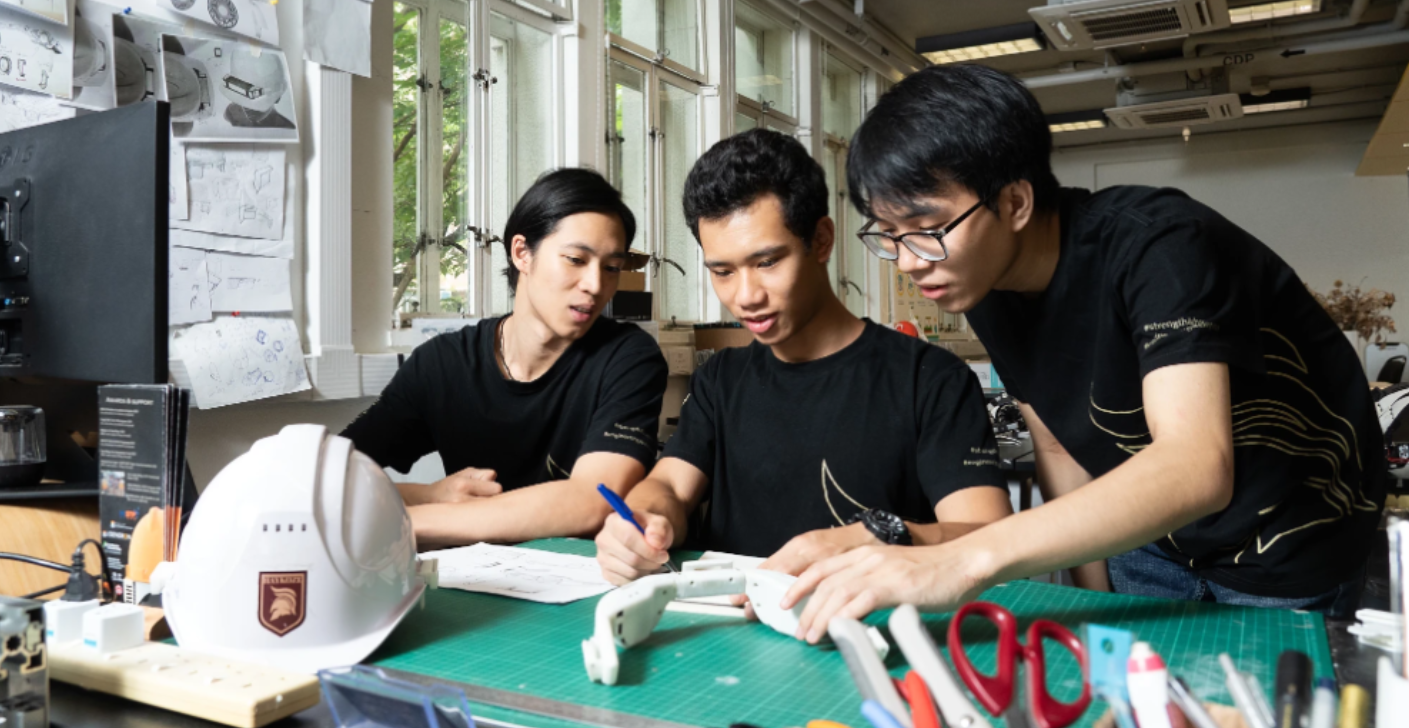
| Air Ring 48 | A helmet cooling accessory to protect construction workers from heat stress. | Yu To Mak, Ze Fu Jeff Li, Jing Hymn Joseph Wong | Hong Kong SAR |
| Airxeed Radiosonde | A controllable flap to steer a radiosonde back to be reused after weather measurement. | Shane Kyi Hla Win, Danial Sufiyan Bin Shaiful | Singapore |
| Athena | A portable post-chemotherapy scalp cooling device. | Olivia Humphreys | Ireland |
| Cap Snap | A medical multi-tool for safe crimp seal cap removal and ampoule breaking. | Jack Pugh | New Zealand |
| Co-Jump | An ergonomic and AI-based stroke rehabilitation glove. | Li Yuanjing, Zhan Jing, Guan Shunzi, Yu Tianlin, Li Junkai, Qian Qingyun, Wei Yi | China |
| Concavix | An adaptive mouse for users with underdeveloped hands. | Jonathan Lopez Calderon, Raúl Hernandez, María de Lourdes Zaldívar Martínez | Mexico |
| DysphagiaDynamics | A portable, non-invasive dysphagia assessment and rehabilitation system. | Zhu Zhaopeng, He Qi | China |
| finGrip | A catheter system for users with low dexterity or wheelchairs. | Philipp Niechoj | Austria |
| Flying ear pressure regulator | A pressure-adjusting product that relieves ear discomfort during airplane take-offs and landings. | Yi-Shan Zheng, Wen-Yeh Hsaio-Lin | Taiwan |
| Mammosense | A mammogram sensor to enhance comfort during breast cancer screenings. | Luke Goh | Singapore |
| Moii | An Airway Clearance Therapy training kit for adolescents with Cystic Fibrosis. | Yuchen Lan | Sweden |
| OcularSky | An affordable, smartphone-based fundus camera. | Houssam Hammoud, Mohammad Yaman Al Aref, Mohamad Hammoud, Mayar Jabouli, Wessam Shehieb | UAE |
| Oxynizer | A non-electric oxygen generator for developing countries. | Kyeongho Park, Jiwon Lee, Jiwon Kim, Yeohyun Jung, Seung-Jun Lee | South Korea |
| Peter | A wearable biomedical device for Parkinson’s Disease patients with freezing of gait. | Jonathan Fisher | United Kingdom |
| PulpaTronics | A recyclable paper-based RFID clothing tag. | Adonis Christodoulou, Barna Soma Biro, Chloe So | United Kingdom |
| Pyri | A bio-inspired and bio-based early wildfire detection system. | Richard Alexandre, Karina Gunadi, Blake Goodwyn, Tanghao Yu | United Kingdom |
| Social Plast | An affordable plastic recycling system. | Johannes Kastner | Germany |
| Sorbet | An acoustic panel made from shredded textile waste. | Sze Yek | Australia |
| TAILWIND | A cooling construction helmet designed to create airflow. | Youngki Kim, Jisu Kim, HyeonJun So, Seunghun Jeong | South Korea |
| The Reef | An ecological filter to counteract blue-green algae boom in water bodies. | Anton Vervoort | Belgium |