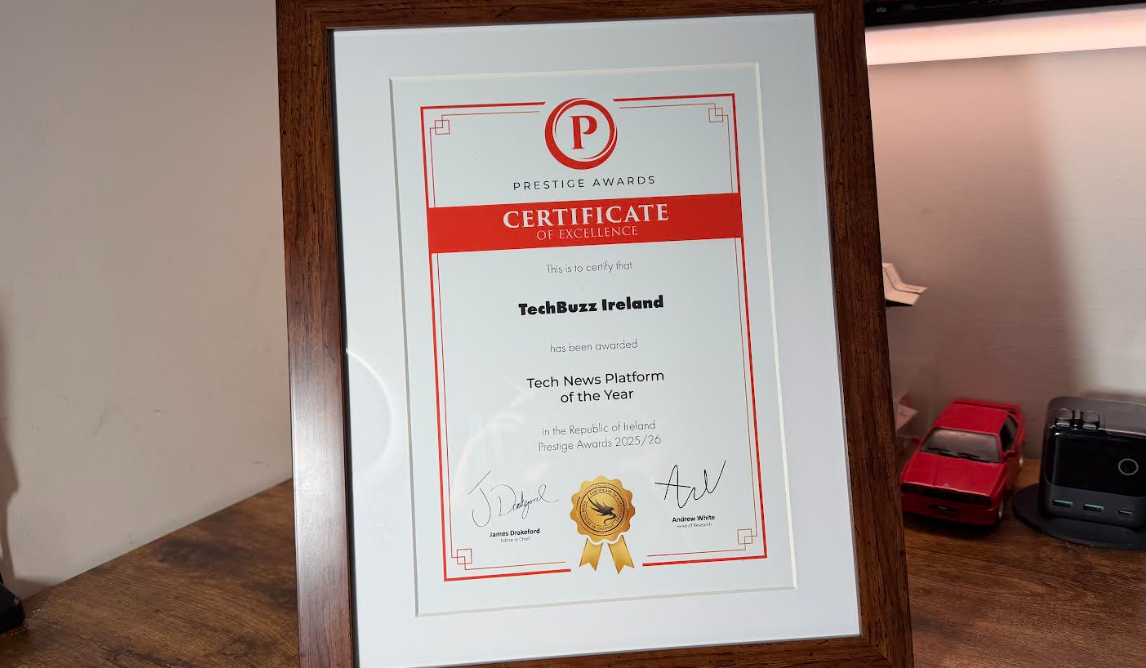
Prestige Awards Best Tech Platform Ireland 25/26 winner

Just a small announcemnt to thank the guys at Prestige Awards to say thanks for awarding us best tech platform winner of 2025/2026 which came as a surprise to us.

At techbuzzireland we strive to bring real hands on reviews with context real images and videos and the best tech news suited to us and over the years it has been hard work from starting out till where we are now today getting your news and reviews seen all around the world and we hope to keep going for several more years yet and brining more exciting products which of course we have some in right now, March is a huge tech month for new products and we cant wait to show you.

Stay tuned and also check out our YouTube for more and a big thanks from the team past and present.

Irish winner of James Dyson Award 2024 announced

Limerick woman Olivia Humphreys (24) witnessed how upsetting it is for patients who face losing their hair during chemotherapy when her mother went through it in 2019.

65-99% of patients going through chemotherapy will be affected by hair loss*. Scalp cooling can help prevent this by shrinking the blood vessels and is done by applying cold temperatures to the scalp during chemotherapy treatment. Scalp cooling is intended to help prevent hair loss, known as chemotherapy-induced alopecia, for people undergoing chemotherapy. It works by limiting blood flow to the scalp. This can reduce the amount of the chemo treatment that reaches your head, protecting your hair follicles from the chemo drugs.

Olivia noticed the shortage of scalp-cooling machines aimed to minimise hair loss in the hospital her mother was in, as well as how limited the existing solutions were.

Current products require the patient to arrive 30 minutes early and stay for 90 minutes after infusion for pre and post scalp cooling. With Athena, patients can manage this aspect of treatment themselves and seamlessly integrate into an infusion appointment with no extra time or attention required, using this device from the comfort of their own homes.

The Problem:

Current chemotherapy scalp cooling devices are either heavy duty hospital-only machines which cannot be moved easily and require patients to sit in a ward for long periods of time.

On the other hand, there are cheaper, manual cooling alternatives available used to cool the heads of chemo patients to prevent hair loss, yet these prove to be less powerful, ineffective and they don’t last long enough for maximum benefit. Athena aims to offer an effective hospital standard device that gives control to a patient in a time of little control.

The Invention:

University of Limerick graduate Olivia Humphreys, witnessed firsthand how much of an impact chemotherapy induced hair loss can have on a person, when her mother was sadly affected by cancer in 2019 and from spending time with her during treatment experience, was inspired to reimagine the way scalp-cooling can be done.

How does it work?

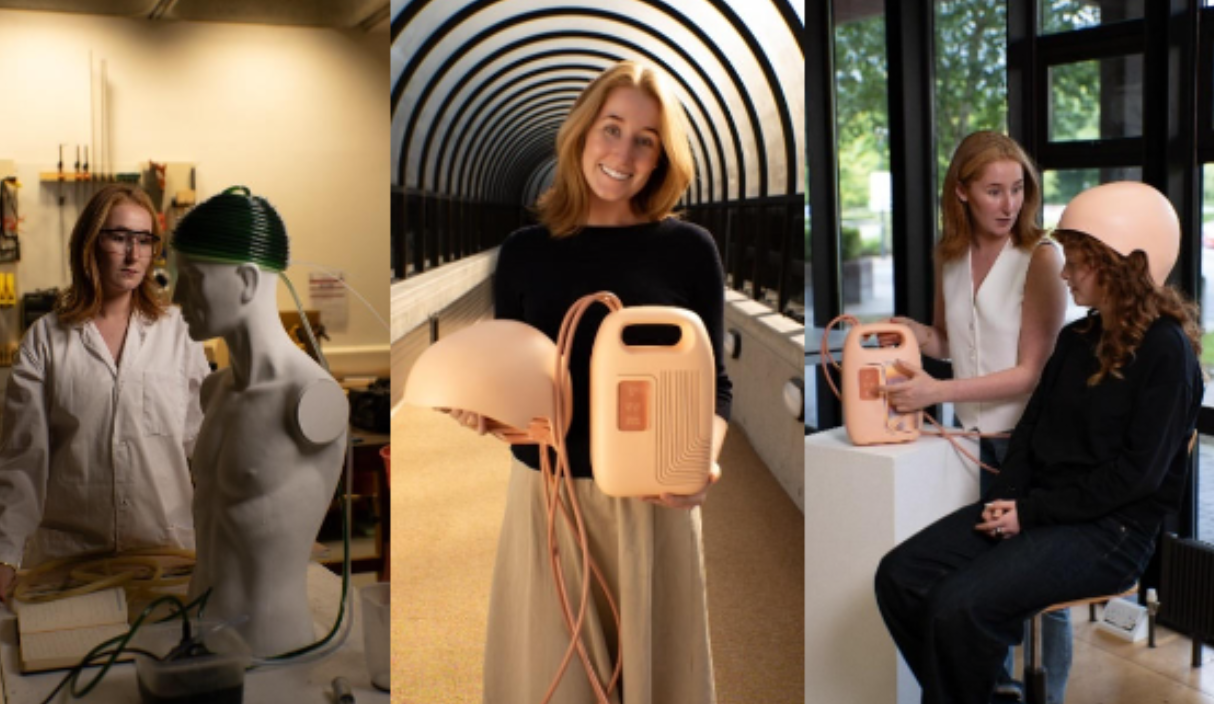
Athena works by utilising low-cost thermoelectric semiconductors called peltiers, and these cool a tank of water, which circulates the cold water around the head with the smartly designed headpiece. The battery powered device allows patients to bring the device home and control it themselves, making it more accessible to the consumer market.

The estimated cost for Athena would be around €1000, according to Olivia Humphreys, compared to industry machines which come in at around €40,000 or more.  Weighing around 3kg, Athena is more portable than the current leading products on the market, which use refrigeration technology requiring constant plugged in power. Athena, at full battery power, can run for 3.5 hours, allowing the patient to commute to and from the hospital while cooling and move around during infusion for bathroom visits, etc.

Speaking about Athena, Olivia Humphreys said: “I decided to build a working prototype to test the capabilities of the Peltier semiconductors. Using a Peltier computer cooling fan system, a diaphragm pump, my mum’s old suitcase, and my dad’s plane battery, I was able to create a strong proof of concept to gather valuable feedback to develop the concept. Following this, I focused on the product’s form, creating cardboard and foam models and determining functionality aspects and touchpoints to ensure the best user experience. Ultimately, I arrived at my final model, Athena, which was crafted using SolidWorks 3D CAD modelling.”

The future of Athena:

Speaking about what is next for this invention, Olivia says: “To elevate Athena to the next level, extensive research and development is required. While working on this project, I have been fortunate to network with Luminate Medical, a company in Galway, Ireland, dedicated to building a better future for cancer care. They have extended an internship offer to me as a research and development engineer. I have accepted and am very eager to apply the insights gained from my own research and development to contribute to their mission.”

Speaking about Athena, Lead Design Engineer at Dyson James Gilchrist who was part of the judging panel, said: “Hair is a deeply rooted symbol of our identity. Losing it can be one of the most difficult side effects of chemotherapy. Currently, only 8 of Ireland’s 26 hospitals offer scalp cooling as a treatment[1], partly due to the expense of the equipment and the additional time required to deliver the treatment.

The genius of Athena isn’t just in increasing access; it’s in taking the patient out of the clinic. Instead of spending an extra two hours in the treatment centre, Athena allows patients to precool their scalp on the way there and continue the cooling process post-treatment in the comfort of their own home. That’s not just a win for patients but also for clinics, enabling them to treat more patients each day.

Olivia impressed us with her first prototype—a ‘cut and shut’ computer cooling fan and diaphragm pump built into her mum’s old suitcase. Once that proved the concept, she went on to develop a high-fidelity prototype, leveraging recent innovations in battery-powered coolers.”

Olivia is eager to see how her work can inspire further innovation in cancer treatment and patient care and continue contributing to advancements in the industry.

Athena will now progress to the international stage of the James Dyson Award and Olivia will aim to commercialise this product by producing a fully functional, technologically integrated prototype.

The Runners Up:

Suas designed by Ko Kallewaard, a student in the University of Limerick

The Problem: People with reduced mobility who need to travel with their wheelchair, encounter problems such as having to check in their wheelchair at the gate and get assigned the airline wheelchair, which is often not suitable and doesn’t offer independence to people with disabilities. On landing, many wheelchair users have experienced lost wheelchairs or worse, completely broken wheelchairs, leaving them in a terrible predicament.

The Solution:

Suas enables wheelchair users to travel with their own chair and is encouraging airlines to fit specially engineered seats with Suas’s universal wheelchair lock as well as offering a connecting lock to the wheelchair user for their chair. Any plane supporting SUAS allows you to board and fly in your own wheelchair meaning no more damage to customer equipment, no more discomfort or humiliation for wheelchair users– just the freedom to travel independently. SUAS consists of two parts- the lock on the wheelchair and the redesigned seating system on the plane. The lock is a tool steel part that attaches to the rigidizer bar situated on the back of all rigid manual wheelchairs.

The newly designed seating system is a plane seat that can be set up in two ways – a traditional seat or a wheelchair space. There is a small stainless steel and aluminium lock inside the frame of the seat that automatically locks into either the traditional seats or the SUAS lock. The frame is designed so that any sized wheelchair can fit over it and lock into the space.

The SUAS system is equipped with a turbulence control module which uses a pendulum to trigger the adjustable arm to tighten, keeping the wheelchair or the seats in place.

Swoop created by Sean-Jameson Galvin from the University of Limerick

The Problem:

Many people have conditions such as dyslexia, dysmusia and dysgraphia, making music more difficult and meaning a lot of people just give up if they can’t engage creatively in music practice at foundation level. Swoop is a way of connecting early music learners with the music by making it more visually interesting, accessible through sight, sound and sensation by way of a projector on a wall or screen. Music is then learned through hand movements and colour codes.

The Solution:

Swoop is a new and accessible way of learning and creating music. Using hand movement, it enables the user to create, feel and learn music both individually and in group settings. Swoop aids in helping to bridge the gap between traditional and digital music. The product includes two gloves with embedded haptic motors . These motors provide haptic feedback relative to the note and volume intensity and aid gesture recognition software in distinguishing the user’s hand from the background. all works in tandem with a companion app allowing the user to change parameters based on their experience.

 The product system enables learners to engage with music concepts transferrable to traditional music learning. It functions using 3 axes of movement:

– X Axis (Octave Displacement): Moving the hand left and right shifts the octave, mimicking guitar or piano movements. The accompanying parameter app controls the number of octaves.

– Y Axis (Note Pitch): Moving hands left and right transitions between seven notes, with the left hand for lower and the right for higher notes, mimicking a traditional music stave.

– Z Axis (Volume Variation): Moving hands forward and back adjusts volume, teaching sound intensity through pressure.

Speaking about creating Swoop, Sean-Jameson Galvin said:

“Throughout the development of Swoop, I learned so much about accessibility when it comes to music. What works for one may not work for another in a linear learning system. It is for that reason I believe the user should have autonomy over their learning direction. It is with this principle in mind that I aim to further the development of Swoop by making music learning and creation a more enjoyable and expressive experience.”

The international top 20 shortlist will be announced on October 16th  and the international winners on November 13th.

How to enter

Candidates enter through an online application form via the James Dyson Award website.

14 year old Claremorris Teen-Turn Participant Wins European Regional Winner Award

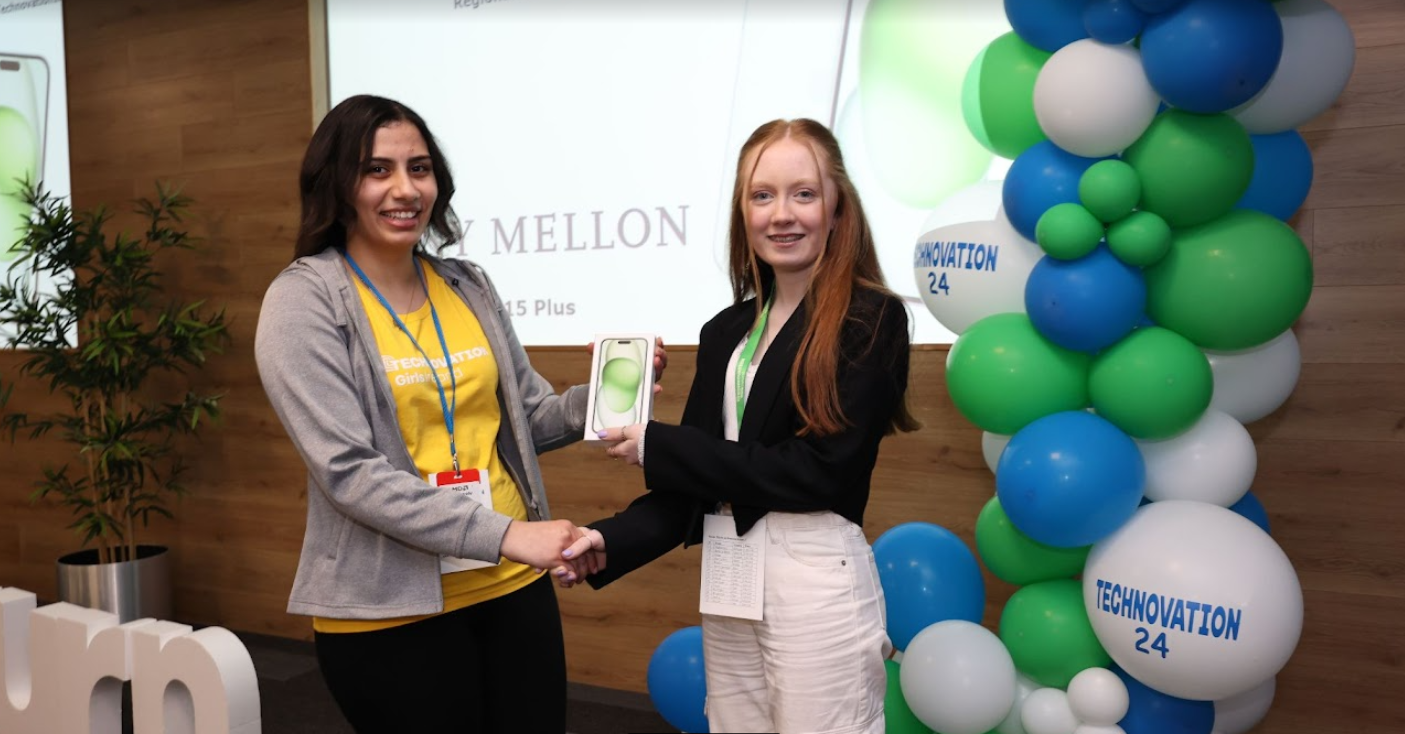
Dana Carney, a visionary young innovator from Claremorris, has been honoured with the prestigious European Junior Regional Winner award at the Technovation Global Celebrations for her groundbreaking project, ‘Secure Hands.’ The Technovation Global Celebrations recognise young innovators from around the world who use technology to solve real-world problems. With nearly 11,000 girls from 69 countries creating 3,200 tech-based solutions to community problems, this year was especially competitive. Dana’s achievement shines a spotlight on her innovative approach to bridging the communication gap for Ireland’s deaf community during emergencies.

Ireland’s emergency services are renowned for their exceptional ability to handle a myriad of languages, ensuring effective communication across diverse linguistic needs. However, the deaf community, which relies exclusively on Irish Sign Language (ISL), faces a significant disadvantage. In moments of crisis, the absence of ISL knowledge among most emergency service providers leaves ISL users vulnerable and underserved.

Dana’s project, ‘Secure Hands,’ addresses this critical issue through the power of technology. By leveraging advanced machine learning, Secure Hands equips emergency responders with the tools to learn and interpret ISL swiftly and accurately. This transformative solution not only enhances the capabilities of emergency personnel but also ensures that ISL users receive the same level of urgent care and support as the broader population.

Dana worked on her project coding her app and creating her business plans at Teen-Turn’s after school sessions in Mount Saint Michael Secondary School in Claremorris with teacher and Teen-Turn lead mentor Stephanie Hogan, facilitated by Iseult Mangan, Teen-Turn’s regional manager in the area. Dana also received support while coding her app from industry and academic volunteers through Teen-Turn’s online support and at this year’s in-person Super Sessions at Genesys in Galway and the Ideas Lab in the University of Galway.  Dana says “Working on my project with Teen-Turn was an incredible experience. Their sessions guided me from the initial idea stage to coding a functional app. I loved visiting Genesys in Galway, where I collaborated with volunteers and coding experts. Additionally, visiting the Ideas Lab at the University of Galway provided invaluable support for the business aspects of my project”.

“I am deeply honoured to receive the European Junior Regional Winner award at the Technovation Global Celebrations,” Dana expressed. “Secure Hands is more than just a project; it is a mission to ensure that no one in our community is left without help in their most critical moments. This recognition motivates me to continue working towards a future where emergency services are inclusive and accessible to all.”

Secure Hands is set to revolutionise the way emergency services and front line workers interact with the deaf community, ensuring that language barriers do not impede life-saving interventions. As Dana continues to develop and refine her app, her work promises to pave the way for a more inclusive and responsive emergency response system in Ireland and beyond.

Joanne Dolan, Technovation’s Ambassador in Ireland added, “with the largest number of submissions from Ireland ever, and 9 of those entries reaching the global semi-finals, we already had a banner year, but seeing Dana’s project go on to be awarded the Junior Category prize for all of Europe, well that’s the icing on the cake.”

To learn more, visit technovation.org.

More information on their activities and the support they provide to girls is available at www.teen-turn.com

The Winner of our Ulak Samsung S5 Case has been announced.

Thanks to all who entered our latest competition for the Ulak defender case for the Galaxy S5,sadly only one winner but stay tuned for a new competition this week..

The winner is Lisa Lynch,well done and we will be in touch to organise shipment of your new case…

https://twitter.com/jimboireland/status/634081289327509505


And the winner of the #Noreve case for your #iPhone6plus is …….

Thanks to all who have entered the  competiton,as always there can be only one winner im afraid but do not fear we have yet another on the way very soon.


Well done to Mandy Sheehan,we will be in touch to arrange delivery of your spanky new iphone 6 plus case..