Irish-Dutch collaboration for Pathfinder space mission

SUAS Aerospace, the leading Irish aerospace company based in Cork, and T-Minus Engineering, a Netherlands-based company that develops, produces and launches rocket systems for research, observation and training purposes, have announced a strategic partnership to launch the Pathfinder mission in late 2025. Pathfinder is Ireland’s first commercial rocket launch.

This groundbreaking endeavour will serve to position Ireland as a key player in the European space industry. Up to now European orbital rocket launches have primarily been conducted from French Guiana in South America. With the stated EU aim of having sovereignty in space, this Irish launch heralds a truly new era for the European space industry.

To execute the Pathfinder mission T-Minus will provide expertise in solid rocket propulsion, onboard electronics, and launch operations; while SUAS Aerospace will oversee the complex logistics of the launch including site acquisition, licensing, and stakeholder engagement. T-Minus is the most prolific rocket-launch business in Europe.

The Pathfinder launch site will be on Ireland’s west coast, which is an ideal destination for commercial rocket launches. Offering cost-effectiveness, easy access by sea and air, and a large safety zone over the Atlantic Ocean, the west coast location will establish Ireland’s position in the European launch market and encourage state support for space infrastructure to capitalise on this once in a generation opportunity.

The project will demonstrate Ireland’s geographical advantage and capability for delivering satellites to Northerly and Southerly low earth orbits and focus European awareness on the opportunity for commercial rocket launches from Ireland.

T-Minus Engineering brings extensive expertise in the development, production, and launching of rocket systems, providing end-to-end solutions for both the scientific and defence markets. With capabilities in solid rocket propulsion, onboard electronics and telemetry, lightweight materials, and safety simulations, T-Minus Engineering has a proven track record, having launched various rockets from locations across the globe, including Australia, Scandinavia, and the UK.

Rory Fitzpatrick, CEO of SUAS Aerospace, said: “The Pathfinder mission is a significant milestone for Ireland’s space program. It will not only demonstrate the country’s technical capabilities but also contribute to economic growth and job creation. By partnering with T-Minus, we are ensuring that the launch meets the highest safety standards and regulatory requirements, paving the way for future space activities.

“Having collaborated on a project previously with T-Minus Engineering, they are the obvious choice for the Pathfinder mission, having conducted multiple suborbital launches within Europe and worldwide,” he said.

Hein Olthof, CEO of T-Minus Engineering, said: As T-Minus seeks new opportunities outside the Netherlands due to space restrictions, the Pathfinder project presents a unique solution and will support our further expansion across Europe. We believe this partnership will open up new opportunities for our customers, and we are confident that our collaboration with SUAS Aerospace will lead to innovative and successful projects, fuelling the growth of Europe’s space capabilities. Ireland can be a centre of this growth.”

“The establishment of new launch sites, such as Ireland, will encourage harmonization of launch operations within Europe, mainly in regulations, which in the end leads to better and more efficient legislation. This can give Europe the desired edge in the important field of space access.”

SUAS Aerospace was founded in 2019 and is supported by Enterprise Ireland.  With initial investment of €1.1 million to date, and along with T-Minus Engineering, it has secured significant partnerships with major European Companies including Skyrora and Pangea Aerospace. It is part of a successful consortium awarded a €5m grant from Horizon Europe to develop interoperable (plug and play) rocket engine testing infrastructure for Europe.

Irish winner of James Dyson Award 2024 announced

Limerick woman Olivia Humphreys (24) witnessed how upsetting it is for patients who face losing their hair during chemotherapy when her mother went through it in 2019.

65-99% of patients going through chemotherapy will be affected by hair loss*. Scalp cooling can help prevent this by shrinking the blood vessels and is done by applying cold temperatures to the scalp during chemotherapy treatment. Scalp cooling is intended to help prevent hair loss, known as chemotherapy-induced alopecia, for people undergoing chemotherapy. It works by limiting blood flow to the scalp. This can reduce the amount of the chemo treatment that reaches your head, protecting your hair follicles from the chemo drugs.

Olivia noticed the shortage of scalp-cooling machines aimed to minimise hair loss in the hospital her mother was in, as well as how limited the existing solutions were.

Current products require the patient to arrive 30 minutes early and stay for 90 minutes after infusion for pre and post scalp cooling. With Athena, patients can manage this aspect of treatment themselves and seamlessly integrate into an infusion appointment with no extra time or attention required, using this device from the comfort of their own homes.

The Problem:

Current chemotherapy scalp cooling devices are either heavy duty hospital-only machines which cannot be moved easily and require patients to sit in a ward for long periods of time.

On the other hand, there are cheaper, manual cooling alternatives available used to cool the heads of chemo patients to prevent hair loss, yet these prove to be less powerful, ineffective and they don’t last long enough for maximum benefit. Athena aims to offer an effective hospital standard device that gives control to a patient in a time of little control.

The Invention:

University of Limerick graduate Olivia Humphreys, witnessed firsthand how much of an impact chemotherapy induced hair loss can have on a person, when her mother was sadly affected by cancer in 2019 and from spending time with her during treatment experience, was inspired to reimagine the way scalp-cooling can be done.

How does it work?

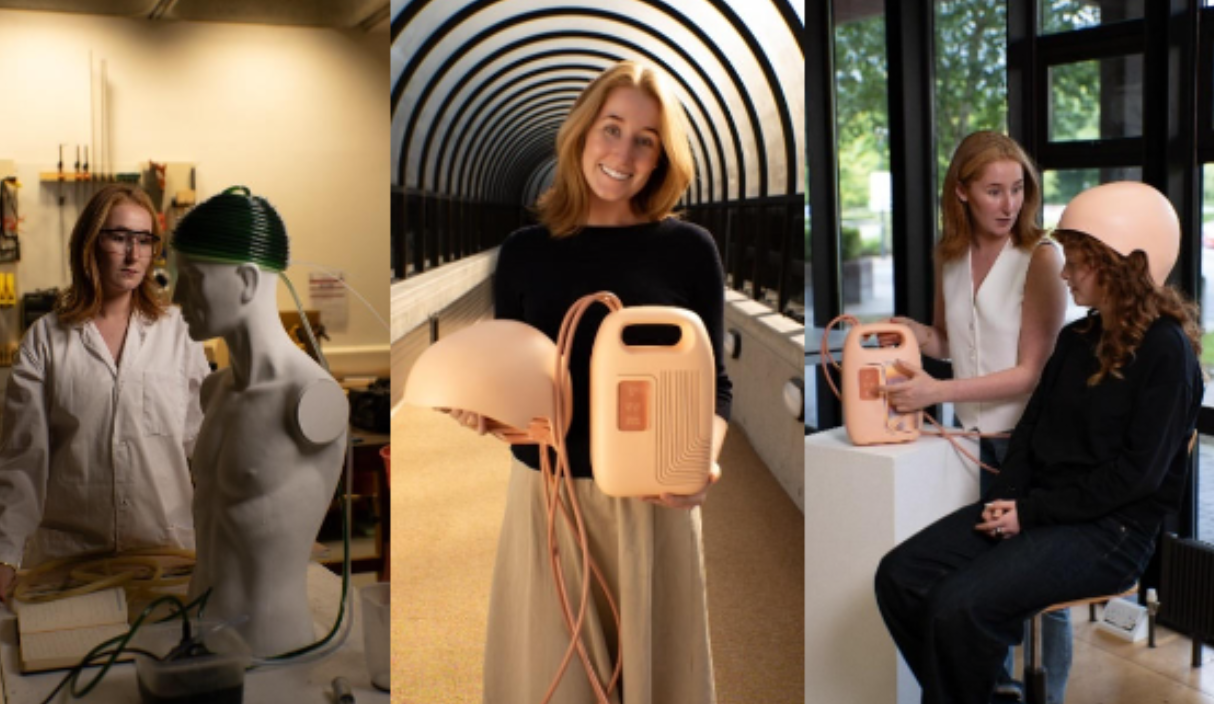
Athena works by utilising low-cost thermoelectric semiconductors called peltiers, and these cool a tank of water, which circulates the cold water around the head with the smartly designed headpiece. The battery powered device allows patients to bring the device home and control it themselves, making it more accessible to the consumer market.

The estimated cost for Athena would be around €1000, according to Olivia Humphreys, compared to industry machines which come in at around €40,000 or more.  Weighing around 3kg, Athena is more portable than the current leading products on the market, which use refrigeration technology requiring constant plugged in power. Athena, at full battery power, can run for 3.5 hours, allowing the patient to commute to and from the hospital while cooling and move around during infusion for bathroom visits, etc.

Speaking about Athena, Olivia Humphreys said: “I decided to build a working prototype to test the capabilities of the Peltier semiconductors. Using a Peltier computer cooling fan system, a diaphragm pump, my mum’s old suitcase, and my dad’s plane battery, I was able to create a strong proof of concept to gather valuable feedback to develop the concept. Following this, I focused on the product’s form, creating cardboard and foam models and determining functionality aspects and touchpoints to ensure the best user experience. Ultimately, I arrived at my final model, Athena, which was crafted using SolidWorks 3D CAD modelling.”

The future of Athena:

Speaking about what is next for this invention, Olivia says: “To elevate Athena to the next level, extensive research and development is required. While working on this project, I have been fortunate to network with Luminate Medical, a company in Galway, Ireland, dedicated to building a better future for cancer care. They have extended an internship offer to me as a research and development engineer. I have accepted and am very eager to apply the insights gained from my own research and development to contribute to their mission.”

Speaking about Athena, Lead Design Engineer at Dyson James Gilchrist who was part of the judging panel, said: “Hair is a deeply rooted symbol of our identity. Losing it can be one of the most difficult side effects of chemotherapy. Currently, only 8 of Ireland’s 26 hospitals offer scalp cooling as a treatment[1], partly due to the expense of the equipment and the additional time required to deliver the treatment.

The genius of Athena isn’t just in increasing access; it’s in taking the patient out of the clinic. Instead of spending an extra two hours in the treatment centre, Athena allows patients to precool their scalp on the way there and continue the cooling process post-treatment in the comfort of their own home. That’s not just a win for patients but also for clinics, enabling them to treat more patients each day.

Olivia impressed us with her first prototype—a ‘cut and shut’ computer cooling fan and diaphragm pump built into her mum’s old suitcase. Once that proved the concept, she went on to develop a high-fidelity prototype, leveraging recent innovations in battery-powered coolers.”

Olivia is eager to see how her work can inspire further innovation in cancer treatment and patient care and continue contributing to advancements in the industry.

Athena will now progress to the international stage of the James Dyson Award and Olivia will aim to commercialise this product by producing a fully functional, technologically integrated prototype.

The Runners Up:

Suas designed by Ko Kallewaard, a student in the University of Limerick

The Problem: People with reduced mobility who need to travel with their wheelchair, encounter problems such as having to check in their wheelchair at the gate and get assigned the airline wheelchair, which is often not suitable and doesn’t offer independence to people with disabilities. On landing, many wheelchair users have experienced lost wheelchairs or worse, completely broken wheelchairs, leaving them in a terrible predicament.

The Solution:

Suas enables wheelchair users to travel with their own chair and is encouraging airlines to fit specially engineered seats with Suas’s universal wheelchair lock as well as offering a connecting lock to the wheelchair user for their chair. Any plane supporting SUAS allows you to board and fly in your own wheelchair meaning no more damage to customer equipment, no more discomfort or humiliation for wheelchair users– just the freedom to travel independently. SUAS consists of two parts- the lock on the wheelchair and the redesigned seating system on the plane. The lock is a tool steel part that attaches to the rigidizer bar situated on the back of all rigid manual wheelchairs.

The newly designed seating system is a plane seat that can be set up in two ways – a traditional seat or a wheelchair space. There is a small stainless steel and aluminium lock inside the frame of the seat that automatically locks into either the traditional seats or the SUAS lock. The frame is designed so that any sized wheelchair can fit over it and lock into the space.

The SUAS system is equipped with a turbulence control module which uses a pendulum to trigger the adjustable arm to tighten, keeping the wheelchair or the seats in place.

Swoop created by Sean-Jameson Galvin from the University of Limerick

The Problem:

Many people have conditions such as dyslexia, dysmusia and dysgraphia, making music more difficult and meaning a lot of people just give up if they can’t engage creatively in music practice at foundation level. Swoop is a way of connecting early music learners with the music by making it more visually interesting, accessible through sight, sound and sensation by way of a projector on a wall or screen. Music is then learned through hand movements and colour codes.

The Solution:

Swoop is a new and accessible way of learning and creating music. Using hand movement, it enables the user to create, feel and learn music both individually and in group settings. Swoop aids in helping to bridge the gap between traditional and digital music. The product includes two gloves with embedded haptic motors . These motors provide haptic feedback relative to the note and volume intensity and aid gesture recognition software in distinguishing the user’s hand from the background. all works in tandem with a companion app allowing the user to change parameters based on their experience.

 The product system enables learners to engage with music concepts transferrable to traditional music learning. It functions using 3 axes of movement:

– X Axis (Octave Displacement): Moving the hand left and right shifts the octave, mimicking guitar or piano movements. The accompanying parameter app controls the number of octaves.

– Y Axis (Note Pitch): Moving hands left and right transitions between seven notes, with the left hand for lower and the right for higher notes, mimicking a traditional music stave.

– Z Axis (Volume Variation): Moving hands forward and back adjusts volume, teaching sound intensity through pressure.

Speaking about creating Swoop, Sean-Jameson Galvin said:

“Throughout the development of Swoop, I learned so much about accessibility when it comes to music. What works for one may not work for another in a linear learning system. It is for that reason I believe the user should have autonomy over their learning direction. It is with this principle in mind that I aim to further the development of Swoop by making music learning and creation a more enjoyable and expressive experience.”

The international top 20 shortlist will be announced on October 16th  and the international winners on November 13th.

How to enter

Candidates enter through an online application form via the James Dyson Award website.

SUAS Aerospace seeks €5 million to develop Irish spaceport

Irish Aerospace Company, SUAS Aerospace, has announced a fund-raising round of €5 million for the development of a spaceport to facilitate orbital and suborbital rocket launches for carrying small satellites to polar orbits.

The company aims to have world-class upstream space infrastructure fully operational by 2027, facilitating up to forty-eight launches annually and driving initial projected revenues in excess of €70 million.  Long term plans include a major aeronautical facility that will encompass launchpads, integration facility, control center and visitor center.

Ireland was identified as one of the top three suitable locations in Europe for a Spaceport in a technical feasibility study commissioned by SUAS and undertaken by British-based high-altitude expert B2Space.  The study looked at safety, launcher range and flights paths and concluded that orbital rocket launches for small satellites can be achieved from various locations in Ireland.

The SUAS Aerospace project aims to capitalise on Ireland’s location and climate advantage for small satellite launching and will also respond to the deficit in European launch capabilities for European companies developing commercial launch vehicles.

Rory Fitzpatrick, CEO, SUAS Aerospace, said: “This is a significant opportunity for Ireland to establish itself as a leader in the European space sector. The current round of seed funding will help SUAS Aerospace substantially progress its vision to to create a thriving space hub in Ireland.    It will help develop initial infrastructure, conduct test launches, establish strategic partnerships and ultimately pave the way for the first orbital launch from Irish soil. Our hope is that it will inspire young people to pursue careers in science, technology, engineering, and mathematics (STEM) in an indigenous Irish operation.”

SUAS Aerospace was founded in 2019 and is supported by the Enterprise Ireland.  With initial investment of  €1.1 million to date, SUAS has secured significant partnerships with major European Companies including Skyrora, T Minus Engineering, Pangea Aerospace and is part of a successful consortium awarded a €5m grant from Horizon Europe to develop interoperable (plug and play) rocket engine testing infrastructure for Europe.

SUAS Aerospace is currently headquartered at National Space Centre in Cork.