BOI – Urgent Fraud Alert – Live Chat Scam

Bank of Ireland is warning businesses about a recent increase in ‘Live chat’ scams. Fraudsters are mainly targeting business banking customers with this scam, duping them into allowing remote access to their computers and bank accounts.

Fraudsters are calling customers pretending to be from Bank of Ireland, claiming that their account has been compromised, directing them to a live chat service or to download software to your computer, and asking for card details, online banking details and activation codes.

 What happens?

  • The customer gets a phone call from someone claiming to be from Bank of Ireland.
  • The caller asks the customer to log into their online banking as normal.
  • The caller (fraudster) then asks the customer to go to another new website address, saying that this is: “for a live chat service” or “to verify the customer’s PC”, but in reality it allows the fraudster remote access to the customer’s PC. The fraudster can now see the customer’s screen and access all of the customer’s files and programmes.
  • The caller will set up payments on the customer’s online banking and ask the customer to read out the one-time codes from their BOI app to approve the payments.


Bank of Ireland’s advice

  • If you get a call from someone who asks you to go to a website or to click on a link that they will send to you, just hang up.
  • Never allow a caller to take remote access of your PC.
  • If someone asks you for a one-time code from your online banking app, they are a fraudster. Never, ever share those codes with anyone, even if they say they are from Bank of Ireland.
  • Be very careful when logging on to your online banking website. The safest thing is to type in the website address yourself or to log in through the main Bank of Ireland website at bankofireland.com


Nicola Sadlier, Head of Fraud, Bank of Ireland said: “We’ve had an increase in reports into our fraud line in recent days so we want to warn businesses in particular to be extremely alert to this scam. Fraudsters try to convince people to allow access to their PCs via a fake ‘live chat’, where they can then access business customers’ online banking, and other personal files and information. Never allow a caller to take remote access of your PC.  If someone asks you for a one-time code from your online banking app, they are a fraudster.  Never share those codes with anyone, even if they say they are from your bank. If you get a call like this, just hang up.”

Consumer Alert: Budget 2025 energy credit announcement sparks new fraud attempts – Bank of Ireland

Bank of Ireland is warning customers to be very vigilant to a wave of new fraud attempts following the announcement of a range of new energy credits this week.

Fraudsters often use topical events that are the subject of a lot of media coverage and commentary – in this case, energy credits announced in the recent Budget – to defraud consumers.

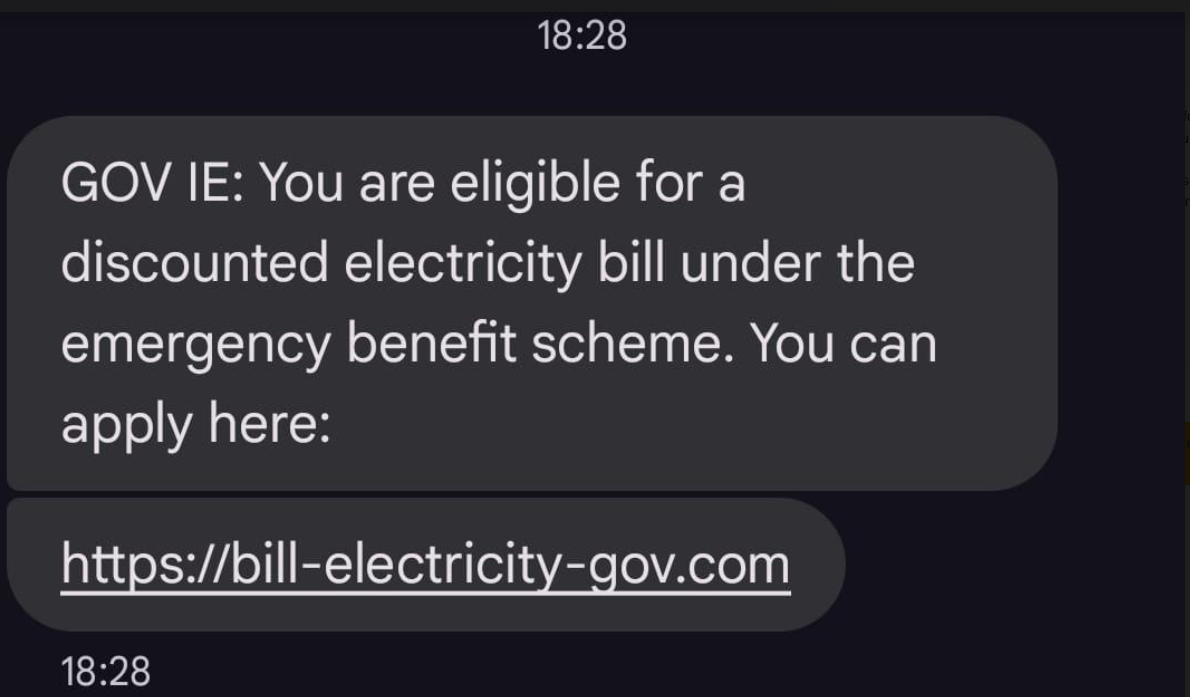
Bank of Ireland is seeing cases where customers receive an SMS pretending to be from the Irish Government (Gov.ie) saying they are eligible for a discounted bill under the new energy credit. However, this is just the first step in a scam designed to get the consumer to hand over their personal banking details.

How it works:


  • The consumer receives a text – pretending to be from an official Government source – telling them they are eligible for an energy credit.
  • The consumer replies to this and provides their personal contact details.

  • The fraudster then calls the consumer and pretends to be from their bank. The fraudster informs the consumer that they responded to a fake text and that now their debit/credit card, PIN, and phone sim card are compromised. The fraudster says someone from the bank, or a courier is on their way to collect the consumers card, PIN, and phone sim card.
  • In some cases, the consumer is kept on the phone to the fraudster until the person from the ‘bank’ or courier company arrives at their house.
  • Once they have taken these, fraudsters can then use the card for high value items, using chip & PIN.
  • Unfortunately, because the consumer believes they have been speaking with their bank, it can take some time before they realise that they are the victim of a theft and report this to their actual bank.

Nicola Sadlier, Head of Fraud, Bank of Ireland said: “Fraudsters are like chameleons. They design their scams to blend in with what’s in the news. But like all their criminal activity, this is just another attempt to steal your money.  

“There are new fake texts in circulation from “GOV IE” telling consumers they are eligible for a discounted electricity bill. These are smishing texts, and when the customer responds, they get a call from the fraudster posing as a bank employee informing them that their debit/credit card, PIN and phone sim card have been compromised. The fact that this call is followed by a fraudster calling to the victim’s house to collect the “compromised” card and phone sim card is of particular concern. 

“Be extra vigilant.  Fraudsters want your personal information, even if it’s simply your phone number. Do not give it to them.”

Bank of Ireland’s advice to customers in response to the current activity:

  • Do not click on links or respond to any SMS text messages which are designed to appear as if sent by the bank or other businesses and service providers.
  • If you receive a suspicious call, hang up and don’t call back any number the caller may have given you.

Remember:

  • Bank of Ireland will never send you a text with a link to a website that asks you for your online banking login details or any One-Time Passcodes that we’ve sent to you.
  • Bank of Ireland will never, ever, call you and ask for your security credentials such as your full 365 PIN, card details, one-time codes, or codes from your Business On Line Approve App.
  • Where customers receive a text appearing to be from Bank of Ireland, the Check Your Text service (Security Zone – Bank of Ireland Group Website) is now available.
    • If you get a text that claims to be from Bank of Ireland but you are not sure if it’s genuine, here’s how to verify it:
    • Copy the text you wish to verify.
    • Paste into a new message.
    • Add the word CHECK before the text. (In the same text)
    • Send to 50365.
    • Alternatively send it to 365security@boi.com

If you think you may have given away any of your banking details, please call our 24/7 Freephone line 1800 946 764 immediately.

F-Secure Adds Industry-Leading Scam Protection Capabilities to F-Secure Total

 F-Secure, a global leader in consumer cyber security, today announces that F-Secure Total, its online security application, will now host several new features specifically designed to protect consumers against scams by utilising AI. These new advanced features protect users against the most prevalent scams in the digital world, which consumers are exposed to while going about their daily lives.

The seven new features include:

  • Shopping Protection

  • SMS Scam Protection

  • Banking Protection

  • Browsing & Phishing Protection

  • Wi-Fi Protection

  • Cookie Popup Blocker

  • Ad Blocker

New AI integration means F-Secure Total users can now have scam SMS messages immediately deleted/flagged. Users also receive a pop-up warning on an unsecure site or see if they are entering a safe banking or payment site. This level of constant monitoring is unique to F-Secure Total.

Responding to one of the biggest consumer threats today

The suite of protection features has been developed as a response to the increasing number of scams faced by consumers. Research from the Global Anti-Scam Alliance (GASA), of which F-Secure is a member, found that £119.6 billion ($159bn) was lost to scams in 2023 alone, with 73% of consumers now encountering a scam monthly. At the same time many consumers can find cyber security confusing and are unsure how best to protect themselves.

These industry leading features, along with a dedicated Scam Protection Engineering Team, mark the new direction for F-Secure as it sets out to be the number one provider of scam protection.

Timo Laaksonen, President and CEO at F-Secure says: “The biggest online threat to the modern-day consumer is scams. We have seen the issue increase year-on-year not only in volume but in credibility and effectiveness. As a company we are committed to providing a complete solution that keeps our customers safe across their digital lives. Thanks to AI we are now able to fight back against even the most sophisticated scams and provide safety across a number of areas. These new features are just the beginning for F-Secure as we continue to pioneer in scam protection.”

The new features will be rolled out on F-Secure Total throughout the rest of this year, and include:

Shopping Protection

A completely unique feature, F-Secure Total will now provide clear real-time reliability ratings for online stores and block malicious sites while users browse. Not only does this feature help prevent a potential scam, it also helps to improve awareness and to ensure users avoid questionable online stores.

Available now on desktop and mobile platforms.

SMS Scam Protection powered by AI

Many people are falling victim to SMS scams due to the use of advanced technology. F-Secure reports that SMS scams have ‘exploded’ into popularity in the last year.

AI can now create sophisticated, seamless and convincing scam messages. F-Secure has also used AI to create the unique SMS Scam Protection feature which analyses received text messages for potentially harmful intent. Bad messages are flagged or automatically sent into a junk folder preventing the user being put at risk.

Available for both iOS and Android by the end of this year.

Banking Protection

UK Finance’s Annual Fraud Report 2024 reported remote banking alone accounted for £152m in unauthorised fraud losses and F-Secure reports their sophistication is increasing at an alarming rate. The new Banking Protection feature, unique to F-Secure, visibly secures sessions on legitimate banking and payment sites and blocks untrusted connections, preventing session hijacking to keep users’ money safe.

Available on desktop and now also on mobile Chrome and Safari.

Browsing & Phishing Protection

Browsing protection works in the browser by preventing access to known malware and phishing sites.

Available on desktop and now also on mobile Chrome and Safari.

Wi-Fi Protection

Allowing users to enjoy public Wi-Fi hotspots with peace of mind, this feature safeguards personal information and issues alerts if it detects potential network risks, which could lead to theft of information like banking credentials, so the user can select another network or turn on VPN.

Available now on mobile platforms.

Cookie Popup Blocker

Protects user privacy by automatically rejecting non-essential cookies from common cookie consent providers. Users also encounter fewer cookie prompts.

Available now for Windows and Mac. Coming for Android and iOS at a later date.

Ad Blocker

As well as improving browsing experience, Ad Blocker decreases exposure to potential scams and fraud that utilise ads. It also enhances browsing experience and speeds up page loading by blocking advertising loading when accessed through desktop.

Available now on desktops and on iOS by the end of the year.

For more information about F-Secure, please visit https://www.f-secure.com/en/total/scam-protection.

Revolut scam to be aware of if selling items online

OK so many of us are now using Revolut to pay bills and sort out financials on a night out or just paying IOUs and works really well and as we know now they are an official bank in Ireland but only virtual.

I keep a nominal amount on my card due to unforeseen incidents such as being overcharged or just landed with charges which often happens with hotels so they can’t touch it, where if you use your standard debit card now they can take money and if using a VISA credit card you can fight for your money back and get a chargeback via your bank.

Like many people will use their card to shop online any on that front we can now use our Revolut card to do the same however clever scammers now also use this as a way to scam you which they tried on me recently.

This scam works the same way as you would get from a Paypal scammer asking you for details, the key thing they will ask for is your email address so as to send you the email to give you one back looking legitimate from the company and only recently this happened to me on Paypal too.

Of late Revolut is taking a lot of slack over scams due to the nature of contacting them and how it is dealt with here in Ireland and presumably the same elsewhere in the world.

Again having contacted Revolut about this I yet have to hear anything back about it but beware if you are buying online this scam is identical to one that has been on Paypal before and as always when buying or selling online be careful as this kind of things is rampant on the likes of Facebook who also have yet to respond to the matter which is nothing new.


Revolut payment scam – Transport for Ireland – Facebook. relatonpaydotcom and relationshipitdotcom to watch out for in your revolut account

It has been brought to my attention over the last few days people are being pilfered money from their accounts on Revolut from a company called relatonpay dot com who when looking appears to be a content marketing services company, on further investigation from invoices from Revolut they are in fact a company for relationships with children and partners but have two websites.. Again this as seen below is down to people not checking details of pop up facebook accounts, also I am working on another case regarding Facebook marketplace using Revolut only to pay for goods being purchased.. This particular scam is a page that is still running on Facebook which is not surprising either as they just collect money.


Having seen messages myself people have noticed small payments incrementing in value over a period of days after receiving passwords and so on to enter the said site it is a dating site of sorts upon checking with the login details there is no account and no option to change, edit or anything but you can delete your account and an email will come back from zendesk stating they will look into the details and report back.

Below is all the screengrabs taken from the incidents and with permission have been given to post the details, pass on the details and we also have been in touch with Revolut on this and awaiting a response..

Again after some digging this came from a TFI transport for Ireland page on Facebook and here it seems where this has originated from and as expected Facebook has done nothing about it and now people are seeing money being taken from their Revolut accounts, I hate to stress myself here but time and time again I tell people to watch out be aware and be vigilant no matter what social media you use and this was a simple one to spot immediately but it has been reported and reported and nothing done about it which again says how Facebook does business.


Deposit Return Scheme (Re-Turn) Review in Ireland. It is a scam another tax.

Since I first heard of this deposit return scheme (DRS) or Re-Turn I immediately said here we go another Green vanity project and no further than the truth it is even after using it after taken me a week to find a machine working with plenty of them around but Lidl since testing has been the one that works most but Tesco need to sort it. I have been highly critical about this naming it #scamcycle on social media. They have claimed to refund 1.2 million and 5.6 million drinks containers have been collected.

This like other issues has been put down to teething issues despite being the technology being around for years because the Green brigade will come back at me with that but being honest I have seen and heard more bad than good, Yes I have seen one or two Green party members who seem to be the biggest spenders in the west going back with two empty cans and saying the my two cans have went through and all is good and the myth is busted, are you going to look like a complete tit and hang around a machine for 30 cent? I think not so I said I would stock em up.

Thus this is the 1st issue here, taking up space babysitting empty effing bottles keeping them in perfect condition which means more storage when in a normal used state would go in the green bin and happy out!!

So we have a two tier recycle system now whereby one can be returned and the rest go in bins at home or in the store, my local Lidl had both and this is said to reduce waste, From what I have seen there is no reduction in waste or rubbish on the street and people are still throwing their cans in the bin by habit so in short they are paying a green tax. I also have seen staff from recycling companies going in with black bags full of cans so that is another matter. Also note there is still stores charging the deposit whilst the logo is not on it and that will be taken up another time,but according to Re-Turn in time if you still have them you will get your money back.

An exemption notice that should be but is not displayed in all stores rendering this a complete waste of people’s time making them travel more..

OK so I had 123 items and three was refused which in fairness is not bad but one thing I did purposely was leave stones in a can to see if they are weighed and it seems so which can be seen in the video below of what I ran through the machine, they turfed it out saying it needs to be empty with the other two that gave no reason, all my cans where sporting the Re-Turn logo. I ran several sized items just to be sure and it took me almost 30 flaming minutes by the way.

Samples used for the Deposit Return Scheme

People will argue that you can just return them when you go back to the shop you bought them well this is far from reality when half the local shops have not got a deposit return machine and most of them told me they are not getting one and they are not obliged to have one, so does that mean people will stop going to their local and just buy their soft drinks etc from shops that have these contraptions that take up space use electricity then costs to pay a driver to empty them which needs a van to collect them that are not electric and run on diesel, I think not on this either here is where the Greens will argue saying it creates jobs.

Yes it might create jobs but the whole idea is counterproductive costing retailers money, valuable space and putting more vehicles on the road which the Greens are trying to cut out and passively active on us buying EVs which again is another matter for the car experts which we don’t need to find out why the arse is falling out of EVs with the value dropping big time.

The machines themselves are big and as stated take up retail space which is valuable they cost money to run and staff, the technology seems simple enough whereby you put your can in bottom first on a conveyor belt and it gets scanned and on occasions decides some are not good enough despite being perfectly fine.

Next test will the the reverse vending machine or RVM where things are slightly different and again makes things harder when your empty cans where going in the Green bin at home and you can only spend the voucher in the shop purchased. Another thing that is annoying many online retail stores like Tesco and Dunnes and take-aways etc are exempt from this and for example out having breakfast the other day with my family and the diner would not give me back my money and do you think for a minute we are all going to walk back to the car like plebs with empty cans??

Overall this is just making us take up more space storing and babysitting empty bottles and cans it is costing other people money taking up shop space using more electricity and for the most we all just tossed these into a bin at home and now it entails us finding storage and then the time to stand there and wreck your knees in a shop like an eejit just to get your deposit back and by habit I do not see this coming to fruition across the country by default when you look a the system in its entirety.

I might be wrong but let’s see, I see it as a tax. You can look at this as a rant or review but it is my genuine 2 cents worth. It is a scam. Re active in many cases with exemptions making you travel more to do what you could already do in your green bin #scamcycle

I will be updating this as time goes on and you can decide for yourself and lets see if our bin charges comes down. but alas a few months later they are going up. You have less waste now they want more money. It is a scam.

Machines not working

Millions unclaimed after 40 days

Millions Unclaimed –  So where does it go to? When asked and how much the CEO and not reporting rejection rates on they go and block you.

Video

BOI Fraud Alert: Bank of Ireland warns about false articles online

Bank of Ireland is warning about an increasing number of false articles appearing online designed to defraud consumers through fake financial products, investments or cryptocurrency schemes.

The articles appear like news articles from genuine media outlets, but are false advertisements that fraudsters are paying for online. The advertisements feature fabricated news stories with claims about specific cryptocurrency trading platforms or designed to entice readers to websites where they can then be defrauded. The false articles/advertisements generally feature a well-known personality or celebrity, combined with a controversial headline to grab attention.

Nicola Sadlier, Head of Fraud at Bank of Ireland said“Fraudulent advertisements are increasingly appearing online and on social media channels and are designed to steal consumers’ money through fake financial products, investments or cryptocurrency schemes. We see more and more fraud attacks starting from social media and tech platforms – these fake ads should be caught before they are published online, but many are not.

“Unfortunately, supervision of this is very inconsistent, at times it’s like a game of whack-a-mole trying to report the different scams to the social media companies and get them taken down. It’s unacceptable to see fraudsters operating so openly on social media. No company should be generating advertising revenue from criminals – social platforms really need to step up and crack down.

“Our advice to consumers is: Don’t click on these adverts, ignore them completely, and if an investment sounds too good to be true, it’s probably fraud.”


Examples of recent scam articles featuring Bank of Ireland:

For more advice and information on fraud, visit boi.com/security or www.fraudsmart.ie

UPS customs fee sms scam to watch out for

There is plenty of scams knocking about now and if you are one to regularly get packages like me it seems like an easy target for scammers be it coincidental or not these scams are getting better all the time and catching people out and even some high profile individuals have took to the press here which was a silly move in my eyes they should know better.

When it comes to scams they are with all courier companies and in the form of looking for some form of payment such as customs fees and they do have tell tale signs from the offset such as a bad URL and incorrect spelling in the text itself.. See  below what the situation is with the UPS customs fee scam is.

In all cases if you do get an sms or email and not sure you can always check if these are real or fake by checking the tracking code with the courier website or using 17 track as we have shown above and in the video below and you will swiftly get the result, in all cases you should always ask and check before proceeding any further as it is most likely a scam and this one with UPS is a new one on me and for the most looks original.

Video

How Telekopye Telegram scam toolkits onboard aspiring fraudsters – ESET

ESET researchers have recently discovered and analysed Telekopye, a toolkit that helps less tech-savvy people pull off online scams more easily, with the first part of the research being published in August. In this second part, ESET Research focuses on scammers’ internal onboarding process, a detailed view of the whole scamming operation, and analysis of the scam scenarios.

The capabilities of Telekopye include creating phishing websites, sending phishing SMS texts and emails, and creating fake screenshots. According to ESET telemetry, this tool is still in use and in active development,and is implemented as a Telegram bot. Victims of this scam operation are called Mammoths by the scammers. For the sake of clarity, and following the same logic, ESET refers in its findings to the scammers using Telekopye as Neanderthals.

Telekopye groups recruit new Neanderthals via advertisements across many different channels, including underground forums. These advertisements clearly state the purpose: to scam online marketplace users. Aspiring Neanderthals are required to fill out an application, answering basic questions like what experience they have in this line of “work.” If approved by existing group members with sufficiently high rank, the new Neanderthals can start using Telekopye to its full potential.

There are three main scam scenarios: seller, buyer, and refund. In the seller scam, attackers pose as sellers and try to lure unsuspecting victims into buying some nonexistent item. When the victim shows interest in the item, the “seller“ persuades him them to pay online rather than in person and provides a link to a phishing website posing as a legitimate payment site. Unlike the legitimate web page, though, this page asks for an online banking login, credit card details (sometimes including balance), or other sensitive information. The phishing website automatically steals it.

In the buyer scam, attackers pose as buyers, researching victims to target. They show interest in an item and claim they’ve already paid via the provided platform. Then they send the victim an email or SMS message (created via Telekopye) with a link to a carefully crafted phishing website, claiming that the victim needs to click this link in order to receive their money from the platform. The rest of the scenario is very similar to the “seller“ scam. In the refund scenario, attackers create a situation where the victim is expecting a refund and subsequently send them a phishing email with a link to the phishing website, once again serving the same purpose.

“In almost every group of Neanderthals, we can find references to manuals with online market research from which Neanderthals draw their strategies and conclusions,” says ESET researcher Radek Jizba, who investigated Telekopye. “For example, during the buyer scam scenario, Neanderthals choose their targets based on the type of items they are selling. For instance, some groups avoid electronics completely. The price of the item is also important. Manuals recommend that Neanderthals, in the buyer scam scenario, pick items with a price between €9.50 to €290,” he adds. Additionally, attackers using Telekopye utilize web scrapers to quickly go through many online marketplace listings and pick a “perfect victim” who will most likely fall for the scam.

Telekopye attackers believe that their groups are full of “rats” (for example, law enforcement or researchers). Thus, they religiously stick to the rules; mainly, no probing for information that could identify other members of the group. Breaking such rules may very well result in being banned. The golden rule is “Work more, talk less.”

Even though the main targets of scammers are online markets popular in Russia, such as OLX and YULA, ESET has also observed targets that are not native to Russia, such as BlaBlaCar and eBay, and even others that have nothing in common with Russia, like Jófogás and Sbazar.

For more information about how Telekopye attackers operate, check out the blogpost “Telekopye: Chamber of Neanderthal’s Secrets.”