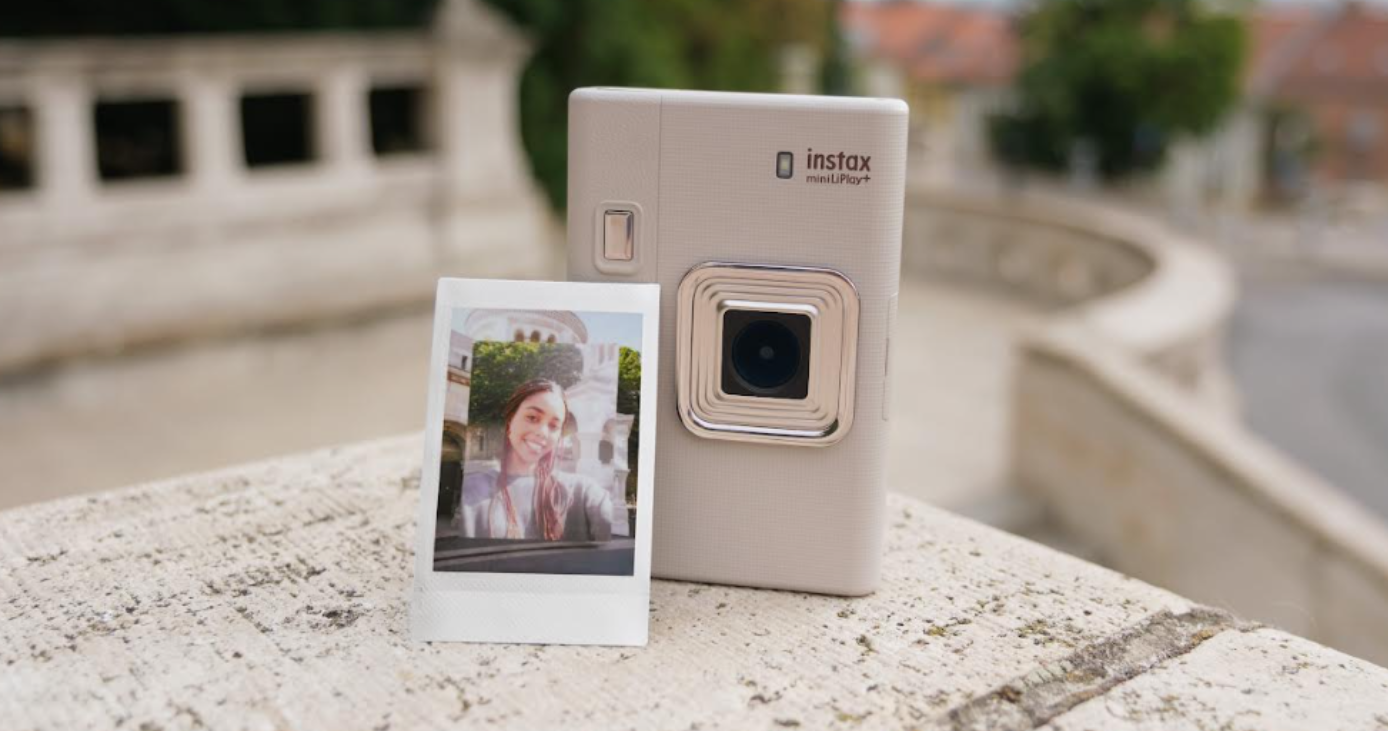
Fujifilm Announces instax mini LiPlay+ hybrid instant camera

FUJIFILM Europe GmbH, Imaging Solutions Division, is proud to announce the introduction of its instax mini LiPlay+™ hybrid instant camera (mini LiPlay+), an update to the popular instax mini LiPlay™ line that debuted in 2019. This new camera debuts a variety of new features including dual cameras (a main camera plus a wide-angle selfie camera) with new capabilities for image makers, various enhanced sound capabilities that allow the user to integrate sound into their images (through the use of an integrated QR code printed onto the image), and tasteful upgrades to the camera body.

“As Fujifilm’s first hybrid instant camera, and the first camera with the unique capability to integrate sound into photos, our mini LiPlay™ line of hybrid instant cameras has always been one of our most unique offerings,” said Shin Udono, Senior Vice President, Imaging Solutions, FUJIFILM Europe. “mini LiPlay+™ builds on the distinctive features of the original mini LiPlay™, giving users even more creative ways to express themselves through photos and sound. It’s a truly versatile hybrid camera with a unique set of attributes to suit every skill and interest level”

Main Features:

instax mini LiPlay+™ Smartphone App 

The free, downloadable instax mini LiPlay™ App allows users to capture images remotely via Bluetooth connection, add finishing touches to images with frames, and print photos from a connected smartphone. Users can further embellish their images by adding sticker icons or overlay text, making each image a true custom creation.

Dual camera functionality

The mini LiPlay+™ hybrid instant camera features both a front main camera and a rear-facing wide-angle selfie camera. New to mini LiPlay+™ is layered photo mode, in which images created with both the front and rear cameras can be combined so the images appear in layers, one in the foreground and one in the background. When editing images, users can choose between instax-Rich mode™ and instax-Natural mode™ to accentuate their images and choose from a selection of artful filters to express themselves further. mini LiPlay+™ also features automatic exposure and flash control to enhance image quality and includes either 2 or 10 second timers.

Instax Sound Print™ and instax Sound Album™

Users can utilise the free, downloadable instax mini LiPlay+™ App to add sound features to their images. With the instax Sound Print™ feature users have four unique ways to record 3-second audio clips to add to their images, then listen back by scanning the printed QR code on your photo (instax™ instant film required and sold separately) with their smartphone. Alternatively, the instax Sound Album™ feature turns adventures into custom animated videos with sound, vibrant backgrounds, and standout music. 

New instax™ mini film variety introduced

Also being announced at the same time as the mini LiPlay+™ camera is instax™ mini Soft Glitter instant film available in a 10-exposure pack. Gold accents combine with soothing hues to bring a calming shimmer to the frames around each photo. 

Pricing and Availability

The instax mini LiPlay+™ hybrid instant camera will be available in Sand Beige and Midnight Blue colors from 30th October 2025 at a manufacturer’s suggested retail price of €220.00 (inc. VAT). The updated instax mini LiPlay+™ smartphone App will also be available at this time. Available from Fujifilm retailers nationwide.

For more product information, visit  https://www.instax.ie/cameras/mini-liplay-plus/ 

instax™ mini Soft Glitter instant film will be available from 30th October 2025 at a manufacturer’s suggested retail price of €10.50 (inc. VAT). Available from Fujifilm retailers nationwide.

See our instax reviews

Woodie’s expand online product range by thousands through Virtualstock partnership

 Woodie’s, Ireland’s leading DIY, Home and Garden retailer, has partnered with Virtualstock, the range extension platform, to scale its online product offering and deliver a richer customer experience. The collaboration has already seen Woodie’s expand its product range by 10% in the first quarter since going live, with a further 10,000 products set to go live in the coming months.

By integrating Virtualstock’s user-friendly dropshipping and supplier management tools, Woodie’s can now onboard suppliers faster and more efficiently, cutting time to market whilst increasing choice. The partnership is central to Woodie’s ambition to lead in omni-channel retail, offering customers an even wider selection of products both online and in-store.

Customers are already seeing the benefits with hundreds more orders processed each month, improved returns via Drop2Shop integration and easier access to new product categories. The returns process is also more convenient, with customers now able to return online purchases via QR code at any of Woodie’s 35+ stores nationwide, enhancing the post-purchase journey and brand loyalty.

“At Woodie’s, our mission is to be Ireland’s leading omni-channel DIY, Home and Garden retailer,” said Damien Dwyer, CEO, Woodie’s. “Our partnership with Virtualstock is a key part of that journey, enabling us to rapidly expand our product catalogue and offer customers more choice and flexibility than ever before. Virtualstock also allows us to bring new products and brands to market quickly, helping us stay ahead in delivering the variety and convenience our customers expect as market leaders.”

Ed Bradley, CEO, Virtualstock, added, “People are shopping online more than ever before – Ireland leads this trend, with 96% of internet users making online purchases last year. Purchasing home, furniture, and garden accessories online is on the rise. We want Woodie’s to be able to capitalise on that – giving them the tools to stay one step ahead of shifting demand.

Woodie’s has experienced an impressive 10% range uplift in the first quarter, and there’s lots more where that came from. Strategic range expansion is the fastest, smartest way to meet customer demand without overextending operations, and it’s a clear example of how smart technology can unlock scalable growth.”

Woodie’s is the latest in a growing cohort of major retailers investing in technology-first range expansion. With demand shifting fast and consumer confidence still recovering, giving customers more choice, without the stock risk, has become a strategic imperative.

Cryptocurrency Meets UX: Designing for Speed, Security, and Trust

In just over a decade, cryptocurrency has transformed from a niche concept discussed mostly among tech enthusiasts into a powerful force reshaping how we think about money, value, and ownership. While the blockchain technology behind digital currencies like Bitcoin and Ethereum has progressed in leaps and bounds, user experience (UX) hasn’t always kept pace.

For years, the crypto world was dominated by highly technical platforms that were difficult for the average person to navigate. Setting up a wallet felt like completing a puzzle, and the terminology often read like a foreign language. As crypto moves into the mainstream across the UK, Ireland, and beyond, the industry is waking up to a simple truth: technology is only helpful if people can use it.

The UX Gap in Crypto

Early crypto platforms weren’t designed with the everyday user in mind. They were built by developers for developers. The focus was on making the system work, not making it easy to use. This resulted in clunky interfaces, confusing processes, and a whole lot of user frustration. Wallets demanded users write down secret keys and phrases with little explanation. 

Exchanges offered limited guidance and a steep learning curve. Even experienced internet users often felt lost. For many, the experience was so intimidating that they gave up before completing a transaction. Worse yet, those who persevere sometimes lose access to funds due to simple mistakes. This lack of user-friendly design didn’t just create inconvenience, it eroded trust.

Evolving Expectations

Today’s digital users are used to seamless online experiences. Convenience is king, whether it’s sending money through apps like Revolut, booking a hotel on Airbnb, or ordering coffee via a mobile app. This expectation is increasingly being carried over into the world of cryptocurrency. As a result, there’s a growing demand for platforms that are just as easy to navigate as mainstream apps. 

Forward-thinking businesses are responding by investing heavily in cryptocurrency website development to build blockchain platforms that are not only powerful under the bonnet but also intuitive on the surface. From sophisticated mobile wallets to user-friendly exchanges, the focus shifts from “just making it work” to “making it work effectively.” What is certain is that the crypto space is undergoing a design renaissance, and for a good reason.

Speed: The Need for Instant Gratification

We live in an on-demand culture. Users expect things to happen now, whether it’s next-day delivery, instant streaming, or real-time payments. When it comes to money, especially digital currencies, speed is crucial. We lose trust if a platform takes too long to load or a transaction confirmation lags.

That’s why today’s crypto UX places such a strong emphasis on speed. On the technical side, solutions like Layer 2 scaling and the Lightning Network help reduce latency and network congestion. On the design side, progress indicators, real-time status updates, and responsive layouts reassure users that everything is running smoothly.

This emphasis on speed isn’t unique to cryptocurrency. In the gaming industry, for instance, advancements like cloud gaming and 5G connectivity have significantly reduced latency, allowing for seamless, real-time interactions. These technologies enable players to engage in complex, fast-paced games without high-end hardware, highlighting how critical speed has become across digital platforms. 

A few seconds might not seem like much, but every moment counts in the high-stakes world of digital finance. When users don’t get immediate feedback, they panic and often abandon the process entirely.

Security: Making Safety Effortless

Cryptocurrency and security go hand in hand. Blockchain’s decentralised nature is one of its biggest strengths, but it also puts more responsibility in the user’s hands. That’s where great UX can make a huge difference. The challenge is creating a safe experience without it feeling like a chore. For example, two-factor authentication (2FA) is essential, but constantly entering codes can become frustrating.

Instead, platforms turn to biometric logins, device recognition, and secure QR code scanning to balance safety and convenience. Clear, jargon-free messaging also goes a long way. Explaining why a security step is necessary or guiding users through wallet backups and recovery phrases in plain English helps reduce confusion and builds confidence. Ultimately, good UX means assisting users to make safe choices without slowing them down.

Trust: The Foundation of Adoption

Trust is at the heart of every successful platform, crypto or otherwise, and trust doesn’t come from whitepapers or blockchain specs. It comes from how a product feels to use. Does the interface look polished? Are the instructions clear? Do users feel informed and in control? These elements might seem small, but they make a massive difference in how users perceive a platform.

Visual cues like padlock icons, verified badges, and clear transaction statuses help users feel secure. Onboarding tutorials, FAQs, and in-app support build confidence. Consistency across devices, updates, and interactions helps users know what to expect.

Platforms have already built reputations on solid, trust-first design. Platforms that cut corners on UX or offer inconsistent, buggy experiences often struggle to retain users, even if their technology is sound. Trust is emotional. And in crypto, it’s everything.

Designing for Humans, Not Just Technology

Today’s shift in the crypto industry mirrors trends across the broader tech sector. As digital products become more advanced, human-centred design becomes more critical. Gone are the days when users would tolerate clunky systems just because they were new or exciting. Today’s users are savvier, busier, and more aware. They expect platforms that work and don’t require a computer science degree to operate. So, for crypto to move into the mainstream, it must meet people where they are. That means speaking their language, easing their fears, and making the entire experience simple and smooth, from sign-up to transaction.

In the end, cryptocurrency isn’t just about finance—it’s about freedom, ownership, and possibility. But those ideals can’t reach their full potential unless our tools are fast, secure, and easy to understand. That’s where UX comes in. It’s the bridge between transformative technology and real-world adoption. It turns a confusing system into a trusted one and transforms a first-time visitor into a loyal user. The message is clear for developers, startups, and established crypto businesses alike: design matters. No matter how powerful your platform is, if people can’t use it confidently, they won’t use it.

In the end, the future of cryptocurrency belongs to those who design with people in mind.

DHL sorry we missed you card scam

The latest scam now doing the rounds is one you would not be familiar with so it is time to buckle up and be aware and take heed at what the scammers are now up to.

This time of year we usually see a raise in sms scams from courier companies and more in fact I got one from PTSB the other day in which they have yet to respond to and make people aware. well done lads.

Being involved in the logistic industry years now this is a new one rather than a text or email and it is a missed call card left in your letterbox with no name on it, the giveaway here is there is a QR code on the right with a website address to type in and it is as you guessed a scam and some will fall for it thinking they have a missed parcel. This is for the DHL on demand service.

This all goes down well now with the hold up at holyhead and people will be in panic mode now hoping they have not missed a parcel for themselves or a gift purchased for someone else.

Below is two samples of what you need to watch out for the one on the left is a legitimate card DHL will leave and the one the right is the dodgy one so be extra aware of what is coming through on your phone and in your letterbox and have a great Christmas. Don’t get scammed.

DHL have advised the following

 Important Update from DHL  We’re aware of social media and WhatsApp messages circulating today about a potential DHL “Not Home” card scam involving our On Demand Delivery service. Here’s what you need to know: Our couriers in Ireland DO leave official cards (see example) when no one is home to accept a delivery. These cards include a QR code for rescheduling your delivery. Scanning this QR code should redirect you to:
Alternatively, typing DHL.ie/ondemand in your browser will direct you to the same link.
 Safety Tip: If you’re directed to a different address or encounter cards that don’t match our sample, do not interact with them. Stay vigilant and thank you for trusting DHL!

Optimizing VCard Usage with QR Codes

QR codes provide a versatile solution for optimizing the usage of VCards. By incorporating VCards into QR codes, you can enhance their accessibility and convenience. This article explores the benefits of using QR codes for VCards and highlights how they can be utilized in various scenarios, such as presentation design, to maximize their impact. Discover how free qr code for business card can streamline the sharing and utilization of VCards, making them more efficient and user-friendly.

Unlocking the Potential of VCards in QR Code Format

Explore the reasons why utilizing VCards in QR code format can be advantageous. Whether you need to present your contact information in a visually appealing and interactive way or streamline the process of sharing your details, VCards in QR code format offer numerous benefits. By using QR codes, you can conveniently provide others with quick access to your VCard information, making it easier for them to save and utilize your contact details effectively.

Creating a QR Code for VCard

Learn how to create a QR code for your VCard, whether by converting an existing VCard file or building a VCard page from scratch. To create a QR code at generator ME-QR for your VCard, follow these steps on the:

  1. Visit the website and navigate to the VCard QR code section.
  2. Select the option to create a new VCard QR code.
  3. Fill in the required contact information, such as name, phone number, email, and address.
  4. Customize the appearance of the QR code if desired.
  5. Generate the QR code and download it for use.

By following these steps, you can easily create a QR code for your VCard and optimize its accessibility and usability.

QR codes offer a powerful tool for optimizing the usage of VCards. By converting VCards into QR codes, you can enhance their accessibility and convenience, making it easier for others to save and utilize your contact information effectively. Whether for presentation design or simplifying contact sharing, QR codes streamline the process and ensure a seamless experience for both parties involved.

Utilizing QR codes for VCards provides a practical solution to optimize their usage. By creating a QR code for your VCard and incorporating it into your communication materials, presentations, or digital platforms, you can enhance the accessibility and convenience of your contact information. Embrace the power of QR codes and unlock the full potential of your VCards for efficient and user-friendly contact sharing.

HP Wolf Security report: Daily QR “Scan Scams” Phishing Users on their Mobile Devices

HP Ireland has today issued its latest quarterly HP Wolf Security Threat Insights Report, showing hackers are diversifying attack methods, including a surge in QR code phishing campaigns. By isolating threats on PCs and mobile devices that have evaded detection tools, HP Wolf Security has specific insight into the latest techniques being used by cybercriminals in the fast-changing cybercrime landscape. To date, HP Wolf Security customers have clicked on over 25 billion email attachments, web pages, and downloaded files with no reported breaches.

From February 2022, Microsoft began blocking macros in Office files by default, making it harder for attackers to run malicious code. Data collected by the HP Threat Research team shows that from Q2 2022, attackers have been diversifying their techniques to find new ways to breach devices and steal data. Based on data from millions of endpoints running HP Wolf Security, the research found:

  • The rise of QR scan scams: Since October 2022, HP has seen almost daily QR code “scan scam” campaigns. These scams trick users into scanning QR codes from their PCs using their mobile devices – potentially to take advantage of weaker phishing protection and detection on such devices. QR codes direct users to malicious websites asking for credit and debit card details. Examples in Q4 included phishing campaigns masquerading as parcel delivery companies seeking payment.
  • HP noted a 38% rise in malicious PDF attachments: Recent attacks use embedded images that link to encrypted malicious ZIP files, bypassing web gateway scanners. The PDF instructions contain a password that the user is tricked into entering to unpack a ZIP file, deploying QakBot or IcedID malware to gain unauthorised access to systems, which are used as beachheads to deploy ransomware.
  • 42% of malware was delivered inside archive files like ZIP, RAR, and IMG: The popularity of archives has risen 20% since Q1 2022, as threat actors switch to scripts to run their payloads. This is compared to 38% of malware delivered through Office files such as Microsoft Word, Excel, and PowerPoint.

We have seen a rise in scan scams, malvertising, archives and PDF malware recently, and we would encourage everyone to look out for emails and websites that ask to scan QR codes and give up sensitive data, as well as PDF files linking to password-protected archives. Being aware of the signs to watch out for is the first line of defense when it comes to detecting and eliminating any breaches, it ensures these threat actors don’t gain access to sensitive data and move throughout systems,” explains Val Gabriel, Managing Director of HP Ireland.

In Q4, HP also found 24 popular software projects imitated in malvertising campaigns used to infect PCs with eight malware families – compared to just two similar campaigns in the previous year. The attacks rely on users clicking on search engine advertisements, which lead to malicious websites that look almost identical to the real websites.

While techniques evolve, threat actors still rely on social engineering to target users at the endpoint,” comments Dr. Ian Pratt, Global Head of Security for Personal Systems, HP Inc.

Organisations should deploy strong isolation to contain the most common attack vectors like email, web browsing and downloads. Combine this with credential protection solutions that warn or prevent users from entering sensitive details onto suspicious sites to greatly reduce the attack surface and improve an organisation’s security posture.”

HP Wolf Security runs risky tasks like opening email attachments, downloading files and clicking links in isolated, micro-virtual machines (micro-VMs) to protect users, capturing detailed traces of attempted infections. HP’s application isolation technology mitigates threats that might slip past other security tools and provides unique insights into novel intrusion techniques and threat actor behavior.

The full report can be found here: https://threatresearch.ext.hp.com/hp-wolf-security-threat-insights-report-q4-2022/

Criminals are using QR codes to scam people in restaurants!

There has been a massive increase in the use of QR code restaurant menus over the past two years, and now it seems criminals are using this development to scam innocent people out of their money and data.

According to TitanHQ, an Anti Phishing Platform based in Galway and with offices in Connecticut, almost 84% of smartphone users have scanned a QR code at least once, and over 34% scan a QR code once a week. Cybercriminals love popular technologies and focus on them to scam, hack, and cause malware infection.

This popularity has led to a rise in “QR code phishing” and in the US the FBI even issuing a warning about QR codes, highlighting their use for data phishing. Here is how hackers use QR codes to hack your network and how you can prevent it:

Types of QR Code Phishing Scams

QR codes work by embedding instructions into a black and white dot-based image. They work a little like the barcodes you see on food in a store. A smartphone camera, app, or QR code scanning device scans the QR code. The scan then translates the data into human-readable information.

QR codes usually contain web links or links to media such as videos or links to download an app. This use of links in a QR code provides a cybercriminal with the opportunity to perform phishing.

During the pandemic, many restaurants switched to using QR code menus and have kept them. With a smartphone you can easily access the menu removing the need for  paper menus. The customer simply scans the barcode using their phone’s camera app, and a link to the online menu becomes available.

With a QR code scam the scammer replaces the legitimate menu QR code with a malicious one. Instead of taking the customer to the restaurant website, the fake QR codes takes them to a fake website designed to mimic the real account and have the customer divulge personal data.

QR-Phishing

Quishing is a mashup of QR codes and email phishing. The fraudsters embed a malicious QR code into a legitimate-looking email. A recent example of a quishing attack was a Microsoft Office 365 phishing campaign that used QR codes to steal log-in credentials. Researchers identified spoof Office 365 emails that offered access to missed voicemail messages by scanning a QR code. Scanning the QR code took the user to a fake Office 365 page, which requested credentials to gain access to the message.

QR codes are also being used in various regular scam types, such as tax scams. The UK tax department, HMRC, recently added support for QR codes on their website. However, fraudsters have now used this new feature as a basis for a new QR code tax phishing scam. The spoof HMRC email asks the recipient to scan the code to pay overdue tax. The QR code takes the taxpayer to a spoof site where their financial information is then stolen.

QRL Jacking

This is an older version of the more recent Quishing scam, but one that has phishing implications. QR codes are very convenient for users, and some companies have extended this convenience to their log-in systems, where users scan a QR code to log-in to an account. In QRL Jacking, an attacker navigates to a legitimate site, initiating a session and generating the QR code to log in. The attackers then capture this QR code (for example, using screen scraping) and places this legitimate QR code on a spoof site.

The attacker then uses spear-phishing to target an individual, tricking them into going to the spoof site. The target then uses the captured QR code to log-in; this logs into the original session, thus logging the attacker into the legitimate account. This scam is more challenging to carry out as it is time-sensitive; however, it will be worth the effort if this is a high-value or sensitive account.

QR crypto scams

QR codes are often used to make it more convenient to download a legitimate app. However, they can be used to encourage people to download malicious apps, including crypto-wallets. For example, the QR crypto-quishing scam involves capturing persistent consent (prior authorization) to use the wallet; this allows the fraudster to drain the wallets of cryptocurrency.

Drive-by-QR Code Phishing

Drive-by-downloads of malware are one of the most insidious forms of malware infection. A person must land on an infected site, and a flaw in any software they use can open the door to malware infection. QR code phishers take advantage of drive-by-download opportunities by sending phishing emails with QR codes that take the recipient to an infected website: one scan of the code and their mobile device may become infected with a trojan.

Ways to Prevent QR Code Phishing:

QR codes are one method in a long line of phishers’ favorites. No matter what technology comes along, fraudsters will find a way to exploit it if it is popular. Moreover, a single-point solution cannot capture all possible cyber-attack scenarios. Clever attack chains require a creative response, comprising a mix of security awareness training with advanced AI-enabled spam and content filers.

  1. Know your stuff: Education is key, use behavior-based security awareness training to limit the risks. If you’re worried about your working information, ensure that you include QR code phishing templates in your simulated phishing exercises so employees understand what these phishing emails look like and the different methods used to steal credentials and other data.
  2. Use a DNS filter: This will break the phishing cycle by stopping users from navigating to a malicious website. The DNS filter creates a ‘blocklist’ of URLs, using a dynamic system based on a “threat corpora”, based on the data from millions of subscribers. These data are used to train Machine Learning algorithms. The result is that even emerging malicious URLs are spotted and added to the blocklist.
  3. Apply email filters: Email filters such as SpamTitan use multiple mechanisms to catch difficult-to-detect phishing messages. These mechanisms include advanced AI-based algorithms to spot difficult-to-detect spam.

Q.tk Scanner – An Irish Revolution in QR Scanning Apps. #QR #Android #iOS

There is plenty of QR Code scanners available today and to be honest most of them do as they say on the tin,but this one is different,Apart from being Irish made its got plenty to offer that sets it apart from others,one main point is NO ADS. Another thing is it’s super fast and it’s got a nice minimalistic design too, you can also look at QR options.

Quick and reliable, the Q scanner is able to detect QR codes from low resolution and off-angle pictures taken directly with your phone or tablets camera, as well as any qr codes stored in your camera’s library from previously taken pictures.

Gerry from Q inc has also told us that this app has had in excess of 60k downloads within 7 weeks and a 96% approval rate,In short that is nothing short of brilliant.. On a side note having tried this app out I can also this is LIGHTNING FAST and hats off to the team for this…. Gerry explains more below..

What is it?

The Q.tk Scanner is, quite simply, the most advanced QR Scanning app available on the market today. It allows you to quickly, easily and accurately scan QR codes whenever, wherever and however you need to!

Does it really work that well?

Yes! The Q.tk Scanner is truly the best of both worlds. On the one hand you have an incredibly sophisticated piece of technology that is going to vastly improve the way you go about QR Code scanning.

But that’s not all! The Q.tk Scanner is not only incredibly sophisticated and powerful, but it is also incredibly easy to use. It doesn’t matter your experience level, in a matter of moments you can have the app downloaded and away you go!

We’ve managed to make the app truly intuitive and an absolute pleasure to use. Who wants an app that’s needlessly complicated? Nobody! The Q.tk Scanner is as elegant and easy to use as it is technologically advanced and 100% ad free.

The process is simple;

  • Scan
  • Decode
  • Display

It truly is as simple as that!

What else do I get?

If getting a reliable, fast and powerful QR Scanner isn’t enough for you, the Q.tk Scanner also allows you to;

  • View an ‘In-App Preview’ before going on to open the website in a browser!
  • Detect even low resolution codes with ease!
  • Detect codes even when they are off angle!
  • Scan QR Codes that have been stored as photos in your camera’s photo library!


Who can use Q.tk Scanner?

Anyone who is searching for an intelligent QR Code scanner.
• Also Q.tk is perfect for people who looking to perform Advanced QR code scanning and decoding without any unnecessary additions apart from exactly what you need.

Do you know the truly best part? It’s a NO BS or strings attached app and is 100%  FREE! 

[ Download on Android ]   [ Download on iOS ]