How Job Management Software Can Improve Trade Businesses’ Operations

Whether you’re in the plumbing, electrical, HVAC, or any other type of trade business, managing your daily tasks is crucial for efficient operations. From tracking jobs and managing schedules to handling customer communications and invoicing, staying organized and responsive is essential.

While the processes may sound complex, technological advancements have actually made it easier than ever to manage jobs, employees, and customers. Job management software is one example of it that can change the way trade businesses operate.

Let’s discuss how these software solutions can benefit trade businesses and why they are so important now.


Why Custom Software Solutions Matter

Job management software provides a range of tools to automate and streamline business processes. But not every business operates in the same way.

So, while standard solutions do work for some, businesses with unique needs can benefit more from customized job management systems like the custom ServiceM8 portal from Right Hook that can be tailored to their specific operations.

Software solutions help with automating workflows, improving efficiency, and can integrate with existing tools. The same solutions, but customized, offer all of those with a more personalized experience. 

So you can design a system that actually fits your model, which will ultimately bring you happier clients and improve your productivity.


Streamline Job Scheduling and Dispatching

Trades are usually fast-paced, and with the rising use of technology, they have become even faster.

That means your operations need to match the pace to keep up. Job management software can take into account factors such as skillset and proximity to the job site when dispatching jobs. This helps avoid inefficiencies that may be caused by scheduling delays or conflicts. 

Automating the entire scheduling process also reduces the chance of human errors and increases responsiveness. The result? Happier, satisfied, and fulfilled customers.


Improve Communication with Clients

Keeping clients informed and up to date throughout the process is important, but it can be challenging. You know that you need to build trust and ensure you satisfy your customers, but doing all of that manually can be exhausting.

A job management portal usually includes features like client portals, where customers can track the status of their jobs in real time, make payments, or request follow-up services. Some even provide integration with communication tools.

So, you can send automated reminders, updates, and confirmations to your clients. It maintains a level of transparency as well, making your customers feel valued and keeping them engaged.

This automated process also reduces the chances of misunderstandings or missed appointments.


Automation and Workflow Optimization

Repetitive tasks are one of the most time-consuming and prone to errors. Job management software can automate many such tasks, allowing employees to focus on more important work.

For example, tasks such as creating invoices, processing payments, or sending reminders can be automated, allowing employees to reduce the time spent on administrative duties.

This optimizes the overall workflow because tasks are automatically routed with project progress tracking. It also makes sure deadlines are met and operations become more organized and efficient.

With software solutions, you can handle more jobs without sacrificing quality.


Better Data Insights and Reporting

One of the biggest advantages of a job management system is its ability to collect and analyze data in ways that provide actionable insights.

Standard systems usually offer basic reporting features, but a custom portal can be designed to provide you with detailed reports that are most relevant to your business. These reports include insights into things like:

  • Job completion times
  • Revenue trends
  • Customer feedback
  • Technical performance

And with the help of this data, businesses can make more informed decisions, identify inefficiencies, and ultimately improve their services and profitability.


Integration with Existing Tools

Trade businesses tend to rely on multiple tools to manage their operations. These tools may include accounting software and customer relationship management (CRM) systems.

A custom job management system can easily integrate with these tools, ensuring that information flows smoothly between all platforms.

For example, you can integrate job management software with your accounting system to automate invoicing and track payment statuses in real time.


Scalability to Grow with Your Business

As your business grows, so will your operational needs. Custom job management software can scale with your business, making it much more flexible. You can add new features, expand user access, and support a team that keeps growing.

These solutions are adaptable and can be easily adjusted to accommodate your changing needs. You can add new job categories, hire more technicians, or even expand your service area. 

Custom software ensures that your system continues to meet your business’s needs.


Choosing the Right Job Management Software

When you’re selecting a job management software solution, it’s important to consider multiple factors.

Start by identifying the pain points in your current systems and the features that would be most beneficial to your team. Some of these features include:

  • Ease of use because you need the software to simplify your processes.
  • Reliable customer support so you can reach out about system-related issues at any time.
  • Ability to integrate well with the other tools that you use.

If possible, look for a platform that allows you to keep customizing it as your business grows, evolves, or even changes direction.


How Customization Increases Profitability

A custom job management solution can significantly improve the profitability of your business. It improves efficiency, reduces errors, and makes sure that every part of your business is optimized for peak performance.

Automation improves job scheduling, workflows, and other systems so your business can focus on handling more jobs, reducing overheads, and delivering the best services to your clients.

Additionally, with personalized portals and automated communication, you can provide a more personalized customer experience. This may lead to higher client retention and more referrals, further improving profitability.

If your trade business is struggling to keep up with the demands of modern job management, it may be time to finally consider a custom solution. With the right approach and software, your business can transform its operations and position itself for long-term success.

How On-the-Job Training Can Boost Employee Performance

On-the-job training has always been considered a burden by employers, as they expect the employees to understand and work as per their demands from day one. But yes!! It’s just a fantasy.

You have to train your employees as per your company’s demands and requirements, yet make sure your training does not effectively improve their skills and working capabilities.

So, here are the 5 benefits you will achieve from on-the-job training, and you will observe a boost in employee confidence; let’s dig in.

On-the-job Training: An Overview? 

On-the-job training means training the employees about the role for which they are hired. This training continues while the employee is working and earning a salary. 

This training lasts from days to weeks, depending upon the employee’s learning ability, once the trainer observes that the employee is ready to take critical responsibility, this training stops. 

OJT comes with many benefits, including:

  • Faster onboarding of the employee.
  • Higher productivity of the new employee 
  • Job satisfaction.

This training program is cost-effective and productive for companies because they get their jobs done by well-trained workers.

Benefits of on-the-job training 

OJ training offers numerous benefits, as we have mentioned earlier, but here are more of them. Let’s dig in:

Better Training with Real-life Experience 

The best part of OJT is that you get hands-on experience. You will learn corporate tools and will also have the opportunity to use them hand in hand. 

Faster critical skill learning is important because the employee has the opportunity to observe others doing the same job.

Better learning is essential as you will get practical experiences. 

Enhanced Productivity 

When the newcomer gets a chance to work with the trained workers, they learn faster and better and get practical learning experience.

Employee Retention Increases 

When newcomers come to a new setup, it usually becomes overwhelming and difficult to cope with the fast-paced system. But OJT here has the magic; it boosts the newcomer’s confidence as they work in practical situations, making them sure there roles and responsibilities. This helps the company retain new and talented employees.

Teamwork is Appreciated  

As the new incoming person works with the already present team, they build stronger bonds and learn teamwork. This technique helps meet deadlines and improve productivity. The employees feel supported and know where to seek help.

Quick On-boarding 

As the workers are exposed to practical working environments immediately, they learn well and quickly, which helps the HR speed up the onboarding process. 

These and many other benefits make OJT the best model to train the employee and it’s beneficial for both companies and the newcomers.

Implementing On – the – Job Training 

These few steps should be followed to maximize the OJT:

  • Choose best trainers
  • Build a training plan
  • Resources should be provided 
  • As for feeding 

Companies that adopt new training trends like OJT will have the benefits of on-the-job training, which means they are working and performing better in the corporate world because their employees have a clear idea about their roles, responsibilities, and working trends.


The Importance of Psychometric Assessments for Tech Job Recruitment

In the rapidly evolving world of technology, hiring the right talent is more critical than ever. Companies are not just looking for individuals with the right technical skills, but also those who fit well within their organizational culture and possess the cognitive abilities to adapt and grow. This is where psychometric assessments come into play. These scientifically validated tests provide a comprehensive understanding of a candidate’s capabilities beyond what is evident on their resume or during an interview.

Understanding Psychometric Assessments

Psychometric assessments are standardized tests designed to measure individuals’ mental capabilities and behavioural styles. These assessments can evaluate a variety of attributes, including cognitive abilities, personality traits, and emotional intelligence. Unlike traditional interviews, which can be influenced by biases and subjective judgment, psychometric tests offer an objective method to gauge a candidate’s potential and fit for a specific role.

Cognitive Abilities: Predicting Job Performance

One of the primary components of psychometric assessments is the evaluation of cognitive abilities. In tech jobs, where problem-solving and critical thinking are essential, understanding a candidate’s cognitive strengths can be highly predictive of their job performance. Cognitive ability tests typically measure skills such as logical reasoning, numerical aptitude, and verbal comprehension. These skills are crucial for tech professionals who need to analyse complex data, develop algorithms, and create innovative solutions.

For instance, a software developer might need to understand and debug a piece of code efficiently. A cognitive ability test can help identify candidates who possess the sharp analytical skills required for such tasks. By incorporating these assessments into the recruitment agency process, companies can ensure they are selecting candidates who have the intellectual capacity to excel in their roles.

Personality Traits: Ensuring Cultural Fit

While technical skills and cognitive abilities are important, they are not the only factors that determine a candidate’s success in a tech job. Personality traits also play a significant role. Psychometric assessments often include personality tests that help employers understand a candidate’s behavioural tendencies, motivations, and interpersonal skills.

For example, in a collaborative work environment, it is essential to have team members who can communicate effectively, work well under pressure, and adapt to changing circumstances. Personality tests can reveal whether a candidate is a good fit for such an environment. Traits such as openness to experience, conscientiousness, and emotional stability are indicators of how well an individual might integrate into a company’s culture and contribute positively to the team dynamic.

Emotional Intelligence: Navigating the Tech Industry

Emotional intelligence (EI) is another critical factor that psychometric assessments can measure. In the tech industry, where professionals often work in high-stress and fast-paced environments, the ability to manage one’s emotions and understand others’ emotions is invaluable. High EI enables individuals to handle pressure, resolve conflicts, and build strong working relationships.

Assessing EI during the recruitment process can help employers identify candidates who are not only technically proficient, but also capable of navigating the emotional complexities of the workplace. This is particularly important for leadership positions, where managing teams and fostering a positive work environment are crucial responsibilities.

Reducing Bias and Enhancing Diversity

One of the significant advantages of using psychometric assessments in tech job recruitment is their ability to reduce hiring biases. Traditional recruitment methods, such as interviews and resume reviews, are susceptible to conscious and unconscious biases that can influence decision-making. Factors such as a candidate’s appearance, gender, or educational background might inadvertently sway an interviewer’s judgment.

Psychometric assessments provide a more objective evaluation, focusing solely on a candidate’s abilities and traits. This objectivity helps create a fairer hiring process, enabling companies to select the best candidates based on merit. Additionally, by reducing biases, psychometric assessments can enhance diversity within tech teams, leading to a more inclusive and innovative workplace.

Improving Retention and Reducing Turnover

Hiring the right candidates is not only about filling immediate vacancies, but also about ensuring long-term success. High employee turnover can be costly and disruptive for tech companies. Psychometric assessments contribute to better hiring decisions, which in turn can improve employee retention.

When candidates are well-matched to their roles and the company culture, they are more likely to be satisfied with their jobs and stay with the organization longer. This alignment leads to increased job satisfaction, higher productivity, and a stronger commitment to the company’s goals. By investing in psychometric assessments, tech companies can build a stable and dedicated workforce.

Implementing Psychometric Assessments in Recruitment

Integrating psychometric assessments into the recruitment process involves several steps. First, companies need to identify the specific skills and traits that are essential for success in the roles they are hiring for. This involves working with experts to develop customized psychometric assessment tools that align with the company’s needs.

Next, it is crucial to train hiring managers and recruiters on how to interpret and use the results of these assessments effectively. The insights gained from psychometric tests should complement other recruitment methods, such as technical assessments and interviews, to provide a holistic view of each candidate.

Finally, companies should continuously evaluate the effectiveness of their psychometric assessments and make necessary adjustments. This ongoing process ensures that the assessments remain relevant and continue to provide valuable insights into candidates’ potential.

Conclusion

In conclusion, psychometric assessments are an invaluable tool for tech job recruitment. They offer a scientifically validated and objective method to evaluate candidates’ cognitive abilities, personality traits, and emotional intelligence. By incorporating these assessments into the hiring process, tech companies can reduce biases, enhance diversity, improve retention, and ultimately select the best talent for their teams. As the tech industry continues to evolve, leveraging psychometric assessments will be crucial for building a capable and dynamic workforce ready to tackle the challenges of the future.

Revolut warns more than 2 million customers in Ireland following sharp rise in job scams

Revolut, the global financial app with more than 40 million customers worldwide, has directly issued a fraud warning to more than 2 million of its customers in Ireland, cautioning those looking to boost their income that job-related scams are on the rise — and advising them on how to stay ahead of these sophisticated job scams.

Amid the rising cost of living, sophisticated scammers are taking advantage, warns Revolut. According to its inaugural Financial Crime and Consumer Security Insight Report, the global financial app found that while just 1% of fraud victims in the country were subject to job scams in 2023, 15% of the total sum lost to fraud in Ireland — second only to investment scams (53%) — was caused by people falling for false job opportunities in a bid to boost their income.

This form of authorised fraud sees scammers post fake job openings either online or by reaching out directly to victims via messaging apps, posing as employers or recruiters. As part of the phoney application process, scammers either request money upfront or require personal financial information to defraud the victim. Common tactics include asking people to pay for training, administration costs, or setup fees, or to purchase required equipment, such as a laptop or a mobile phone. This poses a notable risk for those entering the job market for the first time after school or college, people struggling with the cost of living, or those looking to get back to work.

Revolut’s report also found that job scams had increased globally over the course of 2023 — the most of any type of scam. In Q1 2023, job scams represented only 1% of Revolut’s global fraud cases, as well as just 1% of the overall value of all money lost to fraud. However, by Q4 2023, these figures rose to 12% of all cases and 21% of the overall value lost to scams, increasing 1,200% and 2,100% respectively.

Based on extensive internal research and data analysis for 2023, the report aims to shed light on the growing scam and fraud industry across the globe, and provide tangible watch-outs for everyday people to help them protect themselves. Among the findings, Revolut revealed that in 2023, the company is estimated to have prevented over €550 million in fraud losses, up 130% from 2022. This was largely thanks to its proprietary fraud detection system, which deploys cutting-edge machine learning and artificial intelligence methodologies.

Woody Malouf, Head of Financial Crime at Revolut, commented: “Having harnessed data from more than 500 million transactions per month, our dedicated fraud intelligence team has observed the evolution of job opportunity scams that prey on unsuspecting job hunters. Given the cost of living and high inflation, the number of reported job scams has dramatically increased. Sadly, criminals prey on those seeking a legitimate way to better their income, particularly young and often inexperienced job seekers. Our customers’ security is of paramount importance to us so please pay heed to this warning; we work tirelessly to identify patterns and spot unusual activity, helping our customers to stay ahead of emerging scam trends.”

Revolut’s advice to stay one step ahead of scammers:

  • Observe our warnings. Our proprietary AI systems never sleep. They scan more than 10,000 transactions per minute and flag suspicious transactions in just a few seconds.

  • Stay alert. Always question things that seem too good to be true.

  • Trust your instincts. If something feels off, take a step back and investigate by doing your own research.

  • Be extra cautious. Use secure channels. Stick to trusted websites and platforms for transactions.

  • Report suspicious activity. If something seems suspicious, let Revolut know — we’re here to help 24/7, directly from the app.

To read the full Financial Crime and Consumer Security Report 2023 and learn more about Revolut’s fraud prevention efforts, visit here.

For more information, visit www.revolut.com/en-IE.

58% of employees in Ireland use AI tools as part of their job

Workhuman, the company revolutionising the way employees celebrate, connect with and appreciate each other in the workplace, today announces new findings from its Human Workplace Index, which found that 58% of employees in Ireland now use artificial intelligence (AI) tools as part of their job. Moreover, some 40% of employees have claimed work carried out by AI as their own. The research shows that of these, half of them were rumbled by a colleague or manager.

The survey of 1,000 full-time employees in Ireland was commissioned by Workhuman and conducted by Pollfish to gain insights into the use of AI in the workplace. It found that 58% of employees in Ireland now use AI tools as part of their job and 30% of all employees are using them frequently.

With 47% of users saying they use generative AI (such as ChatGPT) for drafting emails, while 44% use it for brainstorming, the research suggests that AI is helping employees with some of the more difficult interactions in work. Some 28% of those surveyed have turned to AI for help or inspiration when asking for a promotion – 36% said they would consider it – and 20% have used it to ask for a raise. AI has also helped 22% of employees with the delicate matter of resigning from their job.

The survey also shows that AI can help companies to retain skilled talent. The introduction or increased use of AI would make 46% of employees more likely to stay in their jobs (versus 22% who would be less likely to stay), with 71% of those saying it would make them more productive. Moreover, 70% believe AI will lead to better job satisfaction and a better work-life balance, while the same proportion believe it will create new job opportunities – significantly higher than the 42% who believe AI will eventually replace their job.

One of the key benefits of AI highlighted by Workhuman’s survey is the efficiency gains. The majority (88%) of those using AI in the workplace say that it is increasing their productivity. For 49%, it is reducing their workload, while 47% are spending less time on repetitive tasks, enabling them to be more strategic in how they complete their work. When asked what they do with the time that AI gives back to their day, 50% of those using it said they have social chats with colleagues, 46% help other members of their team, and 42% focus on tasks that they wouldn’t have otherwise had time for.

By supporting people in their roles, the survey suggests that AI is helping to reduce stress among the working population. It found that the majority (91%) of employees say that AI is making their job easier or more manageable, while 86% say it is improving their job satisfaction and 84% say it is improving their sense of wellbeing in the workplace. In fact, Workhuman’s research found that employees who use AI in their job are generally happier than those who don’t. Of those who described themselves as being happy in work right now, 64% are using AI – versus 26% usage among employees who describe themselves as unhappy in work.

Reflecting the power of AI to positively impact the culture of an organisation, such as removing bias from the recruitment process or highlighting unconscious prejudices, many of those working in organisations that are using AI believe it is helping their company to become more diverse (cited by 85%) and more inclusive (82%).

Jonathan Hyland, Chief Technology Officer, Workhuman, said: “Our research shows that there is an increasing level of comfort with AI among the working population. Employees are using it as a tool not only to enhance their work, but also to manage their workloads and stress levels. It is helping with inclusivity, too, with 84% of employees saying that it is supporting more inclusive communications and collaborations with colleagues. As more organisations adopt AI, these kinds of benefits are growing in number and compounding to have a positive impact on wellbeing and the ever-challenging issue of retention. 

“Businesses are realising that AI isn’t going to be optional and that means that their employees will need to understand it and embrace it. Yet, our research found that 20% of those who are working in companies that use AI have received no training in its use or application. It’s important that we keep the human element in the process in order to maximise our use of AI. Employees are constantly evolving and upskilling, and AI should be used to enhance the human experience – not replace it entirely. Employers and their teams must work together to find the AI solutions that work best for everyone. Only then will they be able to realise the true benefits of AI by unearthing the tools that will make a difference.”

“At Workhuman, we are excited that, starting in December, our Customer Services team will be actively working with AI to digest case summaries. Currently, agents spend 60% of their time manually reviewing cases, so using AI as a solution will help accelerate response times, increasing productivity and customer satisfaction. The idea of using AI to support with case summaries came directly from our Customer Service Agents during Workhuman’s Hackathon, and we’re excited to see how it will enhance our employee satisfaction.”

Ireland Tops Euro Poll for Working from Home Growth

Of the 27 EU member states, Ireland has come out on top when it comes to how its workforce has adopted remote working. Malta; the Netherlands, Germany and France also feature in the top five (See Appendix).

BNP Paribas Real Estate Ireland (BNPPRE) reports that its analysis of Eurostat data shows that, while the Netherlands has the highest percentage of its workforce engaged in remote working (over 50%), Ireland is leading the charge in terms of how rapidly remote working is taking the place of traditional office-based work.

In 2019, just 7% of Ireland’s workforce said they “usually” work from home – this figure soared to 25% in 2022, the biggest percentage point increase of any EU country.

Speaking to the analysis, John McCartney, BNPPRE’s Director of Research,

Ireland’s adaptability throughout the pandemic has been remarkable in many ways, not least the ease with which businesses and employees alike adjusted their working models.”

Of course this has had knock-on implications for commercial property. Over time remote working has enabled employers to adopt hot-desking and rostering systems which reduce the amount of office space they need to carry per employee.  In the absence of jobs growth this would subtract from the demand for office accommodation.  But Ireland is one of the EU’s most service-driven economies and, since the onset of Covid, we have created service sector jobs at more than twice the average rate in the EU.”

 The impact of remote working on office demand has also been somewhat mitigated by a shift in occupier preferences.

 “In line with a wider European trend, Irish organisations are typically now seeking less, but better quality office space.  This is driven by sustainability objectives and a need to optimise the employee experience in a tight labour market.”

The BNPPRE analysis shows that 27.9% of Ireland’s employees work in desk-based sectors compared with an EU average of 24.6%.   The number of desk based jobs in Ireland has risen by 15% since the onset of Covid-19 in Q1 2020, compared with an EU average of 6.9%.

Sharp Fall In Professional Job Vacancies In Ireland

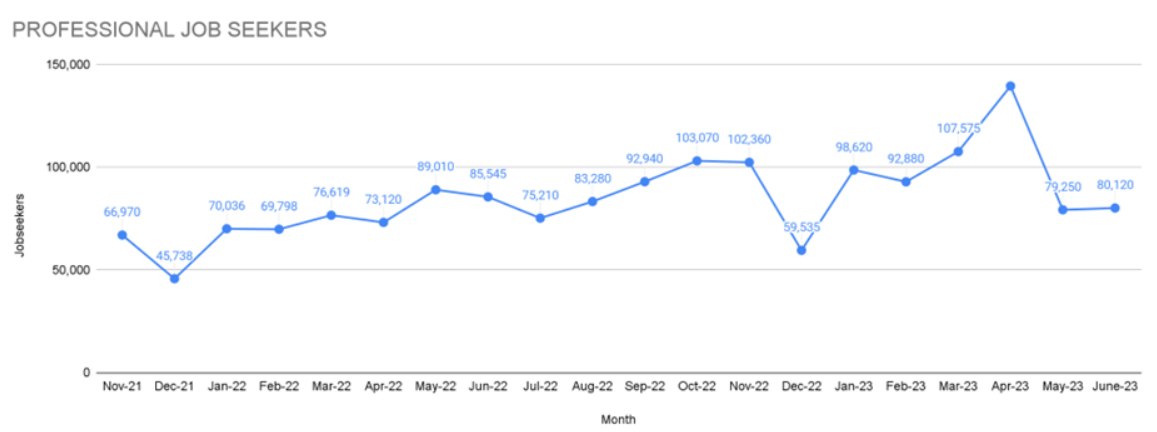
The Morgan McKinley Quarterly Employment Monitor registered a decrease of 15.4% in the number of new professional job opportunities in Q2 2023 compared to the previous quarter across all professional sectors.

The monitor also recorded a slight decrease of 0.8% in professional job seekers during the second quarter. Overall, there has not been a significant change in the number of job seekers from one quarter to another. However, compared to the same period in 2022, the number of applicants in Q2 2023 was 20% higher, primarily due to the tech sector downturn and an increase in business support professionals entering the job market.

Rising inflation, slower business growth, and challenges in the housing market have impacted the overall landscape. Additionally, changes in working models have become apparent, as employers are increasingly resisting remote working arrangements and emphasising the importance of physical presence in the office. However, employers who are flexible have greater access to skilled talent.

The Morgan McKinley employment monitor measures the pulse of the Irish professional jobs market by tracking the number of new job vacancies and new candidates in the Republic of Ireland each quarter. To reflect the changing dynamics of the current employment market, Morgan McKinley are including both permanent and contract jobs in the employment monitor.

Trayc Keevans, Global FDI Director, Morgan McKinley Ireland, said:

“Various sectors experienced a decrease in employment opportunities during Q2 including Accountancy and Finance (-17.3%) and Projects, Transformation and Change (-25%). The decline can be attributed to market cautiousness driven by inflation, sluggish business growth, and difficulties in the housing market. The Technology sector has shown some resilience with single digit declines in professional job opportunities (-7.8%) and an 11% growth in contract opportunities.

“More notably there was a 43% decrease in construction opportunities coming to market for this period due to the long lag time in filling prior positions due to the shortage of skills and difficulty in bringing overseas talent into the market to bridge the gap due to challenges in securing housing. The sector is currently facing a severe understaffing issue, with one in four construction jobs remaining unfilled.

“Despite the challenges, certain sectors continue to experience growth, while employers and candidates navigate the evolving landscape of employment in Ireland. Life Sciences and Engineering saw an increase of 6%, Supply Chain and Procurement experienced a 23% growth quarter on quarter, and Banking and Financial Services recorded a 16% increase. These sectors have been driven by continued investment and expansions of foreign direct investment (FDI) companies, as well as increased demands resulting from regulatory changes.

“In most sectors, salaries have remained steady, except for high-demand positions in Projects, Transformation and Change, Life Sciences, Technology, and Banking where salary increases have been observed. The Banking sector, in particular, has experienced a notable surge in demand for technology professionals due to the growing need for cybersecurity and software application upgrades. However, some sectors have seen a decline in salaries due to increased expenses. Individuals who were let go from technology companies, specifically those in the human resources and talent acquisition field, are now reevaluating their salary expectations as they seek new employment opportunities.

“Although counteroffers during negotiation processes were not as prevalent as in previous quarters, they remained evident in certain sectors. Employee retention has become a strong focus for disciplines and sectors such as Human Resources and Life Sciences, prompting employers to offer higher salary packages and incentives to retain valuable employees critical for business continuity.

“Negotiation dynamics have shifted in certain sectors such as Accountancy and Finance and Engineering, resulting in an increase in under-offering by employers during this quarter. Candidates in these sectors encountered challenges when negotiating modest salary increases, as employers became more conscious of budget limitations and stricter in adhering to hiring budgets.

“The cooling of hiring in the tech sector, which is recovering from widespread resizing of local operations, has led to a larger talent pool of candidates seeking tech sales positions. This has created an employer-led market with increased competition and lower salary offers for senior employees.

“Inflation has impacted hiring practices in certain disciplines, particularly for professionals from lower-cost international locations. The higher cost of living in Ireland has caused professionals to reconsider relocating, while locally based professionals expect higher salaries to offset the impact of inflation. Employers are struggling to meet these salary expectations, leading to the loss of highly skilled talent in certain sectors over the past quarter.

“Emerging technologies such as artificial intelligence have had minimal effects on hiring practices for the majority of sectors during this quarter. Companies are gradually adopting automation and technology advancements, which require skilled professionals to oversee and manage automated processes, rather than replacing jobs.”

Current most in-demand positions by discipline:

  • Technology: Full Stack Developers, Cybersecurity Engineers, Data Analysts, and Site Reliability Engineers (SREs).


  • Financial Services: Commercial Lines Broker, Claims Adjuster/Handler, Personal Lines Broker, Case Manager for mortgages and banking, Pension Administrators, Risk Assurance Analyst, Risk Assurance Manager, Compliance Analyst, Compliance Manager, Internal Audit Manager, Personal Lines Insurance Broker, Internal Auditor, Head of Function.

  • Accountancy & Financing: Newly Qualified Accountants (Big 4/Top 10 trained), Senior Accounts with 2-5 years of post-qualification experience, Tax Accountants, Tax Managers, Payroll, Accounts Payable Specialists, Credit Control, and Account Assistants.


  • Life Sciences & Engineering: Equipment Validation Engineer, Cleaning Validation Engineer, Process Validation Engineer, Computer Systems Validation Engineers, Qualified Persons, Process Engineers with Chemical Qualifications, Quality Control Specialists, Quality Control Engineers, Quality Assurance Analysts, Quality Assurance Engineers, Electrical Engineers, Mechanical Design Engineers, Health & Safety Engineers

  • Projects, Change & Transformation: Project managers, Program Managers, Business Analysts in consulting positions, Payment Roles, SAP Specialists and ERP Specialists.

  • Human Resources: HR Business Partners, HR Generalist and mid-level, HR Managers, HR Operations Specialists, HR Coordinators

  • Construction: Quantity Surveyors, Civil Engineers, Project Managers, Structural Engineers, Mechanical Engineers, and Electrical Engineers.

  • Business Support: Executive Assistants, Office Managers, Receptionists, Office Administrators, and Sales Administrators.

  • Supply Chain & Procurement:  Production Managers, Supervisors, and Operators in the food industry. In the pharmaceutical industry, there has been a need for Planners.

  • Multilingual: Sales, Content Reviewer/Content Moderation, Quality Analyst, Operations/Administration, and Customer Support.

  • Marketing: Communications Specialist, Digital Marketing Manager, Marketing Manager, Brand Manager, and Sustainability Manager.


  • Legal: Corporate Lawyers, Funds Lawyers, Capital Markets Lawyers, Company Secretaries, and Construction Lawyers.


  • Executive Search: Head of Risk, Head of Compliance, Head of Audit, CEO (Financial Services)

Statistical methodology

  • Monthly new jobs and new candidates:

Monthly new jobs and new candidate figures are based on Morgan McKinley’s monthly records of new permanent and contract job vacancies and new candidates registering with the firm for employment. Statistics for the full market are derived using Morgan McKinley’s market share.

  • Job classification:

Job vacancies are professional-level positions within the following sectors and functions: Legal, Funds, Technology, Admin/Office Support, Sales, Supply Chain & Procurement, Life Sciences, Executive Search, HR, Multilingual, Contract, Marketing, Banking & Insurance, Accounting & Finance, and Projects/Transformation/Consulting.

  • Geography:

The data is based on new job vacancies and new candidates registered with Morgan McKinley’s network of Irish offices in Cork, Dublin, Galway, Limerick, and Waterford.

Streamlining Your Job Search: 5 tips

While searching for a job, you normally get tons of advice on what to do, but unfortunately, most of it turns out ineffective. Well, it is no surprise since job searching isn’t just about applying for jobs and hoping to get called for an interview anymore. 

Only some people are able to simply put in an application, get an interview, and land a new job in today’s competitive, network-driven job market. The most successful job seekers utilize a variety of strategies, from establishing a social presence to targeting companies, to help them stand out from the crowd. 

Customize your resume and cover letter

Your resume is the main weapon for your job hunt. It is important to take your time and write a concise resume and cover letter. A resume is used to make a favorable impression on a prospective employer and is often the first impression a potential employer has of you. Without a favorable initial impression, a prospective employer is likely to stop considering you as a suitable candidate for the job on offer and move on to other candidates who have provided better resumes.  

When creating your resume, the purpose is to create a targeted resume or an achievement-oriented resume that highlights your accomplishments that are relevant to the job you are applying for. Ask a friend, family member, coworker, career counselor, or other professional to proofread your resume and cover letter for errors, as well as to offer advice. This will save you the embarrassment of formatting or grammatical mistakes that may go unnoticed to you. 

Customizing your resume to fit the job you want is crucial. If you want to find a job in IT and you already have experience, employers want to see that you work well with others and can manage a team. You might want to reference a time when you collaborated with different departments or led your IT team across different projects. That will show that you have a certain level of expertise and collaborative skills. You should also refer to resume templates online or even resume builders, which will help you customize your resume. 

Know your career goals

Start by identifying what type of career you want. Be clear on what you want, why you want it, and what qualifies you. This is particularly important for people entering the workforce for the first time or those changing careers. Ensure you have a clear, realistic goal, plan how you intend to reach it, and note what qualifies you for that career path. The better you know yourself, the more likely you are to find a new job that provides you with greater satisfaction. 

If you are interested in a future in IT, a great way to impress a potential employer with your goals, motivation, and ability to follow through is if you have recently learned a new skill. Technology is constantly changing, and there are always more things to learn. Get proficient at a new software program, learn about cybersecurity, get to know more about AI, or you could even pick up on data analytics. 

Research your target companies 

As you find job listings that interest you, follow up by researching the hiring companies before you apply. Researching the hiring company will enable you to know if you would want to work with them as it will provide you with information about their company culture, benefits and salary range, products and services, work environment, and more. It will also enable you to tailor and customize your resume and cover letter to meet the demands of the post offered. 

Additionally, if you end up getting an interview for a position, it is always beneficial to be prepared and to already have some knowledge about the company. Being informed helps you make a good impression as well as gives you the opportunity to ask questions.


Two great questions to ask during the interview are:

  • Why is the position available?
  • What determines a good or bad day on the job?

The answers to these questions will provide you with information on the specifics of the vacancy of your potential role and give insight regarding day-to-day expectations.

Your preferred company may look great on paper, but these will provide greater detail.

Use your network

Networking is about establishing and nurturing long-term, mutually beneficial relationships with the people you meet. A large and strong network of contacts results in more job opportunities. Networking – in person and online – is essential to your success in your job search. No matter the age, building connections is still the most prominent means by which people find jobs. In fact, experts agree that the most connected people are often the most successful. 

The right employee referral can increase your chances tenfold of landing the job. If you’re looking to make a career change, your professional network can support you by helping you find connections in the industry you are trying to break into or help you find leads for jobs at specific companies. Lensa’s article on the best job search sites can help determine which sites best suit your desires.

Ace the interview

Cred: @amyhirschi

A job interview, of course, is what will or will not grant you the job offer. Acing the interview should be a priority in your search. Therefore you should take the time to prepare yourself well. Before the interview, develop responses for common interview questions and then practice them – ideally using the mock-interviewing technique with a friend, network contact, or interview coach. The more prepared you are for the interview, the more comfortable you’ll be, and the more likely you’ll succeed. 

Dress smartly during the actual day and wow the interviewer with your skills, experience, confidence, and expertise. It’s also advisable to follow up post-interviews with a thank you note. Use your thank-you note as an opportunity to emphasize why you’re the best candidate for the position. If you flubbed an answer during the interview, you can also use your thank you note to clarify (just ensure it doesn’t come off like you’re making excuses). 

The search for a job may take longer than you expect. In fact, even after you go for interviews, the results will take time before you get them. Patience is, therefore, essential in the long process of job hunting. Understand that it’s a process, and try not to overwhelm yourself. If you have done your research and are prepared, then it’s only a matter of time before you get hired.

Top Tips When Moving To Ireland

Moving to Ireland is something that many people dream of, but it’s also something that can be pretty stressful if you’re not prepared. Ireland is a stunning country with a lot to offer, but it can be challenging to get settled in. The weather can be unpredictable, the language can be difficult to learn, and there are many things that you would need to do before moving. The best way to get the legalities and paperwork sorted is to contact well-reputed Ireland immigration solicitors. If you’re moving to Ireland soon, these tips are for you. They’ll give you great advice on preparing yourself, your family, and your home for the move.

Plan Ahead:

Planning ahead is the best way to avoid stress and ensure you have everything you need when moving to Ireland. You should plan how long you will stay in Ireland, your arrival, and what you would like to do while living there. Everyone in the family must be on board with these plans so they can help prepare for all needs. These include packing clothes, toiletries and other items, buying furniture or renting an apartment or house if needed, arranging transportation between countries, finding an apartment/housekeeper who knows their way around town, etc.

Even something as small as planning luggage storage can make a big difference when planning a move to Ireland. You want to ensure that there are as few hassles as possible, so planning ahead and thinking about the finer details can only set you up for success. It’ll also ensure much less stress for you, so you can sit back and enjoy this next chapter in your life.


Don’t Travel Without Travel Insurance:

Travel insurance is not the same as health insurance, but it is a must-have for any trip. You should have travel insurance even if you’re not planning on staying in Ireland for long. Travel insurance covers any possible travel emergencies that may arise while you’re away from home, including medical expenses and lost luggage/personal effects. It also provides peace of mind by providing coverage against cancellations or delays due to weather conditions, illness, or other reasons beyond your control (like mechanical issues with an aeroplane).

While most standard health plans will cover medical treatment overseas (including emergency evacuation), they won’t do so without consulting with an insurer who may end up refusing a payment due to preexisting conditions or other factors like age and gender (women tend to pay more than men). This could leave you stuck without coverage when you need it most.

Register With The Department Of Foreign Affairs:

The Department of Foreign Affairs is the government body in charge of keeping Irish citizens informed about international events and travel warnings. It’s also responsible for issuing passports, so it’s a good idea to register with them as soon as you arrive in Ireland.

As well as registering with the department of foreign affairs, it’s also a good idea to register yourself with your local Garda station (the equivalent of a police force). This will ensure that any emergencies can be dealt with quickly and efficiently.

Check The Visa Requirements:

When you’re moving to Ireland, you’ll need to know if you will need a visa. Visa requirements vary depending on where you are from and the length of time you plan to stay in Ireland. If your country is on the list of countries whose citizens are eligible for a 90-day visa waiver, then no formal documentation is required for your trip. However, if your country is not included in this list or if it’s unclear whether or not this applies to your specific situation (for example: if you’re going on holiday rather than moving permanently), then check with the Department of Foreign Affairs or contact your nearest Irish embassy for more information. 

Book Your Flights Early:

The earlier you book your flight, the more likely you will get the best deals. Due to low demand, many airlines have cut back on their flights between Ireland, the UK, and Europe.

If you do not book well ahead of time, there may be only one or two fares available at any given time. Booking early also gives you more flexibility regarding when exactly you want to go and for how long.

Find A Job First, Then Look For Accommodation:

If you are considering moving to Ireland, you must find a job before arriving. It can be challenging for people who move to Ireland without a job, so make sure your plans are well-prepared and finalized before leaving. 

Before you leave your home country, begin looking for jobs in Ireland—this can take some time but will eventually pay off if done correctly. When moving to another country, looking at available employment options is always best rather than trying to transfer from another company or organization. Doing this will help ensure that new employers know any skills or experience an employee might already have.