Fibre and Fixed Wireless Access are the two fastest-growing fixed broadband technologies in the OECD

The latest OECD statistics show that Fibre and Fixed Wireless Access (FWA) have seen the strongest growth in fixed broadband technologies in three years. Fibre subscriptions have increased by 56% between June 2020 to June 2023, and FWA subscriptions have increased by 64%. The United States (252%), Estonia (153%), Norway (139%) and Spain (118%) led this FWA growth. The dynamism of fibre and FWA stands in stark contrasts to the decline in DSL (- 24%).

Fibre, which is the dominant technology since 2021, amounts to 41% of total fixed broadband subscriptions in June 2023 (see graph below). FWA still represents a more modest share of 3.7% of total fixed broadband subscriptions (in countries where data is available). DSL now represents a share of 22% of total broadband, while cable accounts for 30.5% of overall connections. Satellite, which grew 11% over the last three years, represents 0.7% of fixed broadband subscribers.

Broadband access technologies as share of total fixed broadband subscriptions in OECD countries, June 2023

Nine OECD countries have more than 70% of fibre connections over total broadband, with Korea, Japan, Iceland, Spain leading the way with the highest fibre penetration rates of 89%, 86%, 85%, and 84%, respectively. The highest fibre growth rates are in Europe, with Austria and Belgium having growth rates of 75% and 73% over the last year, closely followed by Mexico with a growth in fibre of 68%. Two other Latin American countries are in the top 7: Costa Rica and Colombia with fibre growth rates of 42% and 34%, respectively.

Mobile data usage per subscription grew substantially by 28% in one year passing from 10.2 GB to 13 GB per subscription per month in OECD countries as of June 2023. The amount of data consumed in countries vary greatly from 6 GB to 46 GB, with Latvia being the OECD leader.

Despite an already very high mobile broadband penetration in the OECD area, overall mobile subscriptions continue to grow by 4.6% over the last year, which totalled 1.8 billion as of June 2023, up from 1.74 billion a year earlier. Mobile broadband penetration is highest in Japan, Estonia, the United States and Finland, with subscriptions per 100 inhabitants at 200%, 192%, 183% and 161%, respectively.

Eighteen countries were able to provide the number of their 5G subscriptions separately from mobile broadband subscriptions. The share of 5G in total mobile broadband subscriptions is 23% on average for the OECD countries that provided this data.

Machine-to-machine (M2M) SIM cards grew 14% increase in one year. The two leading countries are Sweden with 238 M2M SIM cards per 100 inhabitants and Iceland (203), followed by Austria (179), the Netherlands (93) and Norway (76). Both Sweden and Iceland issue M2M SIM cards for international use.

Download broadband data, charts and penetration maps by country at:  http://oe.cd/broadband.

Acquisition of Speed Fibre Group by Cordiant Digital Infrastructure Limited finalised following all regulatory approvals in Ireland and UK

Speed Fibre Group, the holding company of Ireland’s leading wholesale and retail fibre services providers Enet and Magnet Plus, is delighted to announce that following all regulatory approvals in Ireland and the UK, it has been formally acquired by Cordiant Digital Infrastructure Limited (“Cordiant”), a specialist global infrastructure investor with a focus on digital infrastructure.

The equity consideration for the acquisition is €97million, based on a total enterprise value of €190.5 million.

With Cordiant, Speed Fibre Group will continue to invest and grow its network and services and expand its service offering with innovative telecommunications solutions in conjunction with the evolving requirements of its customers.

Cordiant will provide both sector operating expertise and a stable, long term capital base to support Speed Fibre Group’s strategy. The company’s alignment with Cordiant represents a strong partnership that will further accelerate growth and foster collaborative possibilities, while augmenting Speed Fibre Group’s customer focus and capabilities.

Commenting on the announcement, Peter McCarthy, CEO of Speed Fibre Group, stated:

“Both Cordiant and Speed Fibre Group are dedicated to excellence in the telecommunications sector. This acquisition arrives at a transformative juncture in the growth of Speed Fibre Group. We are poised not only to fulfil our clients’ evolving needs but also to harness momentum to expand our reach, delivering innovative telecommunications solutions on both domestic and international fronts. We eagerly anticipate the collaborative opportunities ahead as we join forces with the Cordiant team and the value that this will bring to our customers and staff.”

Steven Marshall, Chairman of Digital Infrastructure at Cordiant Capital, added:

We are delighted to welcome Speed Fibre Group into CORD’s portfolio, which is now further diversified by asset class and geography. Fibre remains an integral part of digital infrastructure, supporting economic growth and social connectivity. As we remain committed our “Buy, Build, and Grow” strategy, the plan is to invest further in Speed Fibre Group’s network and work closely with the Irish government and local partners to extend high-speed digital access. This will nurture domestic innovation and provide a thriving ecosystem for homegrown tech companies to flourish.”

Fibre is now the dominant broadband access technology in half of all OECD countries

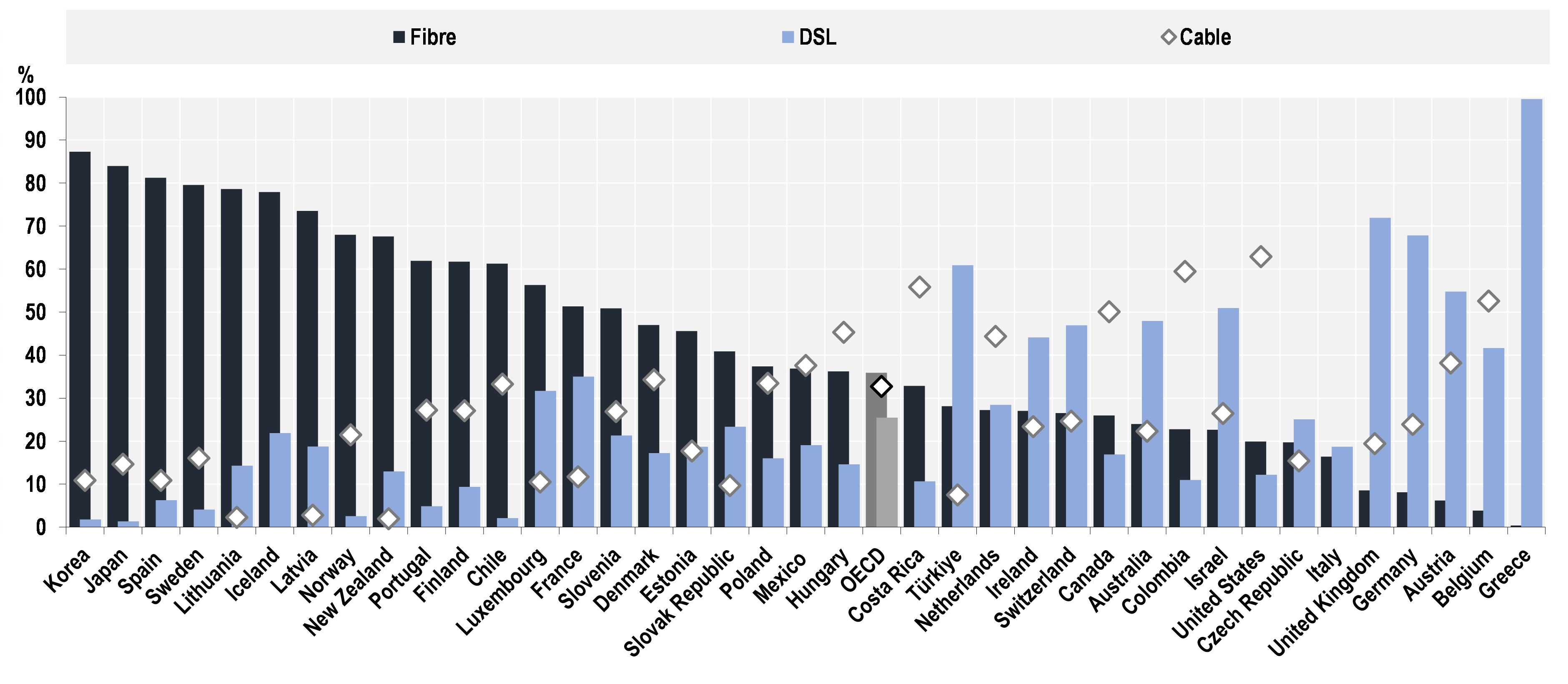
High-speed fibre is now the primary fixed broadband technology in 19 out of 38 OECD countries, according to the latest data. Among these countries, 15 have a share of fibre subscriptions of over 50%.

The latest update of the OECD Broadband Portal shows a 12.3% rise in fibre broadband subscriptions across OECD countries between June 2021 and June 2022, a slightly slower growth rate than the previous 12 months. The need to bolster remote working capacity has remained even as many workers physically returned to the office in 2022, driving demand for fibre connections that provide fast upload and download speeds. Overall, fibre now accounts for 36% of fixed broadband subscriptions in the 38 OECD member countries, up from 22% five years ago.

Korea, Japan and Spain have the highest fibre penetration rates in the OECD at 87%, 84% and 81%, respectively, being among the seven countries with a fibre share of total fixed broadband subscriptions of 70% or above. The highest fibre growth rates in Latin America were in Costa Rica, Chile and Colombia (51%, 35% and 32%, respectively), while in Europe they were Belgium, the United Kingdom and Ireland (87%, 47% and 40%, respectively).

The latest update of the Broadband Portal features 5G subscriptions for the first time, with 14 OECD countries now able to show 5G data as part of their overall mobile broadband data. Overall, of all 38 OECD countries, 5G services are available in 36, with the number of 5G subscriptions representing 17% of mobile broadband subscriptions (in countries with available data). Denmark (41%, 3.5 million subscriptions), Korea (28.5%, 24.6m) and Japan (21%, 51.5m) have seen the highest take-up. Mobile broadband continued to grow overall, with a 6% increase in subscriptions in the year to June 2022.

Cable grew by a more modest 2% in the year to June 2022 and is now declining in 18 countries. It remains the leading fixed broadband technology in eight OECD countries, and is dominant in North and South America, with subscriptions in the United States, Colombia and Costa Rica accounting for 63%, 59% and 56% of the total, respectively (although in Chile fibre has overtaken cable). In Europe, cable remains popular in Belgium, Hungary and the Netherlands, with 53%, 45% and 44%, respectively.

DSL subscriptions fell by 8.5% over the same period, with several OECD countries showing sharp declines. While DSL remains the main broadband technology in several countries, some saw sharp declines in subscriptions, notably Norway (-64%), Chile (-49%) and Sweden (-41%).

Fibre, DSL and cable in total fixed broadband subscriptions, June 2022

Overall, fixed broadband subscriptions in OECD countries totalled 476 million in June 2022, up from 463 million a year earlier, with an average of 34.7 subscriptions per 100 inhabitants. Mobile broadband subscriptions totalled 1.76 billion in June 2022, up from 1.66 billion a year earlier, with an average of 128 subscriptions per 100 inhabitants.

Download broadband data, charts, and penetration maps by country at http://oe.cd/broadband.

Fibre overtakes cable as the primary fixed broadband technology in OECD countries

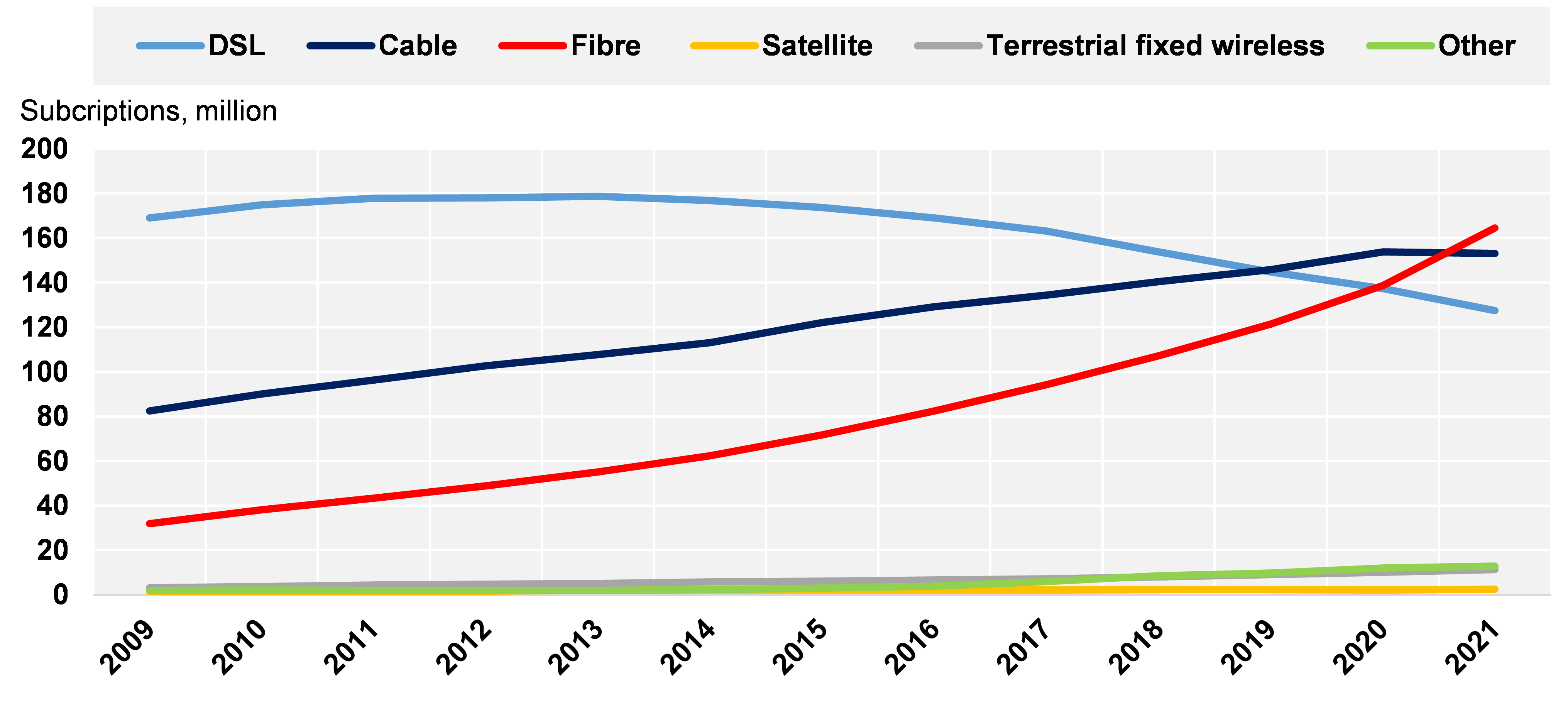
High-speed fibre internet has for the first time overtaken cable to become the primary fixed broadband technology across the OECD’s 38 member countries with 34.9% of fixed broadband subscriptions, according to the latest data.

The latest update of the OECD broadband portal shows that fibre subscriptions increased by 18.6% over the year to December 2021 to move ahead of cable, now at 32.4% of fixed broadband subscriptions, and DSL at 27% and declining. This is good news for the delivery of data-intense services and applications, given the symmetrical capacity that fibre offers. The biggest growth was in Costa Rica, Israel, Greece and Belgium which all increased fibre connections by more than 80% in 2021. The share of fibre in total broadband is now at 50% or above in 13 OECD countries, standing above 50% in Chile, Finland, Luxembourg, New Zealand, Norway, and Portugal, and above 70% in Iceland, Japan, Korea, Latvia, Lithuania, Spain and Sweden.

Fixed broadband subscriptions by technology 2009-2021

Download the data in Excel

Fixed broadband subscriptions continue to grow in almost all OECD countries, increasing by 3.9% across the OECD area in 2021 to total 472 million, up from 454 million in December 2020, to average 34.4 subscriptions per 100 inhabitants in the OECD. Switzerland led the pack with a penetration rate of 48.4 subscriptions per 100 people, followed by France (46%), Norway (45%), and Denmark (45%).

Mobile data usage per subscription rose by 15% in 2021, less than in 2020, but still making a rise of 79% over the three years to end-2021. The amount of data consumed averages 8.4 GB per OECD subscription per month but varies greatly by country. Finland leads the way with 36.7 GB per month per subscription, followed by Latvia (29.7 GB) and Austria (26.4 GB) while monthly averages in Mexico and the Slovak Republic are just below 4 GB.

Despite the very high penetration of mobile broadband subscriptions, 2021 still saw significant growth of 5.5%. Mobile broadband penetration is highest in Japan, Estonia, the United States and Finland, with subscriptions per 100 inhabitants at 191%, 180%, 169% and 157%, respectively.

Iceland is by far the leader in machine-to-machine (M2M) communications with 317 M2M SIM cards per 100 inhabitants. The high number is driven by Vodafone Iceland’s provision of M2M subscriptions to help international pharmaceutical companies distribute COVID-19 vaccines. Sweden, Austria, Norway, and Germany also rank highly in terms of M2M SIM cards per head. Sweden’s 191 M2M SIM cards per 100 inhabitants is boosted by the use of these SIM cards in other countries by a Swedish operator. Overall, M2M/integrated mobile cellular subscriptions have increased by more than 16% (58 million new subscriptions) over the past year in the countries for which data were available.

Download broadband data, charts and penetration maps by country at http://oe.cd/broadband

High-speed fibre internet continues its strong growth in OECD countries as DSL declines

High-speed fibre subscriptions grew by 15% across OECD countries from June 2020 to June 2021, as living and working under Covid-19 restrictions continued to drive demand for high-quality internet connections with the rapid upload and download speeds that fibre offers.

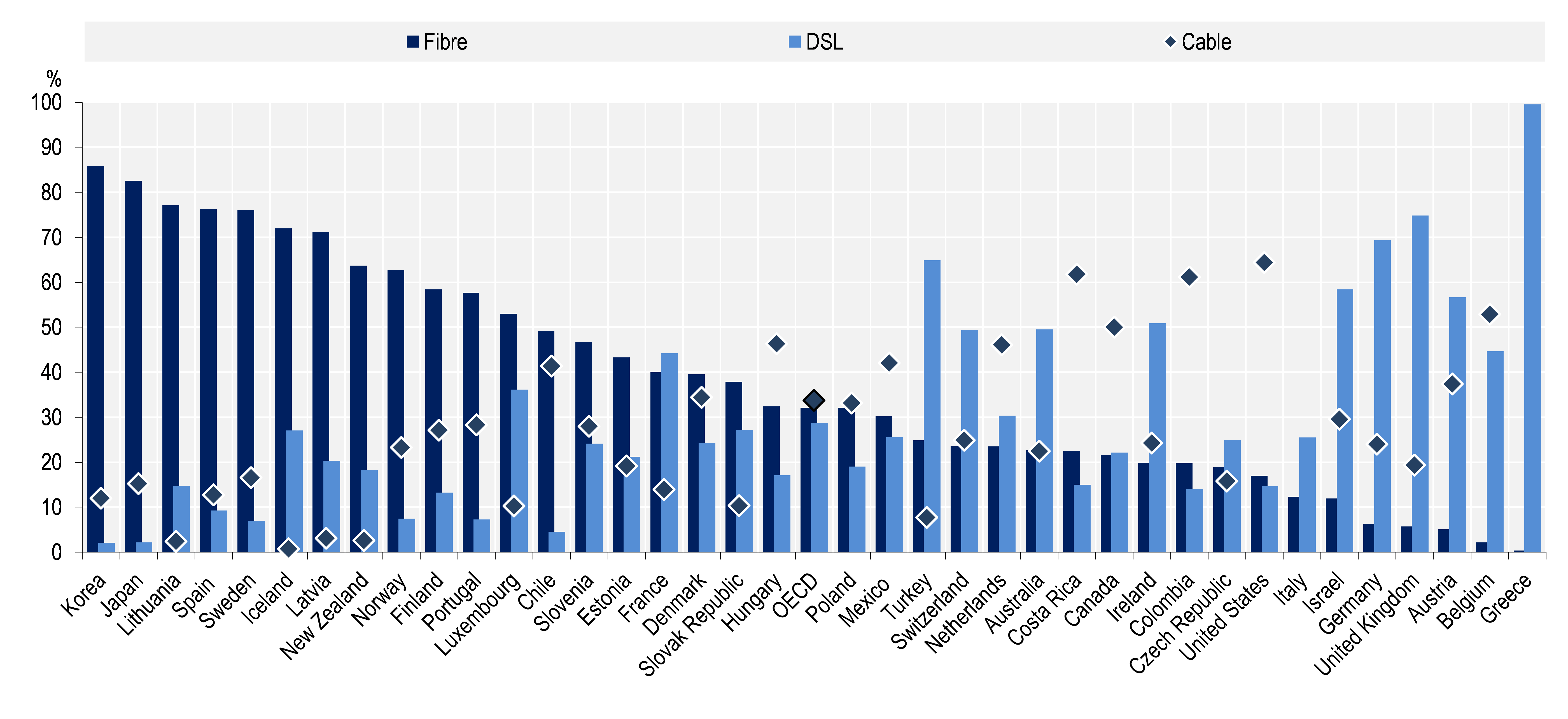
The latest update to the OECD’s broadband portal shows fibre now makes up 32% of fixed broadband subscriptions across the OECD’s 38 member countries, up from 12% a decade ago, and is by far the fastest-growing broadband technology, outpacing a 4.5% rise in overall fixed broadband subscriptions. While countries use different technology mixes, 23 OECD countries have now a higher share of fibre than copper-wire DSL in their total fixed broadband connections, up from 20 countries a year ago.

Cable showed more modest growth of 4% in the year to June 2021, and is now declining in 15 countries, yet it remains the main fixed broadband technology for nine OECD countries. DSL subscriptions declined by 6% over the same period, with several OECD countries showing sharp declines.


Fibre, DSL and cable subscriptions in total fixed broadband, June 2021

Latin American OECD countries saw significant increases in fibre with growth rates of 74% for Costa Rica, 71% for Chile, 43% for Colombia and 26% for Mexico. Other countries with impressive growth in fibre connections include Israel with 76%, Ireland with 54% and Italy with 53%. Seven countries now have a fibre share of above 70% of their fixed broadband subscriptions: Korea with 86%, Japan with 83%, Lithuania with 77%, Spain with 76%, Sweden with 76%, Iceland with 72% and Latvia with 71%.

Cable remains dominant in North and South America, accounting for 64% of subscriptions in the United States, 62% in Costa Rica, 61% in Colombia, 50% in Canada, 42% in Mexico and 41.4% in Chile, where fibre has overtaken it. In Europe cable is the dominant technology in Belgium (53%), Hungary (46.4%), and The Netherlands (46%).

DSL connections, meanwhile, saw sharp declines of over 30% in Chile (-37%), New Zealand (-32%), Norway (-40%), Spain (-32%), and Sweden (-31%).  Some operators in OECD countries are in the process of shutting down copper connections altogether, for instance in France, Japan, Estonia, Finland, Sweden and Spain.

Mobile broadband continued its inexorable growth with a 6.3% increase in subscriptions in the year to June 2021, a higher rate of growth than in the two previous periods (3.6% in June 2019-June 2020 and 5.8% in June 2018-June 2019.) In contrast, the number of data-only subscriptions declined in 17 out of 38 countries and this category experienced a 0.4% drop in subscriptions. This could be due to greater use of fixed networks at home during Covid-19, which tend to offer a better connection quality for work, education, and leisure.

M2M SIM cards have grown by an impressive 16%, with Sweden, Austria, Iceland and the Netherlands dominating the ranking, having 175.6, 82.5, 82.3 and 50.3 M2M cards respectively per 100 inhabitants.

Overall, fixed broadband subscriptions in OECD countries totalled 462.5 million as of June 2021, up from 443 million a year earlier, to average 33.8 subscriptions per 100 inhabitants. Mobile broadband subscriptions totalled 1.67 billion as of June 2021, up from 1.57 billion a year earlier, and averaged 122 subscriptions per 100 inhabitants.

Download broadband data, charts and penetration maps by country at http://oe.cd/broadband.