High-speed fibre internet continues its strong growth in OECD countries as DSL declines

High-speed fibre subscriptions grew by 15% across OECD countries from June 2020 to June 2021, as living and working under Covid-19 restrictions continued to drive demand for high-quality internet connections with the rapid upload and download speeds that fibre offers.

The latest update to the OECD’s broadband portal shows fibre now makes up 32% of fixed broadband subscriptions across the OECD’s 38 member countries, up from 12% a decade ago, and is by far the fastest-growing broadband technology, outpacing a 4.5% rise in overall fixed broadband subscriptions. While countries use different technology mixes, 23 OECD countries have now a higher share of fibre than copper-wire DSL in their total fixed broadband connections, up from 20 countries a year ago.

Cable showed more modest growth of 4% in the year to June 2021, and is now declining in 15 countries, yet it remains the main fixed broadband technology for nine OECD countries. DSL subscriptions declined by 6% over the same period, with several OECD countries showing sharp declines.


Fibre, DSL and cable subscriptions in total fixed broadband, June 2021
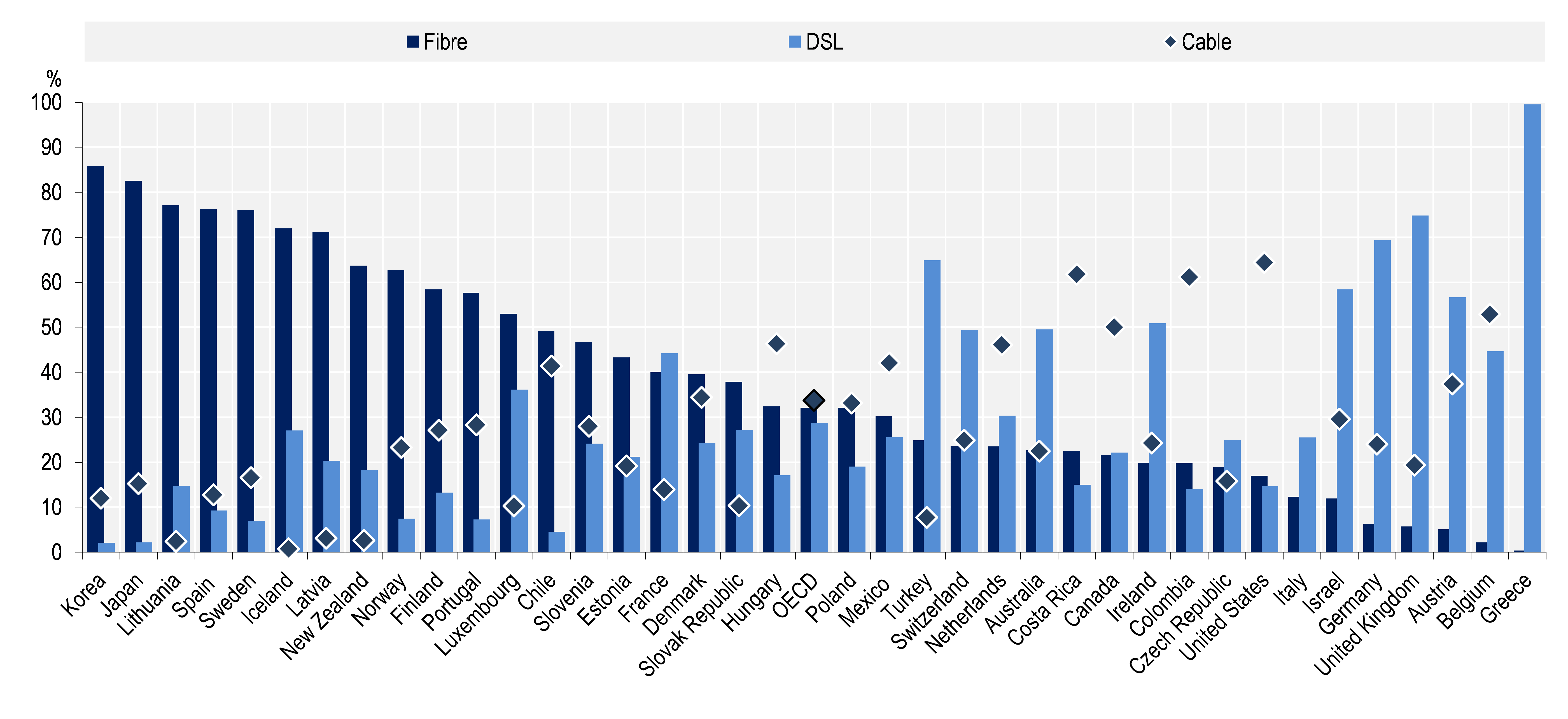
Latin American OECD countries saw significant increases in fibre with growth rates of 74% for Costa Rica, 71% for Chile, 43% for Colombia and 26% for Mexico. Other countries with impressive growth in fibre connections include Israel with 76%, Ireland with 54% and Italy with 53%. Seven countries now have a fibre share of above 70% of their fixed broadband subscriptions: Korea with 86%, Japan with 83%, Lithuania with 77%, Spain with 76%, Sweden with 76%, Iceland with 72% and Latvia with 71%.

Cable remains dominant in North and South America, accounting for 64% of subscriptions in the United States, 62% in Costa Rica, 61% in Colombia, 50% in Canada, 42% in Mexico and 41.4% in Chile, where fibre has overtaken it. In Europe cable is the dominant technology in Belgium (53%), Hungary (46.4%), and The Netherlands (46%).

DSL connections, meanwhile, saw sharp declines of over 30% in Chile (-37%), New Zealand (-32%), Norway (-40%), Spain (-32%), and Sweden (-31%).  Some operators in OECD countries are in the process of shutting down copper connections altogether, for instance in France, Japan, Estonia, Finland, Sweden and Spain.

Mobile broadband continued its inexorable growth with a 6.3% increase in subscriptions in the year to June 2021, a higher rate of growth than in the two previous periods (3.6% in June 2019-June 2020 and 5.8% in June 2018-June 2019.) In contrast, the number of data-only subscriptions declined in 17 out of 38 countries and this category experienced a 0.4% drop in subscriptions. This could be due to greater use of fixed networks at home during Covid-19, which tend to offer a better connection quality for work, education, and leisure.

M2M SIM cards have grown by an impressive 16%, with Sweden, Austria, Iceland and the Netherlands dominating the ranking, having 175.6, 82.5, 82.3 and 50.3 M2M cards respectively per 100 inhabitants.

Overall, fixed broadband subscriptions in OECD countries totalled 462.5 million as of June 2021, up from 443 million a year earlier, to average 33.8 subscriptions per 100 inhabitants. Mobile broadband subscriptions totalled 1.67 billion as of June 2021, up from 1.57 billion a year earlier, and averaged 122 subscriptions per 100 inhabitants.

Download broadband data, charts and penetration maps by country at http://oe.cd/broadband.

Cable vs DSL Modem: Which One Is Better?

The use of the internet has now become more widespread than ever. People worldwide are now on the internet doing various things, including learning, buying and selling, and having fun. If trying to find an internet connection for your home or office, you will face two internet options – the cable and the DSL modem connection. While both of them are widely used, it’s crucial knowing their differences and which one is better for your needs. Both will offer you faster internet signals, faster speeds, and reliability. It is crucial to read this article to the end to understand their differences. Let’s jump right in. 


Differences between the DSL modem and Cable Internet 

Digital Subscriber Line (DSL) internet uses your local telephone line (the insulated copper wires) to connect your office or home with the internet. It’s the same wires that transfer data to and from your location. There are two types of DSL connections which include symmetric and asymmetric connections. Symmetric connections will offer you equal upload and download transfer speeds, with the asymmetric connection offering higher download speeds than the upload speeds.  

Unlike cable, DSL provides you with an uninterrupted, dedicated connection to your premises which can’t get shared with anyone else. Furthermore, the DSL internet connection is always on. You can be on the phone and browsing the internet without interrupting any of the two services.  

In setting up the DSL connection, you will require a DSM modem that connects the telephone line to your PC and a router, which transmits data from the DSL modem to your computer. You will also need a line splitter that creates two connections – one for your PC and another for your telephone. The setup mostly depends on your subscription and usage. 

The cable internet doesn’t use telephone lines. It gets transferred through unique lines, the coaxial cables, from the supplier to your home or office. With this internet connection, you will need a cable modem that gets fixed to the coaxial cable. The modem converts the internet signal into data which gets interpreted by your internet devices. You can share cable internet with other family members or neighbours. However, you have to understand its usage limits to avoid lag time and low performance. 

Cable Internet Vs. DSL Modem: Speed, availability, and reliability


Cable and DSL internet are both used in businesses in both urban and rural areas. They are provided in the form of subscription packages, where you get supplied depending on the package you choose over a certain period – mostly monthly. 

A DSL modem is a bit faster as compared to cable internet. However, its speed depends on the internet’s availability in your location. With it getting offered on a dedicated phone line, it provides a reliable and high-quality internet performance. Its download speeds can range from 1 to 400 Mbps, while its upload speeds can vary from 384 kbps to the highest, 4 Mbps.

Cable internet is a bit faster and reliable as compared to the DSL modem. However, since it’s a shared internet, its performance can vary depending on the number of users. It tends to get slow during peak hours. The cable download speeds are from 25 Mbps to 1gbps, while its upload speeds can vary from 5 to 50 Mbps. 

Cost variance

There is no massive difference in cost between a DSL modem and a cable internet. The internet providers offer different packages, which you can choose from depending on your internet usage. The higher the usage, the more you will pay and vice versa. Your broadband internet pricing depends on several things. These include your needs, the subscription package, the terms of the agreement, and your location. It tends to cost high when far away from a town center. Some providers also offer different upgrades and add-ons, depending on your preference, which increases the supply price.

DSL Internet and Cable Internet: Which one is right for you? 

The DSL internet best fits individuals who use their internet mostly for streaming services, shopping online, and general browsing. It is best for a household with less than three individuals or devices and will need a capped internet price. 

The cable internet is suitable for heavy internet users who have multiple streaming devices as it is best for those who do gaming and cloud-backups and individuals who won’t mind paying more for their internet. It is a high-performance internet for all types of internet consumers and offers high-speed plans that will fit every individual needs. 

After understanding these differences, it’s time to choose a reliable internet provider for your home or business. It’s crucial to choose a reliable internet provider to avoid connection inconveniences. Whether you choose the DSL or cable internet, the service provider will send their technician to access your premises, do the installation and ensure everything works to perfection.