Ookla partners with Dublin City Council to tackle telecoms deficits in the city

Today, Ookla, a global leader in connectivity intelligence, announces its partnership with Dublin City Council and the City Telecoms Association to identify and tackle telecoms deficits in Dublin. This first-of-its-kind initiative, fueled by Ookla’s Speedtest Insights®, offers a practical blueprint for l cities across Europe to drive digital inclusion and optimise network outcomes through actionable, data-driven insights.
The partnership demonstrates how a data-driven approach can enhance connectivity outcomes in a tangible way, empowering cities to better serve citizens. For the first time, the city is addressing connectivity gaps through targeted policy interventions, and fostering collaborative efforts with operators to attract investments that were previously hindered by site acquisition challenges.
You can find the full partnership case study here with more information about the five high-impact use cases created by Dublin City Council using Ookla’s network intelligence data.
Key points from the study:
  • Telecoms strategy and digital inclusion:  A proactive data-driven telecom strategy aimed at bridging digital divides, with significant analysis of how socio-economic factors affect connectivity outcomes, especially in areas with high social deprivation.
  • Identification of connectivity gaps: Ookla’s real-world data has enabled DCC to pinpoint key areas in Dublin with significant connectivity issues, influencing policy and planning to prioritise interventions where they are most needed.
  • Innovative use of city assets: Dublin’s approach to leveraging city-owned assets for telecom infrastructure, including facilitating multi-operator site access, represents a strategic move to optimise asset use and reduce urban clutter, aligned with EU regulatory goals​.
  • Transparency and public engagement: The Council has launched a public educational initiative on telecom infrastructure, including visualisations of before-and-after network improvements from new site deployments, to engage citizens and increase acceptance of new infrastructure.
  • Comparative benchmarking in Europe: Through Ookla’s data, Dublin has gained insights into its telecom performance relative to other European cities, highlighting areas of competitive strength in 5G availability and identifying room for improvement in 4G speeds​.
Key data and methodology:
  • The collaboration saw Ookla collect Speedtest® network data across the city over two 12-month periods (June 2022-June 2023 and June 2023-June 2024) with a sample size in the tens of millions; creating the most comprehensive analysis of mobile network performance ever conducted at the city level in Ireland.
  • Leveraging Ookla’s Speedtest® Insights platform, DCC were able to integrate other data sources, such as internal city asset registries, mobile site location maps from Ireland’s telecoms regulator ComReg, and social deprivation data from Pobal.
  • Geospatial analysis created a localised tile-based grid across the entire city to categorise mobile network performance at different times of the day. Performance was evaluated against two metrics; signal strength and download speed. Each location tile was categorised as unacceptable if it had less than 11 dBm signal strength and 5 Mbps download speed. Anything above 11 dBM and 5 Mbps was categorised as ‘acceptable’.

Dublin City Council Dublin Winter Lights announces the launch of a Video Mapping Competition

Dublin City Council Dublin Winter Lights is delighted to announce the launch of a Video Mapping competition for NCAD students in partnership with The Embassy of France in Ireland. Launched as part of the Digital Arts – Créativité & Innovation Tour in Ireland a workshop was hosted in NCAD and led by world-leading French digital artist Maxime Touroute, the competition aims to develop the medium of Video Mapping in Ireland.

Dublin City Council Dublin Winter Lights, in association with The Embassy of France in Ireland and NCAD will present a showcase of Video Mapping on Newcomen Bank, Dublin. All student competition entries will be projected onto the facade of one of Dublin’s finest Georgian buildings, Newcomen Bank, as part of the annual Dublin City Council Dublin Winter Lights festival in December. This will be a great opportunity for members of the public to see an array of video mapping artworks by emerging artists.

The prize for the winning entry is sponsored by The Embassy of France in Ireland. The winning entrant(s) will attend the IBSIC Video Mapping Conference and associated Video Mapping Festival in Lille France.

The partnership between Dublin City Council Dublin Winter Lights and The Embassy of France in Ireland fosters creative innovation and develops connections in the cultural and creative industries between Ireland and France.

Dublin Portal expands to include 2 cities in Poland and Lithuania

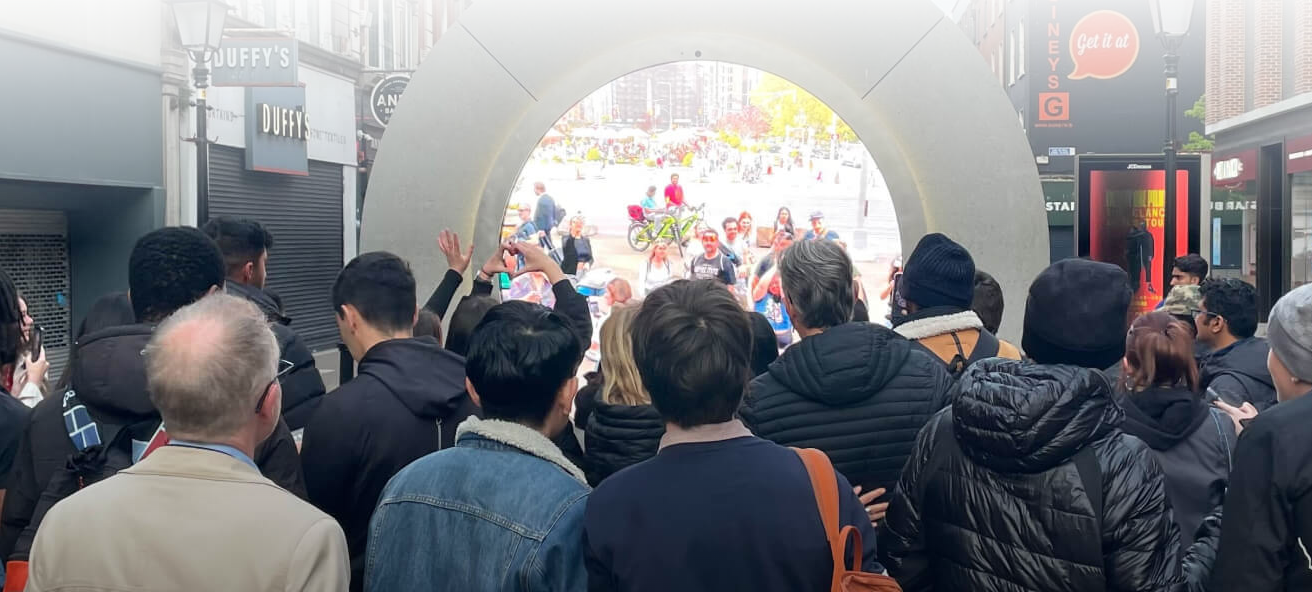
Dublin City Council is delighted to announce that 2 extra cities have been added to the Portal.

So now as well as connecting with New York, people on North Earl St will be able to see Vilnius in Lithuania and Lublin in Poland.

The livestreams will rotate every 180 seconds, beginning from today and forming a global network.

“The Portal in Dublin has attracted over 340,000 visitors since its launch in May and has brought a new lease of life to North Earl Street,” said the Lord Mayor of Dublin, James Geoghegan. “We are delighted to see the network of cities expand to Vilnius and Lublin and look forward to seeing more people enjoy the Portals experience.”

The Vilnius Portal is positioned adjacent to the city’s central station, and the Lublin Portal is located on the central city square, Litewski Square. “We are delighted today to welcome Dublin and New York – the next cities to join this unique project. We are excited that our Portal is growing in reach and popularity, opening up unlimited opportunities for communication and collaboration on an international scale. Thanks to the installation, we can now peek into New York’s Manhattan and Dublin’s city centre, share culture, experiences and initiate new projects together” said Beata Stepaniuk-Kuśmierzak, Deputy Mayor of the City of Lublin for Culture, Sport and Participation.

Having been at the centre of global media attention, Portals have emerged as iconic landmarks, generating billions of online impressions and attracting an average of 25,000 weekly visitors onsite in Dublin. On the Flatiron South Plaza in New York City, foot traffic surged by 47% over the 2023 monthly average.

Previously connected in pairs (NYC to Dublin, and Vilnius to Lublin) the sculptures have fostered diverse interactions across the cities, including vibrant dance competitions, cultural performances and successful marriage proposals. This next chapter of the Portals journey realizes the original mission of the project by evolving from two-city connections to a first-of-its-kind, global artwork that invites people from multiple countries to meet in a spirit of unity.

“We can discover how similar we all are through the use of portals, which connect us to a shared network that brings people from different places and cultures closer together. I hope that this idea, which originated in Lithuania, will continue to grow and connect the entire world, allowing people to better understand each other.” said Aušrinė Armonaitė, Minister of the Economy and Innovation of Lithuania

We are thrilled to finally connect all four Portal sculptures together,” said Benediktas Gylys, founder and artist of portals.org. “The Portals mission is about building multiple Portals, which together form a global entity – a bridge to a united planet that invites people of distant cultures to meet above borders, differences and narratives. It took us eight years to arrive at this special day and we are grateful for the consistent support from our partners in Dublin, New York City, Vilnius, and Lublin. The current four Portals form the foundation of a network that will expand later this year, bringing Portals to even more countries around planet Earth.” 

Visitors to the Portals will be able to meet each other in real time across four different time zones and engage in this global artwork. The network rotation is active daily from 1pm to 8pm in Dublin/ 8am to 3pm in NYC/ 2pm to 9pm in Lublin / 3pm to 10pm in Vilnius. More Portal locations are being added to the network later this year.

Galway County Council digitally maps the heritage of over 25,000 memorials

Esri Ireland, the market leader in geographic information systems (GIS), today announces that Galway County Council has digitally mapped over 25,000 memorials, monuments, and gravestones using Esri’s ArcGIS system. As part of a community-focused project across the county of Galway, Esri’s technology is being used to create a fully digitised process for capturing information about graveyard memorials and making it publicly accessible online.

Throughout Galway, there are 235 council-owned graveyards with ancient monuments and gravestones that provide invaluable insight into family ancestry and social history. Previously, community groups in Galway have endeavoured to capture this culturally significant information, using pen and paper to manually note memorial inscriptions.

Galway County Council’s interactive map, accessed through the Graveyard Memorial Search App, enables volunteers and heritage professionals to view and capture data and images in real-time on their mobile devices. It provides aerial photography of each graveyard, allowing users to zoom into pictorial maps of graveyards on their devices, and accurately identify each gravestone and record data pertaining to it. It also allows citizens to search for burial records and ancestors’ graves, and many graveyards can be explored in 3D, giving people an immersive, realistic experience of visiting family memorials.

The online map provides a streamlined, cloud-based process for collecting, validating, managing and sharing memorial data. It has made the process ten times faster and delivers more accurate and consistent data, which will help to preserve Galway’s graveyard heritage for future generations.

This is leading to increased community engagement, and more than 50 local groups are now using the solution. It is also being used by historians, archaeologists, genealogists and health researchers, as well as schools.

Already, data on over 35 graveyards is available via the app, providing citizens with easy, online access to ancestry information. With over 30 further graveyard surveys planned or in progress, Galway County Council, with support from the Heritage Council, is rapidly expanding the amount of information available via the app. The technology can also be replicated by other county councils and used by all kinds of community groups going forward.

Barry Doyle, GIS Manager, Galway County Council, said: “Simplicity is key to all of this. Everything is done in one efficient, seamless process where the data is stored and accessed centrally in the cloud. With this ArcGIS process we are enabling community groups to achieve their heritage objectives.

Marie Mannion, Heritage Officer, Galway County Council, said: “Digitising Galway’s graveyard heritage has been a powerful way to enable people to learn about the local and national heritage that can be found in graveyards. People can now search for and find photographs of their family’s memorials online and form a stronger connection with their past. It’s an incredible resource for everyone.”

Jack Ffrench, Account Manager, Esri Ireland, said: “Being able to access local heritage, digitally, for Galway citizens has been a really important project to work on and exemplifies the true power of GIS technology. It is rewarding for us to be able to work with local communities, and bringing this important history to life will ensure that Galway’s past can become part of its present. We are looking forward to continuing to work with Galway County Council and seeing how this use case could be repeated within other councils, as well as a wide variety of community groups, in the future.”

Dublin City Council launches first ever Drone Strategy

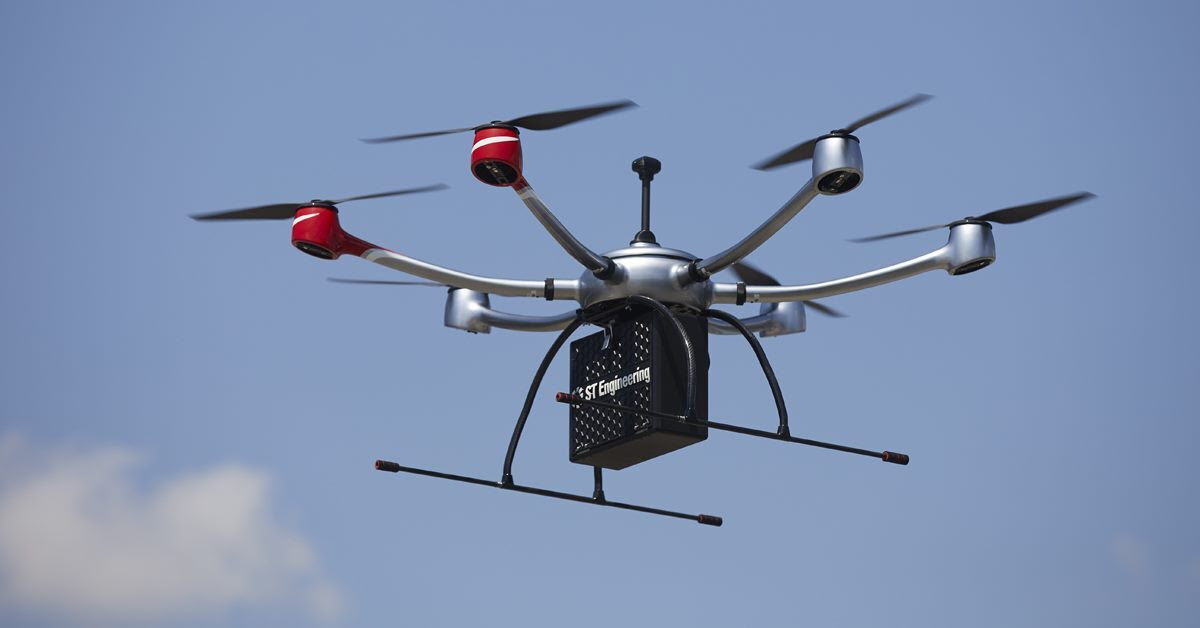
Dublin City Council is delighted to announce that it has today launched its first Drone and Urban Air Mobility Strategy 2024-2029 for the city.

This ambitious and forward-thinking Strategy aims to transform how the city utilises drone technology to enhance public services while understanding their future potential.  Increasingly drones are being applied across a range of city services helping to increase service efficiencies, reduce costs and streamline operations. Areas where drones are being applied within the Council include mapping, dangerous buildings inspections or emergency response.   They are also being used to access to hard-to-reach areas for surveys and environmental monitoring, providing better oversight and management of urban spaces.

Eileen Quinlivan, Assistant Chief Executive and Chair of the DCC Drones High Level Steering Group of Dublin City Council, speaking from the launch at the DCC innovation hub in the CHQ building said:

“This strategy marks a significant milestone for Dublin City Council. By embracing drone technology, we are not only enhancing our service delivery but also paving the way for a smarter, more sustainable city. Drones will revolutionise how we approach various tasks, from emergency response and infrastructure inspections to environmental monitoring and urban planning. The benefits for our staff and citizens are immense, and we are committed to ensuring that Dublin remains at the forefront of this urban innovation.”

A new dedicated Drone Unit is being established in the Council to centralise drone operations and support internal departments to accelerate the adoption of the technology. This unit will build on existing capabilities and resources and maximise efficiencies across the Council. The unit will also play a role in supporting innovation in the drone industry by helping develop new services that benefit citizens and communities as the commercial sector grows.

Jim Gavin, Chief Operations Officer in the Irish Aviation Authority, express his support of the Strategy:

“The Irish Aviation Authority is very supportive of public sector bodies developing drone strategies. We are delighted to support this initiative by Dublin City Council to develop their drone strategy where they will drive innovation and development in the drone sector.

By harnessing the potential of drones, Dublin City Council is taking proactive steps to enhance public safety, improve efficiency, and foster economic growth. We believe that this initiative will pave the way for advancements in urban air mobility, benefiting both the public and the broader aviation industry.”

The development of the Drone and Urban Air Mobility Strategy for Dublin City Council has been led through the Smart City programme which supports the council in future-proofing how new and emerging technologies are applied. By fostering a vibrant drone technology ecosystem, Dublin has the potential to attract new businesses and drive economic growth, positioning itself as a leader in this emerging sector.

Julie Garland, Founder and CEO of Avtrain, who provided expertise and guidance on the Strategy emphasised the transformative potential of drones:

“Drones are revolutionising how we think about urban mobility and public service delivery. Dublin’s strategy is a step towards a future where drone technology can improve our daily lives, enhance safety, and contribute to a more sustainable environment. By integrating drones into various city services, cities can streamline operations, reduce response times in emergencies, and provide more efficient monitoring of infrastructure and environmental conditions.”

Philip Butterworth-Hayes, principal consultant of PMI Media Limited, who advised DCC on the Strategy provided an international perspective:

“Dublin’s approach to integrating drone technology into city services sets a new benchmark globally. The strategy’s focus on safety, efficiency, and public engagement is exemplary and will undoubtedly inspire other cities to follow suit. The efficiency gains from using drones for tasks such as infrastructure inspections, environmental monitoring, and emergency response are significant, leading to cost savings and more effective service delivery. The strategy’s commitment to public engagement means that the community is actively involved and informed, fostering trust and collaboration.”

This strategy has been developed through extensive consultation with internal and external stakeholders, ensuring that it aligns with Dublin’s unique needs and leverages the latest advancements in drone technology. The strategy also supports compliance with evolving European Union regulations and emphasizes public trust, safety, and privacy.

For more information and to discover the benefits of the Dublin City Council Drone and Urban Air Mobility Strategy 2024-2029, please visit: https://smartdublin.ie/dublin-city-drone-strategy  and see Drones

Dublin City Council and OpenAI Announce Partnership to Show the Potential of AI to Support Europe’s Tourism Industry

Dublin City Council and OpenAI are today announcing a partnership that leverages the power of artificial intelligence to support Europe’s tourism industry. This collaboration comes as Dublin proudly accepts the title of European Capital of Smart Tourism for 2024, underscoring the city’s commitment to innovation in tourism.

The partnership aims to set a new standard for smart tourism innovation across Europe, showcasing the potential of AI to enhance the visitor experience. Key initiatives include:

-Co-development of a Dublin Itinerary Planner Proof of Concept “A Day in Dublin”: Leveraging the advanced capabilities of GPT-4, this innovative tool will showcase how bespoke travel recommendations can make Dublin’s rich cultural heritage and vibrant city life more accessible to visitors. This prototype has been designed to show the potential of generative AI to support unique, bespoke experiences for visitors instead of generic to-do lists.

-Supporting Tourism Across Europe: A hands-on workshop will be held for leaders of smart tourism destinations across the EU this September in Dublin. This session will explore how AI can be utilised in various aspects of tourism, including city promotion, destination branding, tourism engagement, and itinerary planning.

Lord Mayor of Dublin Daithi De Roisti: “We are delighted to partner with OpenAI to support Dublin and European cities to realise the potential of AI to transform tourism experiences and offerings. Through our EU Capital of Smart Tourism Designation we also look forward to welcoming city destination leaders to Dublin in September for a unique AI and tourism mentoring workshop to support their innovation programmes

OpenAI’s Vice President of Global Affairs, Anna Makanju:“OpenAI is excited to collaborate with the City of Dublin to support the future of tourism in Europe. Our advanced AI technologies, including GPT-4, have the potential to revolutionize how people explore and experience destinations. We look forward to working together to create innovative solutions that will benefit visitors and cities alike.

The Dublin Itinerary Planner Proof of Concept is a collaboration between Dublin City Council, OpenAi and Data & Design, a local Dublin based data consultancy. It has been designed to show the potential and power of generative AI to create unique and bespoke experiences that move away from mainstream generic ‘things to do’ lists in cities!

Data & Design Founder Rudi O’ Reilly Meehan: “There is little doubt of the transformative power of OpenAI’s technologies such as GPT-4. This collaboration is about creating tools that harness this power to benefit visitors to Dublin – in this case, by providing tailor-made itineraries created using generative AI. I am delighted to be working with Dublin City Council and OpenAI in building this prototype, and the approach we are taking has significant scope for scaling across other cities and experiences.” 

This partnership marks a significant milestone in the integration of AI into the tourism industry, promising to deliver a more engaging and bespoke visitor experience. Dublin and OpenAI are committed to leading the way in smart tourism innovation, inspiring cities across Europe to explore the possibilities.

Dublin city shortlisted for 2024 European Capital of Smart Tourism award

Dublin City Council is delighted to announce that Dublin City has been shortlisted for the 2024 European Capital of Smart Tourism award. It is the second time Dublin has been shortlisted for the designation. Last year Dublin City Council also won the prestigious Tourism Innovation Award in Seville.

The shortlist was announced this morning by the European Commission.

From a pool of 30 candidates spanning 17 countries, the selected finalists for the European Capital of Smart Tourism are in alphabetical order, Bremerhaven (Germany), Cork (Ireland), Dublin (Ireland), Genoa (Italy), Helsingborg (Sweden), and San Sebastián (Spain). 

The European Capital of Smart Tourism recognises best practice and innovative tourism practices in European cities.  Dublin is one of the first European cities to prioritise a specific Smart Tourism programme.  Since 2020, Dublin City Council, Smart Dublin and Dublin City Council Culture Company have been working in partnership on Dublin’s first Smart Tourism Programme, with the aim of making the city a smart tourism destination, using the city’s expertise in technology to deliver a superior tourism experience.

Head of Dublin City’s Tourism Unit, Barry Rogers said:  “This shortlisting is a real recognition of many years of consistent collaboration and work across Dublin City Council, Smart Dublin and Dublin City Council Culture Company. This designation specifically recognises cities who are striving to be more digitally advanced, sustainable, accessible and more equitable for locals.   Dublin being shortlisted amongst these other leading destinations is a welcome benchmark of our own progress to date and provides many more opportunities for innovation and collaboration going forward. We very much look forward to representing Dublin in Brussels in our bid to become the 2024 European Capital of Smart Tourism”

Dublin’s Smart Tourism Initiative is a Dublin City Council programme, made in partnership with Smart Dublin and Dublin City Council Culture Company. The programme is led and governed by the Dublin City Tourism Unit and is underpinned by the Innovation pillar of the new Dublin City Council Tourism Strategy 2023-2028 which states: We recognise the enormous opportunity to blend our expertise in technology, culture and tourism to build a more future facing offer in Dublin. We will be a test-bed for innovation within the tourism industry in Dublin, ultimately creating more and better experiences for visitors.  

The goal of the Smart Tourism programme is to establish Dublin as a world-leading ‘Smart Destination’ through innovation, research and partnerships. The programme is responsible for the development of cutting edge visitor experiences such as the new Dublin Discovery Trails App. Last year Dublin City Council received the Digital and Innovation award at the Tourism Innovation Summit in Seville for its development of the Smart Tourism programme.

You can access a brief profile of each of the shortlisted cities here.

The European Capital of Smart Tourism award will be granted to the city that demonstrates an extraordinary commitment to shaping the future of sustainable and innovative tourism. The award also aims to foster networking and the fortification of destinations while facilitating the exchange of best practices in this field.

Following this stage, the finalists will be invited to present their proposals to a European Jury, tasked with selecting the 2024 European Capital of Smart Tourism. The chosen city will receive extensive support in communication and branding. This includes the creation of a promotional video, installation of a hashtag sculpture for public exhibition in the city, and the implementation of tailored promotional campaigns aimed at boosting visibility at both the EU and global levels, ultimately resulting in an increase in the number of visitors.

The competition welcomed participation from cities within the European Union and non-EU countries that are eligible to the Single Market programme. An impartial panel of experts conducted a thorough evaluation of the applications, and those applicants who achieved the highest cumulative score across all categories successfully advanced.

Paradyn backs up critical data for Donegal County Council

Paradyn, one of Ireland’s leading cybersecurity service providers, is today announcing that it is backing up critical data for Donegal County Council with Vault365, an all-in-one backup, ransomware, and data protection solution.

Donegal County Council needed to effectively back up and secure its Microsoft Office365 data to ensure compliance and eliminate the setup and maintenance of its own hardware, storage, and infrastructure. Paradyn deployed the Vault365 solution which runs in the cloud and backs up information to its own highly secure off-site data centre. The remotely stored data is immutable and cannot be compromised by potential cyberattacks on the organisation’s estate.

Paradyn’s solution is protecting sensitive information for Donegal’s 166,000 citizens. It’s also enhancing the user experience for those who engage with the council’s vital services as public information is backed up, reliable, and up-to-date.

Ongoing monitoring and management by Paradyn of the Office365 estate gives peace of mind to Donegal County Council that its critical assets are protected. The council also has access to a self-service portal, meaning it has full control and visibility of the solution. The solution is flexible and scalable in line with organisational growth in the future.

Paradyn is securely backing up 900 Microsoft Office365 accounts for the council across applications including Teams, SharePoint and OneDrive. As Microsoft only stores data for up to 90 days, the Vault365 solution ensures business continuity and is increasing employee productivity as data can be quickly recovered in the event of an incident. The new solution is based on a cost per user model, which is resulting in significant cost savings for the council.

Sean Dunnion, Project Leader Information Systems at Donegal County Council, said: “With Paradyn’s extensive expertise securing organisations in the public sector and local government, they were the natural fit to support on this next phase of our journey. This Vault365 solution has futureproofed our data protection and backup capabilities, and provides peace of mind that sensitive information is secure.

“Crucially, it’s helping to enhance the services we provide to citizens throughout Donegal as the solution gives us full control of our Office365 estate, while ensuring minimal downtime should an incident occur. Ultimately, the technology is built with growth in mind and will enable us to scale as needed.”

Fergal Meehan, Chief Commercial Officer, Paradyn, said“It’s a common misconception that Microsoft backs up customer data, which is why it’s essential for organisations to proactively protect their critical information. Vault365 eliminates the risk of losing access and control over this data, underpinned by the expert knowledge of our experienced specialists. Hackers will typically target on-site backups and having critical data stored securely in an off-site location provides an extra layer of protection.

“The council deals with citizens’ sensitive information and provides crucial public services to the people of Donegal, and this solution enables the council to meet these needs now and into the future.

Bolt and Dún Laoghaire–Rathdown County Council bring shared electric bike service to region ahead of Car-Free Day on September 22nd

European shared mobility leader Bolt, in partnership with Dun Laoghaire-Rathdown County Council, has officially launched its shared electric bike service across parts of the area today. The occasion was marked by an event attended by Bolt and the council at White Rock beach. The service arrives just in time for European Mobility Week which starts on September 16 and aptly ends with Car-Free Day on September 22.

Though the council area already benefits from an abundance of different transport modes that crucially aren’t the private car, the service from Bolt offers residents and visitors something brand new in a multitude of ways.

To start, it has an affordable €0.18 per minute charge and no unlock fee. Market research often says that the price point of a transport mode determines its utilisation. Since Bolt and DLR CoCo have the common goal of shifting private car use to public and shared transport, especially ahead of Car-Free Day, this is crucial.

Another quality important to consumers, and a differentiator of Bolt’s service, is ease of use. Notably, Bolt’s bicycles have pedal assisted motors. This means they can be used in different ways to push bicycles. For example, riders of Bolt’s e-bikes can scale DLR’s notorious hills or put kilometres behind them (aided by the region’s fantastic cycling infrastructure) without breaking a sweat. This means they can be a genuine alternative to the private car, and connect coastal towns (such as Dalkey, Killiney, Shankill) and Cherrywood with Bray. Additionally, the service provides an important link with Dart and bus services which helps people commute in a sustainable way. The value this can bring can be seen in the almost 3250 people that have cycled more than 38,000 kilometres since the service launched in nearby Bray in late June.

It is not, however, only users of the service that are getting something new. Bolt is a firm believer that transport needs to work for everyone, including pedestrians. Consequently, the firm has a suite of features and smart technologies which ensure the service is used responsibly.

For those with no or little experience of bicycles with pedal assisted motors, there is ‘Beginner Mode’. This limits the top speed of the bicycle to 15 km/h. Once ‘Beginner Mode’ is turned off, the bicycles have a maximum speed of 25 km/h.

The GPS technology packed into the bikes brings a wealth of benefits. For example, in collaboration with the council, Bolt has implemented go-slow zones (where speed is limited to 15 km/h), as well as no-go zones (where the bikes aren’t allowed to be ridden whatsoever).

GPS also brings benefits even when the bikes aren’t being used. Bikes will be stationed in designated mandatory parking locations on public realm and private property (as agreed with the landowners). This means riders will be shown where they can park their bike through the app and physical signage. Not only does this mean the bikes won’t take up space reserved for private bicycles at popular bike racks, Bolt can also see if a parking location is at risk of being overwhelmed and take action. This could be in the form of the local operations team shifting an appropriate amount of bikes to another location, temporarily disallowing bikes being parked in a specific location or discounting trips from a location to ensure the bikes get moved.

The roll-out of the bikes in these areas is a pilot programme and is subject to amendment, pending feedback from all corners of the community. Feedback of all kinds is welcome and can be shared in-app or by emailing Ireland@bolt.eu.

Though the service will operate 24 hours a day, seven days a week, the company will be employing an in-app cognitive reaction test 11pm-5am. This means prospective riders have to prove they are in a fit state to ride a bicycle through their reaction time.

Another way in which the Estonian company offers a unique proposition is the taxi service that can be ordered within the very same app. This means a wide variety of mobility needs can be met within the Bolt app alone. For example, citizens can ride a bicycle to a public transport hub or destination in DLR at the start of the night, and then get home safely by taxi after public transport services have stopped for the night.

Bolt will further support users taking the right mode of transport at the right time and discourage the usage of its bike service whilst under the influence of alcohol by offering a discount for its taxi service to those who fail its cognitive reaction test*. The company will offer this discount during launch week whilst everyone gets familiar with the new service.

Bolt Operations Manager for Rentals in Ireland and Dun Laoghaire-Rathdown resident, John Buckley, said: “We’re absolutely thrilled that our electric bikes will be available to residents and visitors to the southern parts of Dun Laoghaire Rathdown. We offer something completely different – an electric bike service that can get you up that hill, and a taxi service that can get you home safe at night, all in one app. And what fantastic timing, just on the eve of European Mobility Week which encourages everyone who can give up their private car to do so, a cause which is central to our company mission. Providing people with more convenient options make that prospect more likely for many.”