Mothers are leading the way in their children’s use of technology

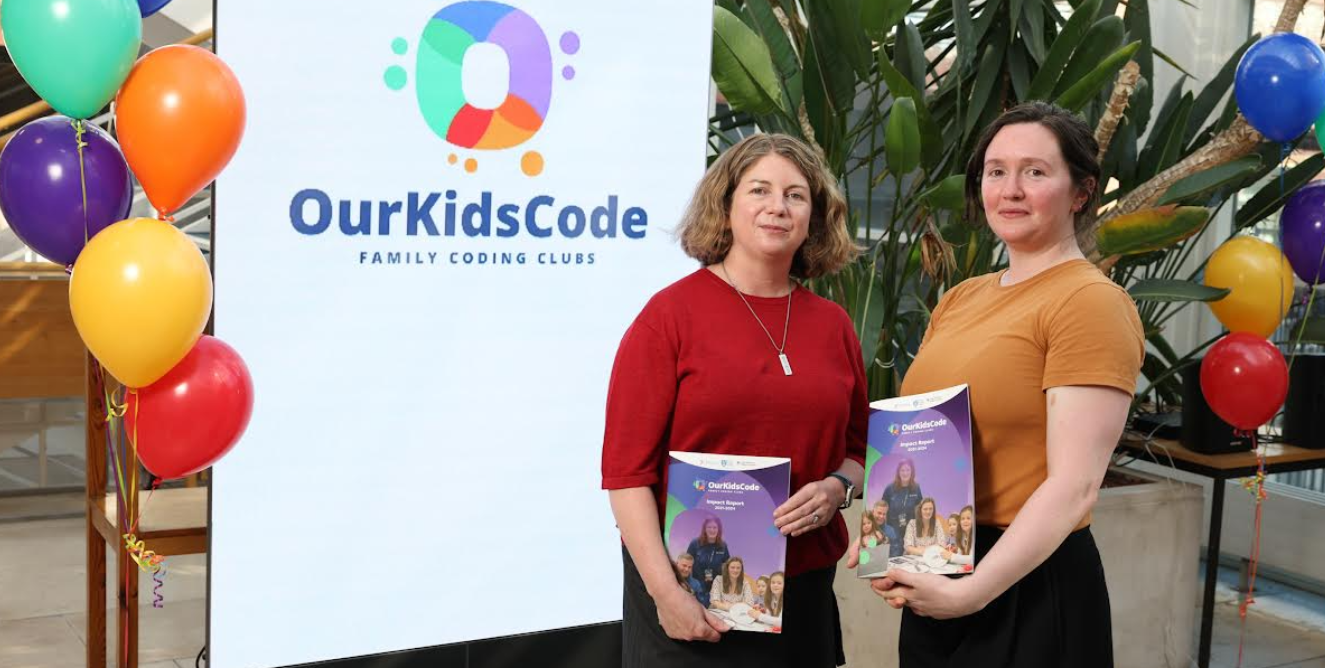
A new report shows how the growing OurKidsCode network of creative coding workshops and clubs for families is enabling parents in communities across Ireland to be more proactive in their children’s use of technology, with mothers comprising 72% of the parents involved.

The OurKidsCode project, based in the School of Computer Science and Statistics in Trinity College Dublin, has built an infrastructure and partnership network with county councils across Ireland, including for leveraging Ireland’s rural grid of broadband connection point community centres, and Microsoft Dream Space, as well as with the National Parents Council.

This network of relationships is successfully enabling OurKidsCode to deliver facilitator-led workshops and a ‘Start a Club’ programme that supports the establishment of parent-led creative coding clubs for families with primary-level children.

The OurKidsCode programme builds parents’ confidence and skills in technology alongside their children at informal, hands-on creative coding workshops. These take place outside of school hours in libraries, primary schools and rural broadband connection point community centres.

Creative coding is the playful use of computer programming to make art, stories, or interactive projects, combining coding, crafting and making. OurKidsCode workshops are appealing to parents who are looking for ways to increase their children’s active creation rather than passive consumption of technology.

OurKidsCode has collaborated with Microsoft Dream Space since 2022 to support young people, families and educators in rural communities through inclusive STEM opportunities. Core to this collaboration are the opportunities given to rural clubs to come together to enter The Dream Space Showcase, a national STEM event that celebrates innovation and creativity found within rural clubs, schools and communities.

OurKidsCode has established fiscal and operational partnerships with county councils across Ireland and has worked closely with an increasing number of county council broadband officers since 2021. In 2024, OurKidsCode began to expand its work with county councils to include partnerships with county libraries.

Facilitated by county councils and through its broadband officers, OurKidsCode offers workshops and provides support to clubs at broadband connection points across the country, which are publicly accessible sites in rural and remote areas that have been provided with a high-speed broadband connection.

Funded by Research Ireland and the Department of Rural and Community Development, OurKidsCode has reached 5,240 parents and children in 111 predominantly rural locations across Ireland. The report shows females (mothers and girls) comprised 55 per cent of participants, with males (fathers and boys) making up 43 per cent, busting the gender stereotype that females are not as interested in computing as males.

OurKidsCode is committed to promoting inclusivity and diversity in STEAM (science, technology, engineering, arts and maths). By partnering with DEIS schools, local development agencies and NGOs, it strives to make workshops that are accessible to all families.

Speaking at the recent launch of OurKidsCode’s Impact Report, OurKidsCode project lead and assistant professor in the School of Computer Science and Statistics at TCD, Dr. Nina Bresnihan, said: “OurKidsCode is committed to increasing opportunities for parental involvement in children’s computing education and contributing to greater diversity, inclusivity and equal access, with a particular focus on rural communities where access to such initiatives is often limited. Getting parents involved in their children’s coding education can have powerful outcomes.

Research in our new report shows how this boosts knowledge and confidence. It also sustains families engaging together in computing activities and promotes computing as a subject choice and future careers in STEAM-related fields. Furthermore, it challenges stereotypes by promoting female participation in computing based on mothers’ interest in their children’s early education. We see mothers who take part in our workshops acting as powerful role models for their daughters, demonstrating that STEAM is a viable and rewarding path.”

Parent and club leader of the OurKidsCode club Rossmore Scratchers, Co Tipperary, Rona Toft, said: “There’s something really special about learning side-by-side with your kids and other local families in a safe, welcoming space. From starting with the OurKidsCode taster programme to running the now award-winning Rossmore Scratchers, in Rossmore, Tipperary, the friendships and fun we’ve found along the way have been the absolute highlight. I watched my kids take a project from a blank screen to something they built themselves ─ figuring out the bugs, problem-solving, and seeing it through. I’ve never been prouder; it’s amazing to see their confidence grow.”

The full OurKidsCode 2021-2024 Impact Report is available to download at www.ourkidscode.ie/impact.

Find out more at www.ourkidscode.ie.

67% of teenage girls lack crucial information about STEM careers, reveals I Wish Report 2023

The I Wish Report 2023, an annual examination of female Transition Year students’ perspectives on STEM careers, has revealed that 67% of teenage girls lack essential information about careers in Science, Technology, Engineering, and Mathematics (STEM). Furthermore, 64% of respondents cited their lack of information on STEM college courses as a considerable barrier to pursuing careers in these fields.

I Wish, the organisation inspiring teenage girls globally towards STEM, asked 2,335 teenage girls about perceived barriers to a career in STEM. The results highlight the power of knowledge, with 41% of students emphasising the need for more career guidance and work-related activities during their school years. Surprisingly, 21% of girls reported never having a career guidance class, despite 97% having access to a guidance counsellor. These findings result in a failure to bring STEM to life for girls and the opportunities to design a better and more inclusive future through STEM.

The ground-breaking research comes as I Wish gears up for its 10th annual STEM Showcase event, taking place on 8 February 2024 at the RDS Dublin. Registration is open at iwish.ie/register, with an estimated 3,000 female students expected to attend. Over 2,000 will receive free rail transport from across the country as part of a national partnership with Iarnród Éireann. Bus Éireann will also be providing free return busses between Heuston Station and the RDS. There will be I Wish watch parties for an international audience post-event.

Gillian Keating, co-founder of I Wish, said on the findings: “These statistics raise questions about the guidance counselling provided in some schools. It’s deeply concerning that 64% of girls lack information about STEM college careers and job opportunities. We must diversify how we present STEM careers and pathways, equipping young women with the knowledge they need.”

In a STEM landscape where only one in four professionals is a woman, the survey respondents revealed well-paid work, the chance to make a meaningful impact, and making discoveries as key values in STEM-related careers. In contrast, their own work-related values prioritised a good work-life balance, a high salary, and the opportunity to travel.

Caroline O’Driscoll, co-founder of I Wish, stated that they have engaged with over 60,000 girls in the past decade and have witnessed substantial positive change. “There has been a notable increase in female enrolment in STEM college courses, with the proportion rising from 29% in 2014 to 36% last year. Nevertheless, while significant progress is evident, there is still room for improvement. We must better appreciate the work-related values held by these girls. A career in STEM arguably embodies these values, but perhaps we are not conveying the story effectively. This is where the I Wish survey plays a crucial role, allowing us to use the data to enhance the way we tell the story and change the story for girls,” she said.

Speaking on the survey launch, An Taoiseach Leo Varadkar said: “The I Wish 2023 report highlights a stark reality – that a significant percentage of our young girls lack crucial information about STEM opportunities. STEM fields are pathways to innovation, progress, and limitless potential. We are committed to ensuring that every young woman in our country has the knowledge and support needed to excel in STEM.

“I commend I Wish’s decade-long effort in empowering young women to pursue STEM careers, and for this annual report which offers invaluable insights.”

I Wish’s aims to provide female STEM role models, address post-graduate gender disparities in STEM careers, improve access to STEM subjects, and enhance focus on STEM-related careers throughout students’ education.

As Space Week Ireland prepares for lift off this October, we look at the Irish Space Connection

Space Week is fast approaching, and Irish stargazers are already planning to celebrate their passion for science by attending many of the out of this world events programmed all around the country from 4th to 10th October. Space Week is funded by Science Foundation Ireland and coordinated by MTU Blackrock Castle Observatory.

The festival, which aims to ignite a passion for space science and inspire the next generation of scientists, engineers, and astronauts, coincides with World Space Week and is the nation’s premier celebration of space exploration and science. Over the week, the public can explore a space-themed festival of events and a captivating series of workshops, lectures, exhibitions, throughout the country.

Rob O’ Sullivan, National Outreach Coordinator for Space Week Ireland says “It’s no surprise that Irish people are so enthusiastic about Space Week as Ireland has a rich, if somewhat underappreciated, history of contributing to the fields of astronomy and astrophysics. Some of these efforts have marked paradigm shifts that greatly advanced their respective fields.”

Let’s meet just a few of these historical heroes as we get ready to celebrate Ireland’s future in space:


Margaret Lindsay Huggins
(1848-1915)

Margaret Lindsay Huggins, along with her husband, William Huggins, contributed to the field of photographic research and astrophotography. Margaret did not receive formal training in astronomy, but instead educated herself using popular science books.

Margaret’s skill with photographic techniques would have proved invaluable to her husband’s research as photography of this type was notoriously difficult at the time.


William Rowan Hamilton
(1805-1865)

Hamilton was a highly respected mathematician from Dublin. While he didn’t consider himself to be a physicist, his work has nonetheless proved invaluable to many fields of physics.

He is most famous for ‘Quaternions’ – a system of four-dimensional numbers. Among other uses, quaternions enabled geometric calculations in three-dimensional space. This kind of mathematics is incredibly useful for studying rotation and helps overcome a problem called ‘Gimbal lock’. Gimbal lock occurs when an object has three rotational axes (Think x, y, and z). If two of the axes become aligned, the object can now only rotate along one axis.

This would have been a particular problem for spacecraft, but thanks to Hamilton’s quaternions, missions such as Apollo 11 were able to overcome this problem.


Ernest Thomas Sinton Walton
 (1903-1995)

Born in Dungarvan, County Waterford, Walton went on to make history with British scientist, John Douglas Cockcroft, by becoming the first person to split the atom.

Walton used high voltages to bombard samples of lithium with fast particles. This process split the lithium atoms, forming lighter helium atoms. According to Walton, these helium atoms resembled “twinkling little stars”.

This also yielded the first experimental confirmation of Einstein’s assertion that E=mc2. The combined mass of the two helium atoms formed by the experiment was less than the mass of the initial lithium atom. The missing mass was released as energy.

This work earned Walton and Cockcroft the 1951 Nobel Prize for Physics.


Annie Scott Dill Maunder
(1868-1947)

Annie Maunder was an accomplished astronomer whose contributions to astronomy were made in spite of an environment of overwhelming gender discrimination.

Annie successfully applied to Girton College, Cambridge, but, due to the sexist restrictions of the time, Annie was not allowed to receive the degree that she had earned.

In 1891, she began working at the Greenwich Royal Observatory, where she would meet her collaborator and future husband, Walter. Following their marriage, Annie had to leave her job, as married women were not permitted to work in the public service at the time. Many of Annie’s contributions to popular journals were made in her husband’s name, to circumvent the oppressive gender norms of the day.

The couple recorded the first evidence of sunspot emergence and migration towards the equator over the course of a solar cycle (about 11 years) and, in 1898, Annie photographed the longest coronal streamer on record up to that point.

Annie also contributed to astronomy outreach by writing a popular science book, ‘The Heavens and Their Story’. Though her husband is listed as a co-author, he acknowledges in the preface that Annie did the majority of the work.


Agnes Mary Clerke
 (1842-1907)

Agnes Mary Clerke, from Skibbereen County Cork, was an astronomer and popular science writer. While Agnes wrote many books, reviews, and articles, her most famous and impactful work was undoubtedly her book ‘A Popular History of Astronomy during the Nineteenth Century’.  Clerke believed that the field of astronomy should be accessible to everyone. She went to far as to say the general public have an “indefeasible right of access” to the subject.

Clerke’s contribution to her field was so profound that, in 2017, the Royal Astronomical Society established the Agnes Clerke Medal for the History of Astronomy or Geophysics. While this is a great accolade, perhaps the most impressive tribute to this great Irish astronomer is the fact that the Clerke crater on the Moon was named in her honour.

We’ve barely scratched the surface of Ireland’s contribution to astronomy and countless other scientific fields. To this day, universities across Ireland continue to study our universe, while Irish scientists and engineers work on ground-breaking space missions with the European Space Agency and beyond.

To this day, universities across Ireland continue to study our universe while Irish scientists and engineers work on ground-breaking space missions with the European Space Agency and beyond. Irelands Space Week celebration runs from October 4th – 10th and it is an ideal time to learn more about Ireland’s deep connection to space. Discover the exciting Space Week programme including events near you online at www.spaceweek.ie