Tyndall Delivers Significant Insights for Ambitious European Space Agency Mission

Tyndall National Institute, based at University College Cork, has wrapped up a multi-year project with ESA, contributing critical expertise to the ambitious Laser Interferometer Space Antenna (LISA) mission.

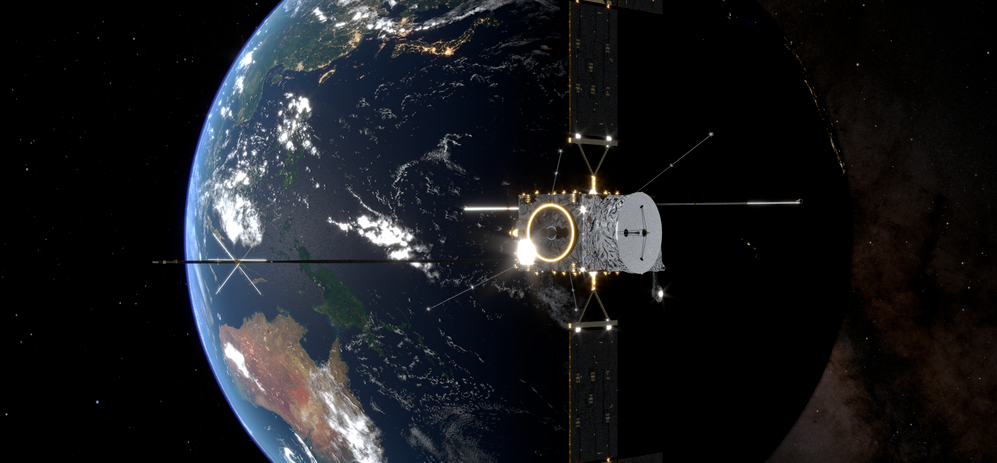
Scheduled for launch in 2035, LISA will be the first observatory of its kind to detect gravitational waves from space, revealing new insights into the most powerful events in the universe, such as pairs of black holes coming together and merging.

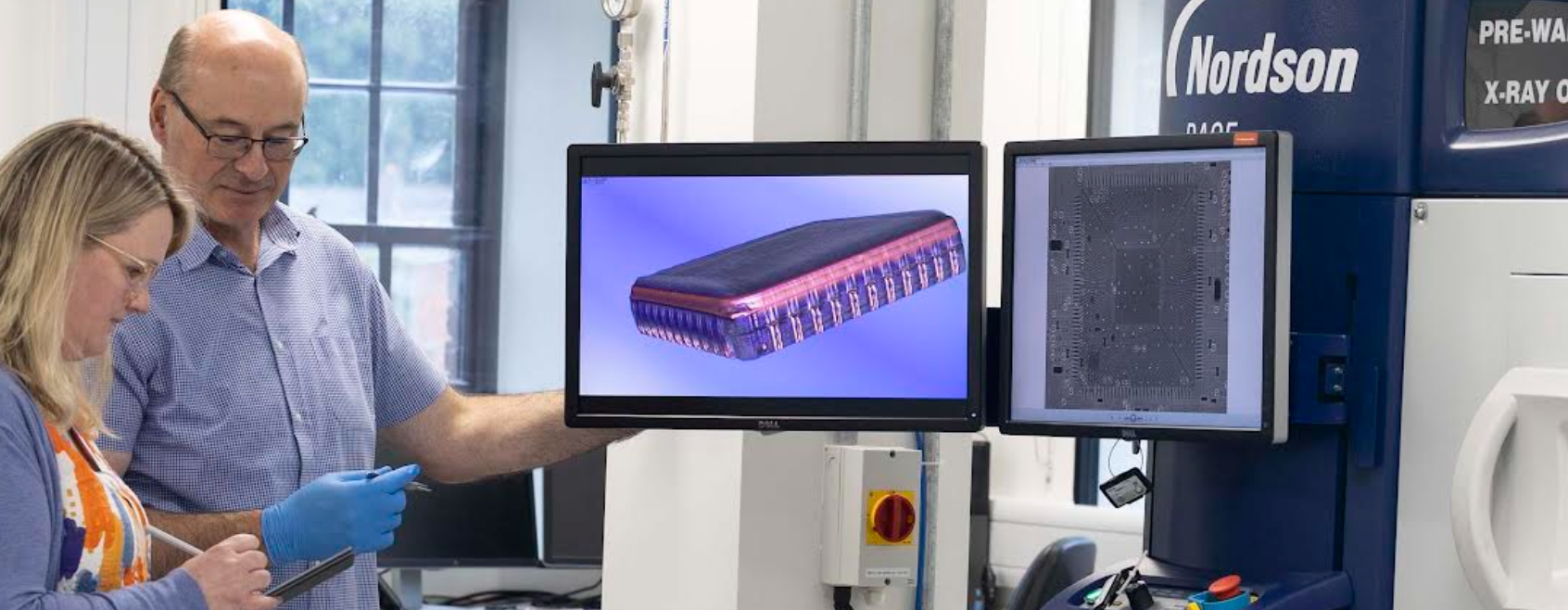
Tyndall’s role focused on evaluating the reliability of commercial photonic components, small but vital parts that will help power LISA’s ultra-precise laser system. These lasers will span millions of kilometres between three spacecraft flying in formation, measuring minuscule changes in distance caused by gravitational waves.

Tyndall conducted long-term reliability testing and detailed construction analysis on a wide range of active and passive photonic devices, including laser diodes, photodiodes, UV LEDs, modulators, switches, isolators, and more. Each component was assessed against ESA’s demanding space standards, with risk levels identified for their potential use in the LISA laser system.

The outcome is a comprehensive dataset that will help ESA make informed decisions about which components to use, ensuring the mission’s laser system performs as intended when deployed.

Finbarr Waldron, Principal Engineer at Tyndall, said: “This project showcases the depth of Tyndall’s expertise in photonics and reliability engineering. Space is a very unforgiving environment, and many commercial photonic components are built using materials that may not be suitable for use in space. Our task was to rigorously test and analyse these components to determine whether or not they could withstand the extreme conditions of launch and long-term operation in space.”

Contec and National Space Centre to progress restoration of iconic 32-metre dish

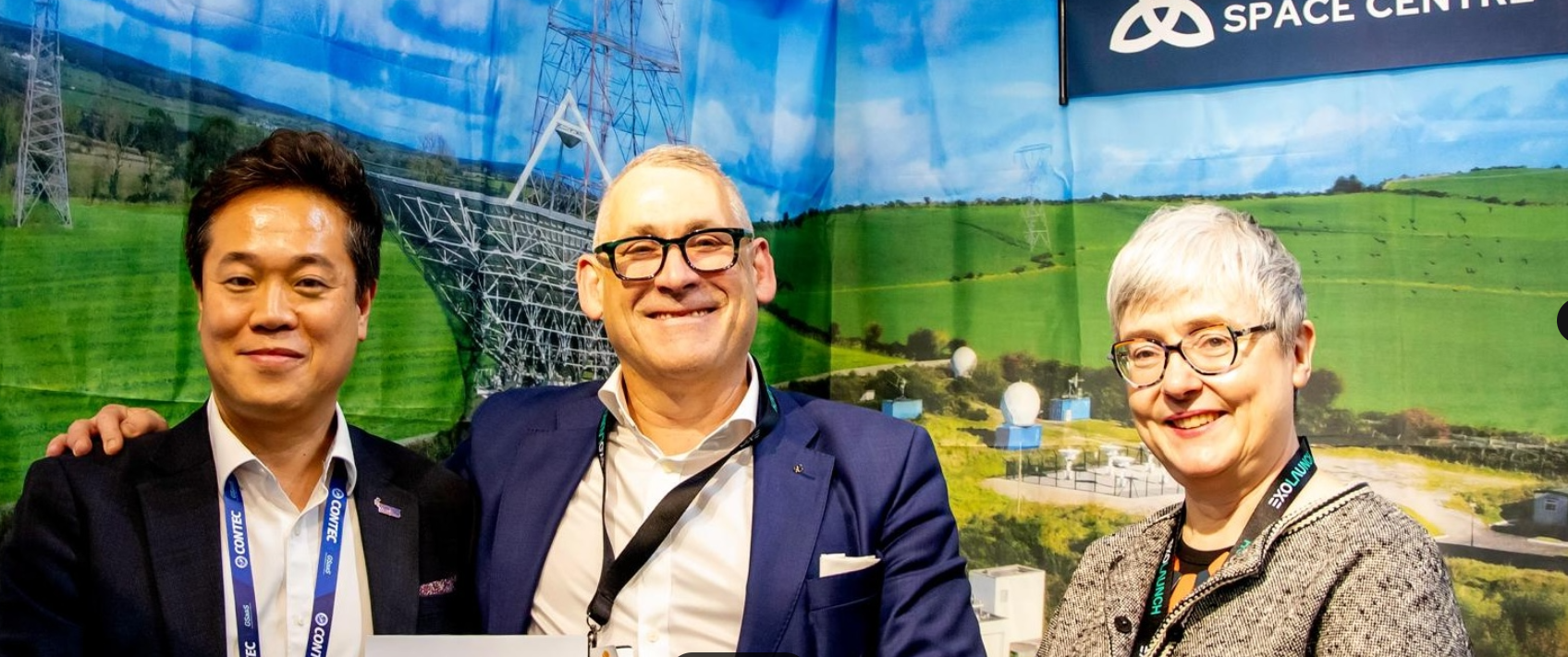
National Space Centre, Cork and Contec Space Group of South Korea, have signed a Memorandum of Understanding (MOU) at the Space Tech Expo Europe 2025 in Bremen, Germany for the refurbishment and return to operation of the iconic 32-metre antenna, The Big Dish, at Elfordstown Earthstation in Cork.

Originally commissioned by Eutelsat in conjunction with Telecom Éireann in 1984, the installation of The Big Dish was for the purpose of hosting transatlantic communications between Europe and North America. It was decommissioned in the 1990’s with the advent of underwater fibre-optic links.

However, a new lease of life is underway for similar large dishes worldwide, which have since been repurposed for deep-space tracking, radio astronomy, and advanced communications. There are fewer than 100 large dishes of this class remaining worldwide and under thirty are estimated to be in active use.  But there are an increasing range of uses for large satellite dishes, along with a demand for the technical capability they can provide.

Contec will provide expert consultancy and guidance throughout the restoration. The South Korean company, is a renowned global leader in space communications and brings deep-space mission support expertise and experience operating large-aperture antennas.

Rory Fitzpatrick, CEO of National Space Centre, said: “This big dish in Midleton is part of European space heritage, but it has been idle since 1997.  In 2024, we kickstarted the preservation of the dish with the Save the Big Dish campaign on Go Fund Me, to stop the continuing degradation of the 32-metre dish.   Now this MOU with Contec will form the foundation for the next step towards restoration.  Bringing The Big Dish back into service to support international science and space collaborations is our goal and we welcome Dr Sunghee Lee and Contec on board for this mission. Their expertise in this area will be invaluable.”

Contec Space Group is a global provider of advanced space communication systems, based in South Korea, specialising in mission support, deep-space tracking, and high-reliability ground-segment technology.

National Space Centre Ltd. is a groundstation partner and teleport services company based in Elfordstown Earthstation and hosts a global ground station for Contec in Cork.

Science Week celebrates 30th anniversary

Marking its 30th anniversary, Science Week, will take place across Ireland from 9-16 November, with 14 festivals and a huge variety of events set to take place nationwide. Coordinated by Research Ireland, Science Week is an annual week-long celebration of science, technology, engineering, and maths (STEM).

With this year’s theme of ‘Then. Today. Tomorrow.’, Research Ireland is encouraging people to explore how science and research have shaped and improved the lives we live today, while also looking at the questions and challenges of tomorrow, and how insights from the past can influence our future decisions.

A wide range of festivals and events will take place across Ireland as part of Science Week, from an Immersive Sustainable Escape Room to an Otter Spotters Roadshow, there is something for everybody.  There will be two showcase events in Cork and Dublin that are not to be missed:


  • Cork: Renowned spectacle theatre company Macnas will make its Cork premiere at Marina Market for Science Week 2025. On Sunday, 9 November, Macnas will bring its vibrant troupe of drummers, stilt walkers, sculptures, and puppets to Cork city to tell a powerful story about biodiversity loss and the gradual disappearance of the corncrake across Ireland. Known for its distinctive and recognisable call, the corncrake’s decline serves as a poignant reminder of the urgent need to protect habitats and biodiversity. An installation inspired by the performance will remain at Marina Market, alongside the Science Week-funded SpaceFest, until Thursday, 13 November.
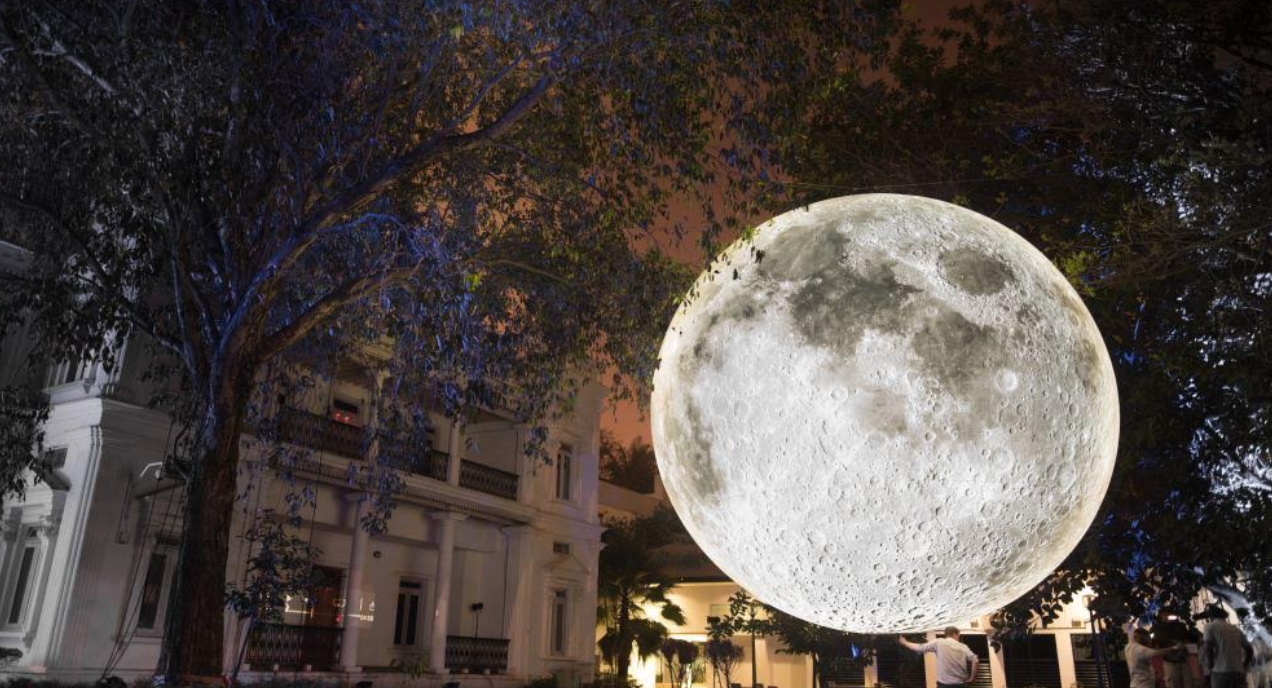
  • Dublin: Luke Jerram’s Museum of the Moon Lands in Merrion Square to celebrate 30 years of Science Week. Internationally acclaimed artist Luke Jerram will bring his breathtaking installation, Museum of the Moon, to Merrion Square, Dublin, from 13–15 November. The seven-metre illuminated sphere, featuring detailed imagery of the lunar surface from NASA, offers visitors an extraordinary opportunity to experience the Moon up close. Suspended in one of Dublin’s most iconic city parks, the artwork invites reflection on our relationship with the night sky, the planet, and beyond.

Some other events taking place not to be missed include:

  • Then, Today and Tomorrow – Exploring a Changing Ocean Around Us – Galway – November 15th, 10am – 5pm

Join the aquarium team and friends to explore the past, present and future of the ocean and waters of Ireland. Explore our marine heritage and past, meet our animals and discover the habitats they live in, and consider the ocean and waterways of the future. Visitors will be to join hourly feeding tours and meet our team at activity stations around the aquarium.

  • The Science of Storytelling – Dublin – November 9th, 4 30pm – 5 30pm

Storytelling is as old as time, but what about the science behind it? Join neuroscientist Shane O’Mara, author of Talking Heads: The New Science of How Conversation Shapes Our Worlds, master traditional storyteller Niall de Búrca and science writer Claire O’Connell as we delve into communication, connection, and why storytelling remains such a powerful form of human expression.

  • Let’s Talk Science Festival – Dublin – November 8th, 10am – 4pm

The Let’s Talk Science Festival is back at the Rediscovery Centre – and this year we’re celebrating 10 years of science, curiosity and fun! Join us on Saturday 8th November for our special anniversary festival with the theme “10 Years of Let’s Talk Science”. It’s an all-day, family-friendly event packed with exciting STEM activities for all ages.

  • Teddy Bears Hospital – Athlone

This event is part of the Midlands Science Festival and will be hosted by the Royal College of Surgeons in Ireland Paediatrics Society through a special pop up teddy bears hospital in Athlone. This event introduces children to healthcare in a fun and friendly way, helping to ease any worries they may have surrounding the hospital environment. Through a number of stations such as the emergency station, phlebotomy, or pharmacy, every teddy bear brought along will receive a wide range of care and a fun experience through the Teddy Bear Hospital.

Dr Ruth Freeman, Director of Research for Society at Research Ireland said: “For 30 years, Science Week has been sparking curiosity and bringing people together through science. Our anniversary theme of ‘Then. Today. Tomorrow.’ is a chance to both celebrate the endeavours of yesteryear that have brought us to where we are today, and to consider what may lie ahead for individuals, families, communities, Ireland, and the entire planet. We’re delighted to see such a wide range of events taking place across the country again this year. The success and appeal of Science Week is due primarily to the creativity and tireless work of local organisers and volunteers. I want to sincerely thank them for making Science Week such a vibrant, nationwide celebration.”

 Speaking about the Museum of the Moon installation, Luke Jerram said: “The Museum of the Moon has travelled the world, but there’s something truly special about bringing it to Dublin to mark such a milestone for Science Week. It’s about inspiring wonder — and seeing our shared world from a new perspective.”

For more information on how to get involved, please visit https://www.scienceweek.ie/. You can also follow developments using the hashtags #scienceweek and #ThenTodayTomorrow.

Maynooth University scientists pioneer breakthrough fingerprint forensic test

A pioneering new test that can recover fingerprints from ammunition casing, once thought nearly impossible, has been developed by scientists at Maynooth University.

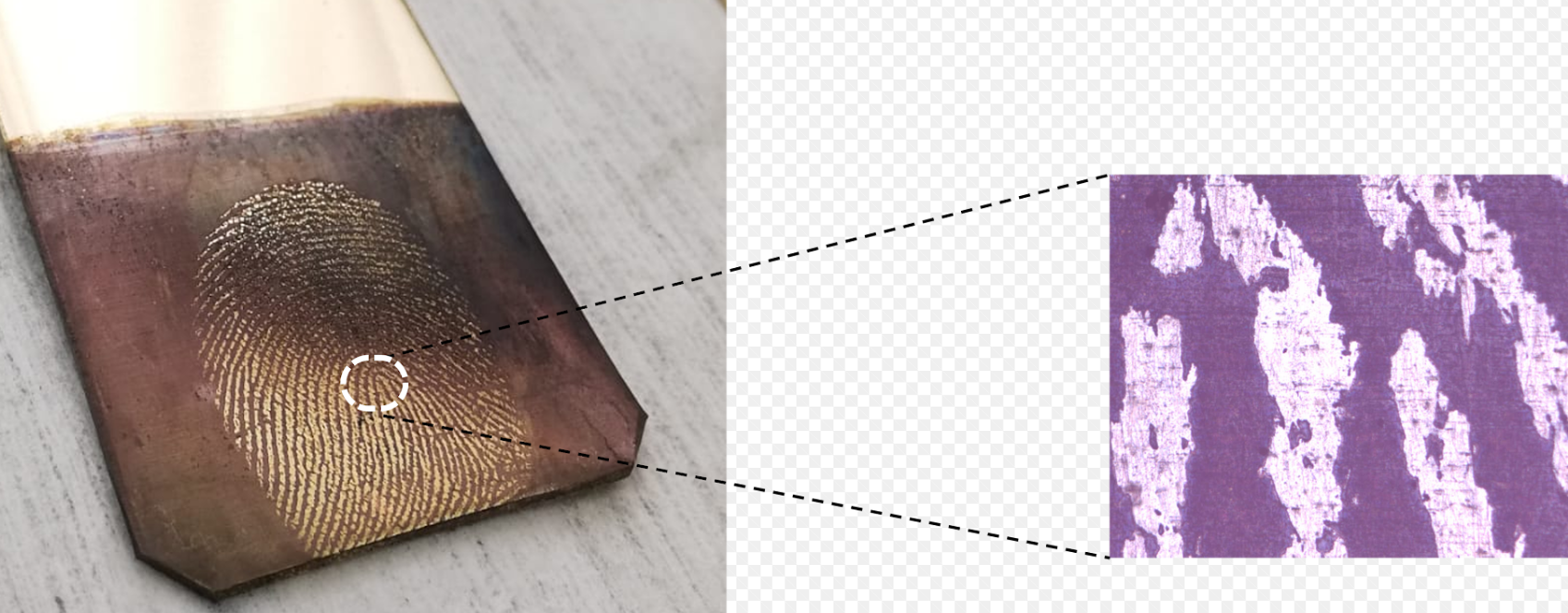
Dr Eithne Dempsey, and her recent PhD student Dr Colm McKeever, of Maynooth University’s Department of Chemistry, have developed a unique electrochemical method which can visualise fingerprints on brass casings, even after they have been exposed to the high temperature conditions experienced during gunfire.

For decades, investigators have struggled to recover fingerprints from weapons because any biological trace is usually destroyed by the high temperatures, friction and gas released after a gun is fired. As a result, criminals often abandon their weapons or casings at crime scenes, confident that they leave no fingerprint evidence behind.

“The Holy Grail in forensic investigation has always been retrieving prints from fired ammunition casings,” said Dr Dempsey. “Traditionally, the intense heat of firing destroys any biological residue. However, our technique has been able to reveal fingerprint ridges that would otherwise remain imperceptible.”

The team found they could coat brass casings with a thin layer of specialised materials to make hidden fingerprint ridges visible. Unlike existing methods that need dangerous chemicals or high-powered equipment, the Department of Chemistry, Maynooth University process uses readily available non-toxic polymers and minimal amounts of energy to quicky reveal prints from seemingly blank surfaces.

It works by placing the brass casing of interest in an electrochemical cell containing specific chemical substances. When a small voltage is applied, chemicals in the solution are attracted to the surface, coating the spaces between fingerprint ridges and creating a clear, high contrast image of the print. The fingerprint appears within seconds as if by magic!

“Using the burnt material that remains on the surface of the casing as a stencil, we can deposit specific materials in between the gaps, allowing for the visualisation,” said Dr McKeever.

Tests showed that this technique also worked on samples aged up to 16 months, demonstrating remarkable durability.

The research has significant implications for criminal investigations, where the current assumption is that firing a gun eliminates fingerprint residues on casings.

“Currently, the best case of forensic analysis of ammunition casings is to match it to the gun that fired it,” said Dr McKeever. “But we hope a method like this could match it back to the actual person who loaded the gun.”

The team focused specifically on brass ammunition casings, a substance that has been traditionally resistant to fingerprint detection and is the most common type of material used globally.

The researchers believe that the test for fingerprints on brass they have developed could be adapted for other metallic surfaces, expanding its range of potential forensic applications, from firearm-related crimes to arson.

This technique uses a device called a potentiostat, which controls voltage and can be as portable as a mobile phone, making it possible to create a compact forensic testing kit.

“With this method, we have turned the ammunition casing into an electrode, allowing us to drive chemical reactions at the surface of the casing,” said Dr McKeever.

While promising, the new technology faces rigorous testing and validation before it could potentially be adopted by law enforcement agencies worldwide. The research, funded by Research Ireland and Maynooth University is published in a leading forensic science journal, has significant implications for global policing.

The published findings are available in the science journal, Forensic Chemistry: https://www.sciencedirect.com/science/article/pii/S2468170925000256?via%3Dihub

Lift-Off from Shannon Airport for NASA competition winning teen scientists

It’s lift-off for five Irish secondary school students flying from Shannon Airport to Orlando today having won a prestigious space design competition founded by NASA. The St Flannan’s College students from Ennis, County Clare, flew from Shannon to Chicago this morning before continuing on to Orlando, where they will present their design at the International Space Development Conference, an annual gathering organised by the National Space Society which brings together leaders and enthusiasts from all sectors of the space industry.

The student’s – Alex Furey, Damian Woros, Najib Haq, Gavin Shiels and Ahmed Ibrahim from St Flannan’s, together with Shreya Mariya Saju and Lexie McKenna from St Dominic’s College in Cabra, Dublin – designed a next-generation space habitat which they named “Inis Beatha” or “Island of Life”. This design uses artificial gravity and plants grown without soil to create a system capable of recycling the food, water and oxygen needed to sustain life in space.

Speaking from Shannon Airport ahead of their flight to Chicago, physics teacher John Conneely from St. Flannan’s College said: “Winning first place in the senior section of this year’s NSS Space Settlement Contest—against over 26,000 entries from schools worldwide—is an incredible achievement, and we couldn’t be prouder of our students! We’re also immensely grateful to Shannon Airport for their continued support, making this unforgettable trip to Orlando possible for our students.

I think Shannon Airport has always been inspirational when it comes to innovation —from welcoming the first transatlantic passenger flight 80 years ago to the recent debut of an Advanced Air Mobility aircraft. Remarkably, at one point it was also an alternate landing site for the space shuttle, making it the perfect launchpad for our students as they set out on this incredible journey to the International Space Conference.”

Welcoming them this morning Tim Ryan, Group Head of Brand & Marketing at The Shannon Airport Group said: “We are thrilled to welcome the team from St Flannan’s College to Shannon Airport today as they travel to such a prestigious event in the U.S. These innovative young minds are a testament to the exceptional talent and ambition coming from this region, making an impact on the world stage. We are immensely proud to support Alex, Damian, Najib, Gavin, Ahmed, and their dedicated teachers on this exciting adventure.”

Axelspace to Launch Seven Next-Generation Earth Observation Microsatellites

Axelspace Corporation (“Axelspace”), which designs, manufactures and operates microsatellites, and conducts business to promote a society where space is accessible to people around the world, today announced plans to launch seven next-generation Earth observation microsatellites, “GRUS-3,” in 2026. This will expand the company’s microsatellite constellation to include more than ten satellites, enabling observation of broader areas with increased frequency.

Axelspace aims to meet growing demand across a wide range of fields, including environmental protection, financial product development, and real estate management, in addition to precision agriculture, forest monitoring, and map creation, to promote use of Earth observation data.

GRUS-3 will build upon Axelspace’s existing constellation of five microsatellites, “GRUS-1,” which provides services to government agencies and private companies in more than 30 countries worldwide.

The seven GRUS-3 microsatellites will capture images of the Earth’s surface at the same location and nearly the same time every day for locations north of 25 degrees latitude, under stable sunlight conditions year-round from a sun-synchronous orbit at an altitude of 585 km. Each satellite has an effective swath of 28.3 km and a maximum capture length of 1,356km. With a combined daily capture capacity of 2.3 million km² across seven satellites, and our unique tasking capabilities that enables targeted area imaging, Axelspace supports timely information gathering and decision-making.

GRUS-3 satellites feature a spatial resolution (GSD) of 2.2 meters. In addition to capturing visible light, these are equipped with sensors capable of monitoring plant growth conditions, coastal seaweed beds and landscape.

Yuya Nakamura, President and CEO of Axelspace Corporation, said, “With the launch of seven GRUS-3 microsatellites, we will be able to observe a wider area more frequently than ever before. By adopting new observation equipment, the image quality will be improved compared to GRUS-1. We will provide enhanced services to our existing customers and continue developing solutions to meet emerging needs, further expanding the use of space.”

Axelspace also plans to launch a microsatellite “GRUS-3α” no earlier than June 2025 to verify the performance of the versatile satellite platform, a standardized platform for satellite function and structure across diverse missions, and the telescope used in GRUS-3.

About GRUS-3

Number of satellites: 7

Name: GRUS-3A/3B/3C/3D/3E/3F/3G

Satellite wet mass: Approximately 150kgSatellite envelope: 96cm x 78cm x 126cm

Spatial resolution: 2.2m

Effective swath: 28.3km

Maximum capture length: 1,356km

Band: Panchromatic, Coastal Blue, Blue, Green, Red, Red edge, Near infrared

Orbit altitude: 585km

Orbit type: Sun-synchronous


About GRUS-3α

Name: GRUS-3α

Satellite wet mass: Approximately 150kg

Satellite envelope: 96cm x 78cm x 126cm

Orbit altitude: 585km

Orbit type: Sun-synchronous


Launch details for GRUS-3α

Date: No earlier than June 2025

Site: Vandenberg Space Force Base, California, USA

Vehicle: Falcon 9

Mission: Transporter-14

Launch Provider: SpaceX


To host the missions of GRUS-3 and GRUS-3α, Axelspace’s General-purpose (Versatile) satellite bus is based on results obtained from the following projects subsidized by the New Energy and Industrial Technology Development Organization (NEDO). 

Development and Demonstration of General-Purpose CubeSat and Microsatellite Buses (FY2023- 2026)

*This project is implemented by the Ministry of Economy, Trade and Industry from FY2021 to FY2022


About GRUS

GRUS is a series of optical Earth observation microsatellites, each weighing 100 kg-class, developed for Axelspace’s Earth observation business, AxelGlobe. The first satellite of GRUS-1 was launched in December 2018, followed by 4 satellites in March 2021, bringing the current total to five satellites in orbit. The name “GRUS” comes from the constellation Grus to symbolize the way satellites orbit the Earth like a flock of cranes.


About Axelspace

With the vision of “Space within Your Reach,” we have been pioneering the development of microsatellites since our founding in 2008. We have two businesses: AxelLiner, where we develop and operate microsatellites for customers’ space missions, and AxelGlobe, where we provide Earth observation data through our proprietary optical satellite constellation. Leveraging our unique technology in microsatellite design, manufacturing, and in-orbit operations, we offer solutions to meet the needs in a variety of industries. Through these businesses, we aim to create a society where space is accessible to people around the world.


Axelspace Corporation Profile

Headquarters: Tokyo, Japan

President and CEO: Yuya Nakamura

Founded: August 2008

https://www.axelspace.com/en/

SciFest competition kicks-off ahead of its 20th anniversary

SciFest, Ireland’s largest and most inclusive STEM fair programme for second-level students has announced its return ahead of its 20th anniversary with a call for entrants to the SciFest regional fairs, taking place across the country. The SciFest programme is funded by grants from the Department of Education and Research Ireland and by private sector sponsorship, primarily by Intel, Boston Scientific, EirGrid and new partner Mallinckrodt Pharmaceuticals.

SciFest organisers kicked off the launch of the 2025 competition in Explorium with students from Firhouse Educate Together Secondary School in Co. Dublin, and announced the theme for 2025 as ’STEM is for All.’

Project entries are accepted across a range of scientific disciplines including physical and life sciences and technology. Students wishing to participate should log on to the SciFest website (www.scifest.ie) and enter online. Completed entry forms must be submitted by 12 March 2025.

The regional fairs take place across the months of April and May, with selected winners going on to compete at the SciFest National Final in November 2025. Here, they will have the opportunity to take home the overall prize and represent Ireland at the Regeneron International Science and Engineering Fair in the United States next year.

Speaking ahead of the competition’s 20th year, Sheila Porter, SciFest Founder and CEO said:

‘SciFest is back for 2025, and we couldn’t be more excited. I would urge all students to get involved and enter, no matter your background or circumstance, to explore the wonderful world of STEM and all it has to offer. Previous winners of the competition are thriving and have gone on to achieve incredible things, from launching their own start-ups to studying at prestigious institutions like Oxford University. SciFest opens the door to an array of opportunities.

As we plan for our 20-year celebrations, we look forward to an exciting year ahead in which the competition will grow to even greater heights. I want to take a moment to thank our sponsors for their continued support, without which none of this would be possible. We can’t wait to see the fantastic and innovative projects that lie ahead, so don’t miss out! Sign up today and be part of this exciting journey.’

The competition has grown rapidly since its inception in 2006 and drew over 15,000 student participants last year. SciFest aims to support students in research development, critical thinking, and problem-solving, all the while fostering an interest in STEM. It is free to enter and is open to students of all backgrounds and circumstances.

109 Irish companies secured European Space Agency (ESA) support in 2023

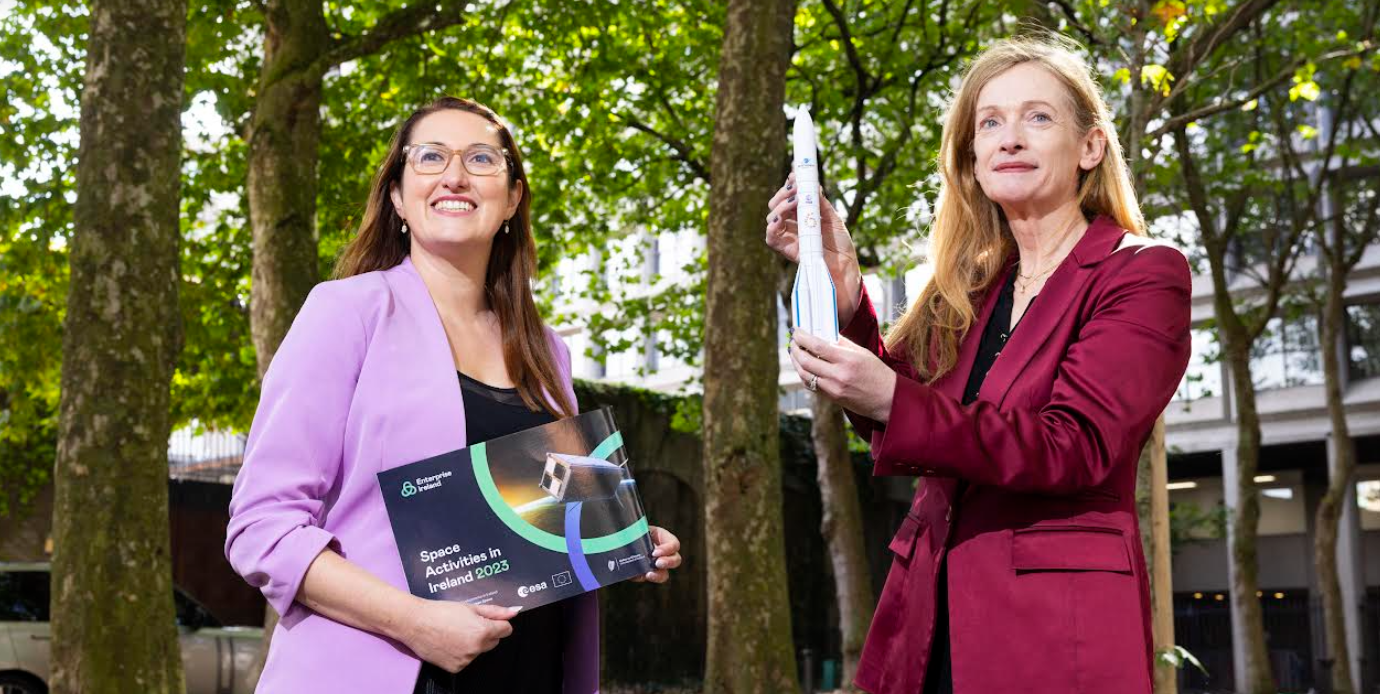
Enterprise Ireland has today published the ‘Space Activities in Ireland 2023’ Report, highlighting the growing participation and success of Irish companies in the European space sector. By the end of 2023, 109 Irish companies were actively engaged with ESA, demonstrating the significant expansion of Ireland’s role in this high-growth industry.

In 2023, ESA awarded contracts worth €9.9 million to Irish companies primarily focused on industrial activities. Industrial co-funding of €2.2 million further supported these enterprises. Throughout the year, 25 companies, including three newly space-active businesses, were supported in developing products and technologies across sectors including telecommunications, earth observation, and space exploration.

A key highlight of the year was the successful launch of the Educational Irish Research Satellite 1 (EIRSAT-1), Ireland’s first satellite, on 01 December 2023, marking a significant milestone. EIRSAT-1 is a student-led project from University College Dublin (UCD) and was developed in collaboration with Irish technology companies.

Commenting on the 2023 report, Minister Emer Higgins, Minister of State for Business, Employment and Retail, said:

2023 was a momentous year for the Irish space sector. The increasing number of Irish companies working with ESA, alongside the launch of EIRSAT-1, highlights Ireland’s strong position in this fast-growing sector.

“As Ireland’s space community continues to innovate and collaborate with European and global partners, the future of the country’s space sector looks brighter than ever. The Irish Government is committed to continuing its support for innovation and enterprise in the space sector as we look to build on these successes and further strengthen Ireland’s role in the global space economy.”

Marina Donohoe, Head of Research and Innovation at Enterprise Ireland, added:

“The strong growth in Irish companies engaging with ESA, now reaching 109, is a clear indicator of Ireland’s expanding footprint in the global space economy. This year’s report demonstrates the progress and impact Irish companies are making through collaboration with ESA, not only in advancing space technology but also in driving innovation in sectors with downstream applications. Enterprise Ireland is committed to supporting these companies and the growing number of research teams actively involved in space-related developments supported by ESA.”

The space economy was valued at $630 billion in 2023 and is forecast to reach $1.8 trillion by 2035, with an average annual growth rate of 9%, significantly outpacing global GDP growth[1]. This rapid expansion, driven by both public and private sector investments, has opened new opportunities for ‘NewSpace’ companies developing innovative space-related products and services.

In a demonstration of Ireland’s position at the front rank of space technology development, ESA’s new rocket the Ariane 6, which launched smoothly in July this year, used two technology systems designed and built by Irish space engineering company Réaltra. Enterprise Ireland’s ESA Business Incubation Centre (ESA BIC) Ireland also had a successful year, welcoming seven new start-ups. These companies are focused on developing both upstream and downstream applications, further bolstering Ireland’s contribution to the burgeoning space sector.

Another key development for the sector in 2023 was the establishment of the Irish Space Association (ISA), a new organization designed to foster collaboration among space-active companies and research organizations in Ireland. This collaborative network will play a pivotal role in the future growth of Ireland’s space sector by promoting knowledge-sharing and enhancing the country’s competitive edge in the global space market.

The ESA End of Year Activities Report 2023 underscores the significant progress being made by Irish companies and researchers as they collaborate with ESA and European partners. With Irish companies continuing to leverage the opportunities created by NewSpace, the future looks bright for Ireland’s expanding space sector.

For more information or to download the full report, visit enterprise-ireland-esa-2023-report-en-134478.pdf

Irish research group DIAS involved in world first lunar-Earth flyby

A team of three researchers from the Dublin Institute for Advanced Studies (DIAS) will play a key role in the first ever spacecraft attempt to fly past the Moon, and then past Earth.  The flyby is set to take place over tomorrow and Tuesday (19-20 August).

The manoeuvre is part of the European Space Agency (ESA)’s Jupiter Icy Moons Explorer (JUICE) mission. As well as conducting detailed observations of Jupiter and its moons, the mission will be investigating Jupiter’s moons as possible habitats for life.

The lunar-Earth flyby will be an opportunity for the DIAS team to test their ideas about the spacecraft’s behaviour in the environment of a moon, in preparation for the actual flybys of Jupiter’s moons.

Senior Professor Caitriona Jackman, Dr. Mika Holmberg and Dr. Hans Huybrighs are all members of the DIAS Planetary Magnetospheres Group, which is the only Irish research group involved in the mission.

Commenting on DIAS’s role in the flyby, Prof. Caitriona Jackman, Associated Scientist and Head of the Planetary Magnetospheres Research Group at DIAS, said “We will be monitoring the flyby with trepidation as it’s an extremely challenging undertaking – the slightest mistake could take Juice off course and spell the end of the mission.

“This is the first step in Juice’s journey through the solar system on its way to Jupiter. The spacecraft will use the gravity of the Moon and then Earth to bend its path through space and redirect it on course for a flyby of Venus in August 2025. This will help to ensure it arrives at Jupiter with the right speed and direction. It’s a journey that requires perfect accuracy and in-depth planning.”

“Having this opportunity to test our ideas about the spacecraft’s behaviour in the environment of a moon is truly exciting and will be a huge boost in confidence for our research once Juice arrives at Jupiter. The encounter of Earth’s moon is a practice-run for when we get to Jupiter, where we will study moons with underground oceans that might support life. I’m extremely proud of the work carried out by our research group so far, and that we can be part of such an important mission.”

DIAS expertise

DIAS’s work on this mission will explore how the spacecraft itself affects the measurement of particles, and will use an advanced computer model to investigate this. Commenting on her involvement in this mission, Dr. Mika Holmberg, Research Fellow at DIAS and Co-Investigator on the Radio and Plasma Wave Investigation Instrument, said “The measurements from the lunar-Earth flyby could have a significant impact on our research going forward. The effects of the interaction between the spacecraft and its environment influences our interpretation of the measurements. For example, it might change our understanding of where the moon particles that we are trying to detect come from, or how many there are.

“The computer simulations account for the environment of the spacecraft and models how the moon particles will be affected, so that we can correct potential misleading effects for later in the mission. When Juice flies by the Moon we have the first opportunity to test our correction techniques during an actual moon encounter, which is exciting. It’s the perfect opportunity for us to calibrate our instruments and smooth out any remaining issues, and who knows what it could lead to!”

Dr Hans Huybrighs, Research Fellow at DIAS and Associated Scientist of the Particle Environment Package instrument explains that the main objectives of the mission are to study the abilities of Jupiter’s moons to host life, which requires accurate and detailed measurements. “Jupiter’s moons slowly release particles from their surface. In some cases, this release could happen through water eruptions that produce 100-kilometre-tall plumes. By detecting these particles, we can learn more about the moons’ potential to support life. Investigating how Juice can best detect these plumes is one of the topics we are working on at DIAS.”

DIAS as a leader in space research

Commenting on DIAS’s role in space research, Dr. Eucharia Meehan, CEO and Registrar of DIAS said, “It’s fascinating to follow the spacecraft’s journey through the solar system with incredibly complex manoeuvres. Scientists around the world have been carefully planning this route over the last 20 years and it’s a huge honour that DIAS is playing a role in this mission. This flyby is hugely important as it’s one of the few opportunities to make certain measurements and adjustments during Juice’s eight-year journey to Jupiter.

“DIAS has a long history in being at the forefront of Ireland’s involvement in cutting-edge space research with the James Webb Space Telescope, and now our contribution to the Juice mission. We have been following Juice’s progress closely since its launch in April 2023. We are very proud of the work of our researchers, and we are looking forward to updates on the progress of the flyby.”

The Juice mission is being led by the European Space Agency, of which Ireland is a member state. 18 different research institutes, 23 countries, 83 different companies and more than 2000 people have contributed to the mission.

DIAS’ work on this mission is funded by Science Foundation Ireland and a European Space Agency fellowship held by Dr. Mika Holmberg. Further Information about DIAS’ involvement in the Juice mission can be found here: https://www.dias.ie/cosmicphysics/astrophysics/astro-Juice/