League of Legends Ranking System and Distribution

It’s not easy to get from the starting rank to master tier or challenger in League of Legends, but not impossible. It makes sense to try and learn the lol ranking, but also divisions, league points and everything else. Many players use League of Legends Boost services to speed up the climb. That will allow you to improve your rank, slowly, as you face more opponents.

How the LoL Ranking System Works

If you want to understand the League of Legends ranking system, it’s more than just booting and trying to play ranked games. The ranked ladder is designed to match people with a very similar skillset. When you play in the competitive league, Riot Games will offer league points or LP. You earn LP when you win games, and if you get defeated, you will lose the LP in competitive play.

The amount of LP you have will automatically affect the match making rating or MMR. While the MMR of a player is hidden, it does affect who you get matched with. When you have a high MMR relative to your rank, you lose less LP and get more points if you win. Placement matches will help figure out the MMR, and then the way you play will adapt it.

The LP you lose or gain will differ based on the rank. If you are in the metal ranks, you will gain or lose 25 LP. For the ranks emerald or above, the amount of LP you lose or gain is 20. But remember that before you can add LP to the name, you have to get to level 30. If you’re not there yet, you can enjoy Draft or Quickplay, and then slowly progress to that level.

Every LoL Ranks and Tiers in Order

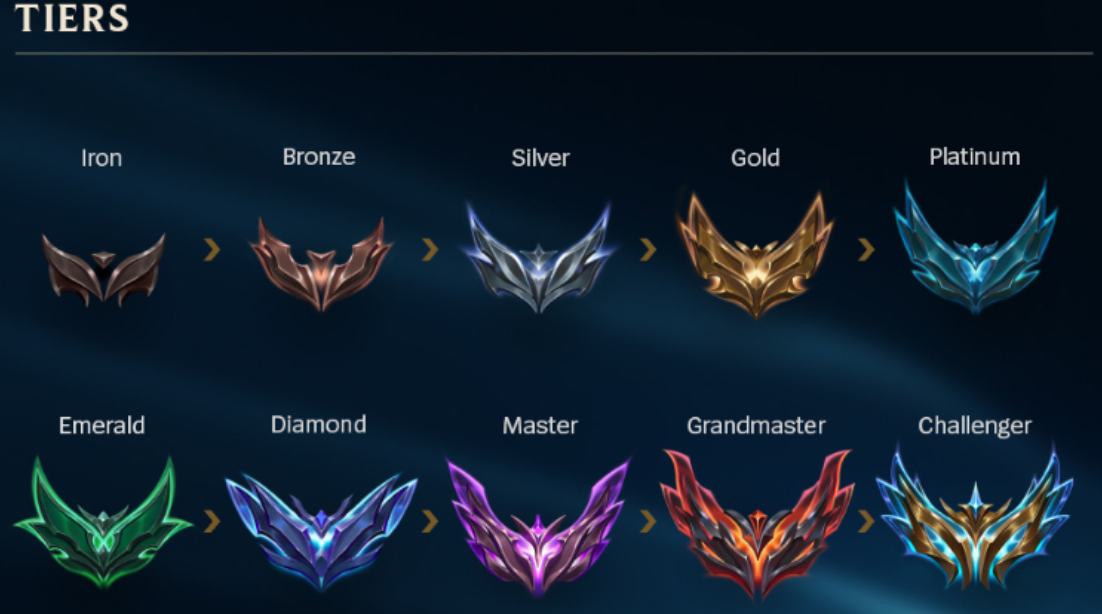
Right now, League of Legends has a ranking system that’s made out of 10 distinct tiers. Here’s the rank split system with each lol league and ranked league you need to know.

– Iron

– Bronze

– Silver

– Gold

– Platinum

– Emerald

– Diamond

– Master

– Grandmaster

– Challenger

One thing to note here is that from Iron to Diamond, every tier has four divisions. Those divisions are labeled using Roman Numerals, from IV being the lowest to I being the best. But if you are platinum iv, then you have new divisions to look forward to and higher tiers, once you get those ranked wins and rank rewards. Once you get past Diamond, though, there are no divisions.

Instead of that, they bring their own special rules to fit the higher stakes that come from a higher rank. Since competitive is split into Solo/Duo and Flex, each one of the two modes is kept separate, so you have ranks for each of them. Entering ranked play is exciting because you can move on to the next tier, play league in ranked matches, get past the gold tier and reach a new tier in your ranked climb.

What is League of Legends MMR?

MMR or matchmaking rating determines who you are getting matched with when playing the game. At its core, this is a hidden rating that will decide how much LP you earn or lose, but also who you are facing in these matches. The MMR is based on your current, but also previous performance. For a full breakdown of tiers, divisions, and how the system works, check out this LoL ranks system guide.

When you have a high MMR, you will be gaining more LP per win, and lose less LP when you are defeated. But when the MMR is low, you lose more points per defeat, and also gain less points if you win, too. Enter the promotion series that Riot Games introduced, and try getting past gold iv, the platinum rank and so on. You want to do more than three games, check the ranked tab for your progress and continue the Legends game rank up. Eventually, you get past the Diamond rank and start playing against some of the best League of Legends players, especially when you are over Diamond I, nine tiers and the lowest division in diamond.

How to Unlock Ranked Mode in LoL?

You can play QuickPlay or other modes, but you only unlock ranked after playing for a while. The requirements for unlocking ranked are as follows:

– You must reach level 30

– You need to unlock 20 champions in your account

– After you unlock ranked, you must do five placement matches

It’s fine if you lose a few matches. If you have the skill, you’ll end up climbing up shortly. And it’s all in good fun, because it brings a very interesting and rewarding experience.

Rank Distribution in LoL

Rank distribution is interesting because very few people reach the top ranks in the game.

– 19% of players are in Iron, with the same percentage being in Silver and Bronze.

– 17% have the gold rank

– 11% are in the Platinum tier

– Then, 8.4% are in the Emerald tier, with 2.7% being in the Diamond tier.

– 0.59% of players are ranked Master

– 0.067% are Grand Master

– 0.028% are in the Challenger tier

But reaching the highest ranks in the game is very hard. Plus, there are LP gains and losses to deal with, and the matchmaking rating will be affected based on your performance in the previous tier, too.

Entering the challenger rank is very difficult, unlike getting through the tiers iron rank and the placement games. The player skill level is much higher and you will encounter a losing streak, especially as you go past that one tier where you got stuck and enter a new league. Doing those five placement matches is crucial, but it could take you hundreds of hours to reach the challenger tier.

LoL Rank Decay

Rank decay is a system meant to prevent people from keeping top spots in ranked even if they don’t play. That means:

– If you are inactive for a longer time span, you will start losing 50 to LP a day.

– However, penalties are only affecting high ranks, such as diamond or above.

– You can prevent penalties simply by playing games, as that will show your account is still active. Doing so will postpone any LP losses.

If you’re ranked Diamond, you are banking 7 days per match, to a maximum of 28 days banked. They offer 28 days before the decay, and you lose 50 LP. If you’re ranked Master or above, a match will bank you a single day, and you can bank up to 14 days, which is also the number of initial days before decay. You will be losing 75 LP per day on decay. For more guides and ranked tips, visit https://eloboss.net.

When you deal with decay, you might find ranked players from previous divisions in your current rank. It’s difficult to improve your past performance, but as you reach the highest division like diamond ii, things can get better. Just make sure that you LP gain often and avoid losing points.

Quick Tips for Ranking Up in LoL


– Try to dominate your placement matches, as it will help you acquire more LP gains in the beginning.

– Play only 1-3 champions per role and try to master them, as it’s better than trying variety.

– Focus on a single role if you can, as it will improve the way you handle that role.

– Chase objectives, not kills and play around power spikes. That means knowing when your champ is very strong, usually after getting multiple items or reaching at least level 6.

– Review mistakes from your games and see where you can improve, as it will help immensely.

– If you have 2 losses already, take a break. Usually, taking a breather is the best idea, because it will help improve your play.

Conclusion

Getting the best rank in the game is tricky, it requires lots of attention and time. But you want to take advantage of the different benefits and tiers, assess the match quality and see how split points are shared. And of course, track the player’s MMR and become the best you can. Reaching master grandmaster and challenger is difficult and it requires hundreds of hours of play, but this is not impossible. Harness that, access free rewards, and continue playing, you will improve immensely.

Eight Irish game studios to launch prototypes through IndieDev cross-border fund

Irish game developers’ ability to punch above their weight in the competitive international games industry, and turn ambitious concepts into playable prototypes, has been boosted by IndieDev 2025.

IndieDev 2025, a cross-border fund programme supporting indie video game developers in Dublin, Galway, Antrim, Armagh, Tyrone, Laois, Clare, Tipperary, Kilkenny, and Down, each received £15,000/€15,000 and 12 weeks of intensive mentorship to bring their visions to life.

Sharp Glass Games, Universe or Nothing, Reliable Plumbing Services, Space Lion Studios, Table Topple, Rúcach, Silly Goose Games, and Round Robin Interactive were the 2025 recipients of this pioneering programme managed by Galway-based Ardán and Dublin-based Imirt on behalf of Northern Ireland Screen and Fís Éireann/Screen Ireland.

The emerging developers were paired with industry mentors Dave McCabe (Spooky Doorway), Sam Redfern (Psychic Software), and Paul Froggatt (Outlier Games), who all shipped games to international markets last year and who brought their hard-won expertise to the programme.

From this, a variety of game prototypes have emerged, showing the diversity and creativity of the games development sector in Ireland: a hot air balloon simulator, a stealth-puzzle game, a meditative, cozy game, a roguelike strategy game, a 3D action-adventure platformer, a minimalist pinball-inspired perseverance platformer, a soft post-apocalyptic romance adventure visual novel, and a first-person, stealth exploration game. 

“IndieDev is the best thing that could have happened to us as a newcomer game studio,” said Sharp Glass Games Irina Kuksova. “Being on the programme was key for connecting with professionals who helped us to test assumptions, try new approaches and get a better understanding of the industry. The funds gave us time to work on the project, while the commitment to deliver sped up our work. We are publishing the Deathwish Bloom prototype next month and are looking forward to growing further.”

“IndieDev gave us the space and structure to turn Persevere from an ambitious concept into a working, playable game,” said Universe Or Nothing’s Mark Aherne. “The mentorship, workshops, and focused development time helped us validate our ideas, sharpen our design, and build a prototype we’re extremely excited about. It’s been a huge step forward for the project and for us as a studio.”

“IndieDev is a great programme,” said Colm Larkin, Imirt CEO and founder of game studio Gambrinous. “If something like this had been around when I started my studio 12 years ago, I would have jumped at the chance to take part. There’s a real sense of things coming together in Ireland for games right now.”

The momentum built by IndieDev’s success continues with Sparks: Game Changers, a pilot career development course for people of underrepresented genders in the games industry. Run by Ardán in collaboration with Code Coven and supported by Screen Ireland, the programme tackles the soft skills that directly affect career progression—confident communication, self-advocacy, and job-hunting readiness in an industry still shaped by bias and power imbalances.

Ardán and the Irish Games Industry:

Other games industry initiatives in Ireland run by Ardán included the annual FÍS Games Summit, a pivotal gathering for the games industry in the West of Ireland, attracting international speakers; the Galway branch of the Irish Games Talent Incubator; Run For The Border which mentors and nurtures game dev talent in the border counties; and the Galway Film Fair Games Event at Galway Film Fleadh.

Ardán was also one of seven Galway organisations awarded funding under The Communicating Europe Initiative, managing the GameDev Connect Europe development project strand. This brought together game developers in Ireland, Iceland, Greenland, Finland, and Sweden, highlighting how the games industry can work remotely and across borders, while also focusing on collaboration, knowledge-sharing, and community engagement.


HP at CES 2026 HyperX and OMEN Unite to Power the Future of Play

HP Inc. is redefining how gamers play, create, and perform with the debut of its most advanced gaming products yet, and the introduction of a new era for its gaming brand.

HyperX and OMEN are officially coming together under one master gaming brand: HyperX. HyperX now delivers an end-to-end experience that combines decades of innovation in gaming PCs, displays, peripherals, and software. This milestone underscores HP’s commitment to pushing performance, personalization, and creativity forward for all gamers.

“Gamers deserve a seamless experience that matches their passion, from the systems that power their worlds to the gear
that connects them,” said Josephine Tan, Senior Vice President and Division President of Personal Systems Gaming
Solutions at HP Inc. “As we bring OMEN and HyperX together, we’re continuing to push the boundaries of gaming
innovation, delivering performance, personalization and experiences that help every player reach their full potential.” hp.com

HyperX and OMEN Unite to Power the Future of Play HyperX debuts new laptop and monitor, delivering breakthrough
performance, personalization, and immersion for gamers everywhere.

A New Era of Play
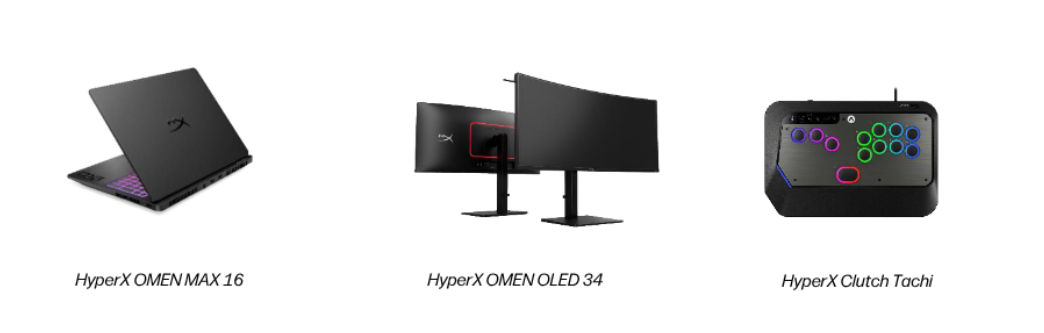
HyperX OMEN MAX 16: Maximum Gaming Power
Gamers want a laptop that never limits their play. They need power to run any game smoothly with high frame rates and
fast load times, lightning-fast keyboard responsiveness where every millisecond matters, and a system that stays cool and
consistent under maximum load.

When power, cooling, input speed and display quality work together, the laptop does more than run games. It helps players react faster, stay immersed, and play at their best. The HyperX OMEN MAX 16 is built for players who demand uncompromising performance and ushers in a new era of performance.

• Next-generation hardware delivers up to 300W Total Platform Power,ii an additional 50W and 20% increase
versus the previous generation, powered by new Intel® Core Ultra 200HX series processors and next-gen AMD
Ryzen ™ AI processors, and up to the NVIDIA® GeForce RTX™ 5090 Laptop GPU1 for lightning-fast, smooth, and
immersive gameplay making it the world’s most powerful gaming laptop with fully internal cooling

• Keep cool under pressure with a redesigned OMEN Tempest Cooling Pro system – featuring a third fan and Fan Cleaner technology that improves cooling efficiency automatically – keeping performance steady even during
intense sessions.

• Player-focused design like an industry-leading high-polling rate keyboardiii that delivers up to 4x faster keyboard polling rateiv compared to previous generations; the keyboard also offers full-size arrow keys and captivating
lighting effects customizable through OMEN Light Studio.

• See every frame clearly on up to a 16-inch OLED 240Hz1 WQXGA 500-nit display delivering sharp and responsive visuals for competitive play.

• OMEN AI redefines FPS optimization with a personalized, one-click solution tailored to each game, adjusting operating system settings, hardware settings, and game settings – eliminating the need for endless
troubleshooting.

HyperX OMEN OLED 34: Pure Visual Brilliance
The HyperX OMEN OLED 34 raises the bar in display innovation, engineered for gamers and creators to deliver
enhanced clarity, speed, and color accuracy powered by next-generation V-stripe QD-OLED panel technology.

• Experience better picture and less text fringing on the next generation V-Stripe QD-OLED panel, with 21:9 WQHD, 360Hz refresh rate, and 0.03ms response time for next level immersive performance.

• Achieve more and create freely with HyperX ProLuma, professional-grade color precision, 100W USB-C power delivery, and a built-in KVM switch for seamless multitasking.

• Make it your own with a fully customizable 3D-printable headphone hook.

• Stay protected with HyperX OLED CoreProtect and three-year limited warranty ensures the longevity of your monitor keeping you in the game without the worry of burn-in.

HyperX Clutch Tachi: Fast Wins Made Easy
The HyperX Clutch Tachi is HP’s first Xbox licensed arcade controller, delivering precision and style with a premium
leverless design.

• Enjoy lightning-fast inputs with Magnetic Switches with TMR sensors.
• Personalize your playstyle by adjusting button mapping, rapid trigger, and actuation in NGENUITY software.

Create aftermarket mods by 3D printing button shapes or unique artwork for the top plate.
HyperX OMEN MAX 16 HyperX OMEN OLED 34 HyperX Clutch Tachi

The New Edge of Player Performance
HyperX & Neurable
HyperX is partnering with Neurable to develop a gaming headset outfitted with neurotechnology. This industry-first gaming
technology demonstrates how AI and neuroscience can work together to help players improve their focus and accuracy
by interpreting brain activity in real time.

Pricing and Availabilityv
• The HyperX OMEN MAX 16 is expected to be available on HP.com in the Spring. Pricing will be provided closer to
availability.

• The OMEN OLED 34 is expected to be available on HP.com in the Spring. Pricing will be provided closer to
availability.

• The HyperX Clutch Tachi is expected to available on HP.com in the Spring. Pricing will be provided closer to
availability.

For more information about HP at CES 2026 and additional HP news at the show, please visit the HP Press Center or
HP.com.

4 Games We Are Looking Forward To In 2026

Thirteen years. That is exactly how long fans have had to wait for the latest instalment of Grand Theft Auto. The hype is so off the charts that the game won Most Anticipated Game at the Game Awards for 2024 and 2025. Developer, Rockstar, describes the game as “the largest game launch in history,” and right now, other games will just avoid GTA VI’s launch day, week, and even month.

However, 2026 is more than one particular game. No doubt, GTA VI will be the focus of most of the attention of game launches in 2026. Yet, the coming year also brings an incredible lineup for the gaming world. From epic fantasy adventures to monster-hunting expansions and console exclusives, 2026 is shaping up to be one of the most exciting years in gaming history. Let’s break down what’s coming.

1. The Game Everyone’s Waiting For: Grand Theft Auto 6

Grand Theft Auto VI will now be released on Thursday, November 19, 2026. This is after several delays resulting from a widely publicised security breach, Rockstar’s own perfectionism, and the game’s sheer complexity and technical scale. The initially scheduled release period for the game was 2025, then May 26, 2026.

Grand Theft Auto VI is positioned to be the most culturally significant game of 2026. Rockstar continues to push the genre they built through innovations such as density, realism, and dynamics that improve over time. All the parts of the common reiterations that felt unfinished are expected to be revamped and improved. The fact that there were no car-stealing side missions, the NPCs were unexciting, and the Diamond Casino was unavailable in story mode. Even though available in GTA online, there were no real stakes, as the money wagered was in GTA dollars because of the regulatory hiccups that surround gambling in different parts of the world. 

Gamers hope that GTA VI will use a special currency that can be converted into real-life currencies. They believe that emulating the same principles already being used by crypto casino sites like the many top Ethereum casinos, for instance, will enhance the gameplay. Using cryptocurrency allows for improved access without dealing with the regulatory hurdles that come with using different fiat currencies in regions around the world. While it is unlikely that Rockstar will incorporate real money gambling on gaming software, fans are hoping for a similar experience.

2. An Epic Fantasy Awaits in Crimson Desert

Crimson Desert marks a significant leap for Pearl Abyss, shifting toward more cinematic, story-driven open-world design. The game combines large-scale exploration with intense, skill-based combat. It takes place in the fictional continent of Pywel, which is dealing with numerous conflicts and mysterious occurrences. The protagonist, Kliff, undertakes a mission to reunite his separated Graymane friends, in the process rallying all the forces of Pywel against the evil that threatens to engulf the world. 

Crimson Desert’s defining characteristic is its active combat system, which is supported by the BlackSpace Engine. The game was initially a prequel to Black Desert Online, but it eventually became a standalone single-player game. Making it standalone allows Pearl Abyss to focus on greater specialisation and polish its storyline.

3. Raccoon City Makes a Return in Resident Evil Requiem

After the story of Ethan Winters in RE7: Biohazard and RE8: Village, Requiem returns the franchise to Raccoon City, the ground zero of the deadly T-Virus. Since RE has always been a classic survival horror game, there’s a strong emphasis on exploration, solving various environmental puzzles, and prudent resource usage. 

Combat is purposeful, not constant, prompting players to weigh when to fight and when to evade. Raccoon City is a dense, interconnected place, merging old and new, with some sections now abandoned or inaccessible due to years of decay. The lighting and sound design are also integral. Limited visibility heightens tension and encourages players to move cautiously, observe their surroundings, and survive by wits rather than brute force.

4. Monster Hunter Just Keeps On Growing

On March 13, 2026, a new Monster Hunter spin-off, Twisted Reflections, is scheduled to drop for Xbox Series X|S, PlayStation 5, Nintendo Switch 2, as well as PC via Steam. Prior to that, though, there’s still a lot to enjoy in the current instalment. 

Capcom recently announced that a fourth major patch for Monster Hunter Wilds is set to arrive in December, wrapping up major updates on that title. The company is also set to release a performance patch exclusively on PC in January 2026. This release features graphics settings, CPU options, and memory presets to help free computer space. This series appeals to fans of turn-based RPGs for its engaging experience and several exciting additions introduced with each new instalment.

The upcoming year brings big sequels, exciting new IPs, and a shiny new console crammed with exclusives. So, whether you’re a monster hunter, vice lord, or island tycoon, there’s something phenomenal waiting for you in the year 2026

How Path of Exile 2’s Combat Became Its Strongest Feature Yet

When Path of Exile 2 was announced, a lot of people assumed it was going to be the same package with a prettier bow. Well, joke’s on them! It’s that and much, much more! In this article, we will dive into the best mechanical expansion they delivered in the sequel. The combat! – and why it’s the best part of this new entry.

If you can’t wait to take part in this journey into the biggest and best evolution of the ARPG genre, consider purchasing PoE 2 currency, as navigating the market is complex and pretty unforgiving for newcomers.

The New Philosophy of Combat

In Path of Exile 1, your power came from spreadsheets. If your passive tree was efficient and your item mods were right, you could delete entire screens before the enemies even noticed you. It was satisfying at first but quickly became detached – more calculation than combat.

Path of Exile 2 flips that idea on its head. Now, your strength doesn’t just come from your stats – it comes from your execution. Every attack animation is a commitment; every dodge is a deliberate decision. You can’t cancel halfway through. You can’t rely on instant flask spam to erase mistakes.

That shift changes the entire rhythm of the game. You’re no longer a walking explosion of numbers. You’re a combatant – one who has to respect space, timing, and momentum. Each swing feels heavy, each projectile purposeful. For the first time in PoE history, your hands matter as much as your build.

Timing Over Spam

Combat in Path of Exile 2 is slower – not in pace, but in mindset. The developers at Grinding Gear Games have introduced something ARPGs often lack: tempo. You read enemies, learn their patterns, and respond instead of reacting blindly.

It’s no longer about emptying your skill bar as fast as possible. It’s about waiting for the perfect moment to strike. When you land a counterattack right after a dodge, it feels incredible – not just because of the damage, but because of the precision.

That’s the magic of this new system. It borrows the deliberate cadence of games like Dark Souls or Monster Hunter but adapts it to an ARPG framework. Suddenly, Path of Exile isn’t just a numbers game. It’s a skill game.

Weapons With Real Identity

One of the most immediate differences players notice is how weapons feel. In the first game, a sword, axe, or mace was often just a vehicle for stats. In the sequel, they define how you fight.

Heavy maces crush armor with satisfying thuds. Spears extend your reach and reward spacing. Daggers enable quick, risky burst plays. Even bows have a palpable tension – you feel the draw and release. Each weapon class brings new animations, new skill interactions, and a new sense of weight.

That’s not just aesthetic polish – it’s mechanical depth. Weapon choice now changes how you engage enemies and what you can safely attempt. It brings identity back to the player’s hands. Your weapon isn’t just your gear; it’s your language of combat.

The End of Mindless Clearing

Old-school Path of Exile fans loved efficiency. The meta revolved around builds that could vaporize everything on-screen before taking a scratch. It looked impressive – but it also killed tension.

Path of Exile 2 moves away from that philosophy. Enemy packs are smaller but smarter. They coordinate. They flank. They punish lazy positioning. The game rewards precision and survival, not just sheer output.

You don’t clear a room by existing in it anymore; you earn it. Each encounter feels more personal, more grounded. Instead of chasing faster kills, you’re chasing cleaner executions. And that’s a major reason the combat feels alive again.

Animation as Gameplay

One of the most subtle but impactful changes lies in animation readability. Every enemy telegraphs its attacks now – the shoulder drop before a lunge, the ground shimmer before an AoE, the flicker of light before a spell burst.

These aren’t just effects. They’re part of the conversation between you and the game. You see a move coming, dodge at the right time, and retaliate. That kind of clarity transforms combat from chaos into controlled intensity.

You still die, of course – this is Path of Exile – but when you do, it’s usually because you made a mistake you can learn from. Not because the camera hid a one-shot from off-screen. It’s fair brutality, and that’s what keeps players engaged.

Cinematic Without Losing Control

What’s remarkable is how Path of Exile 2 manages to be cinematic without stealing control from the player. The camera doesn’t yank itself around during attacks. The game doesn’t rely on flashy finishers or scripted slow-motion kills. Instead, the spectacle emerges naturally – from impact, lighting, and timing.

When your sword connects and the camera shakes just slightly, when a boss crash-lands into the arena and dust fills the air – those moments feel cinematic because they come from your own actions. It’s immersive, not intrusive.

GGG has found a rare balance between visual drama and mechanical precision. It’s fast, beautiful, and completely under your control.

Punishment With Purpose

Make no mistake – this new system is harder. Mistakes cost you. Standing still too long gets you punished. Getting greedy during a combo can mean instant death.

But the difficulty isn’t there to frustrate. It’s there to make victory meaningful. Every close fight, every narrow dodge, and every recovered mistake turns into a story. The punishment isn’t random – it’s instructional. You can feel yourself improving after every death.

And that’s exactly what makes this combat loop addicting. You don’t just grind levels. You grind skill.

FAQs

Is Path of Exile 2’s combat actually slower?

Not exactly – it’s more deliberate. Enemies take longer to kill, and your attacks have real recovery time. The pace feels tighter, but it’s far from sluggish.

Can I still play fast, screen-clearing builds?

To a degree, yes. But PoE2 encourages more control and precision. You’ll still feel powerful, but your power now comes with risk.

Does every weapon really feel unique?

Absolutely. The animation sets, timing, and even skill availability differ by weapon. If you want to try them all, consider purchasing PoE 2 currency so that you can buy, trade, and craft every weapon!

Is the new combat harder for casual players?

It’s more demanding but also more readable. You can see attacks coming and react intelligently. That makes it challenging, but not punishing.

Wrapping Up

Path of Exile 2 shows us something that has been missing in the gaming industry for years. So many franchises nowadays come out with new entries only for them to feel like a recolor or have just barely enough new things for it to be considered a new game in the first place. This game decided to recreate everything from scratch; the things that it does carry from the first game are heavily expanded and reimagined to the point where you can barely recognize them. From classes to systems! If you want to join in on the fun, consider getting Path of Exile 2 Currency from our friends at PlayHub so that you’re always ready for what’s coming!

What to Choose Between PC and Console in Gaming

The debate between PC and console gaming has fueled countless online discussions, especially as technology continues to evolve. With new consoles like the PlayStation 5 Pro and Xbox Series X pushing performance boundaries—and gaming PCs offering unmatched customization—many players are asking: Which is truly better for gaming in 2025?

Choosing between a PC or a console depends on your budget, playstyle, performance expectations, and gaming goals. This article breaks down every major factor to help you make the right decision. Meanwhile, explore the connection with Tongits go real money and GameZone today, with GZone.

1. Performance and Graphics

When it comes to pure power, gaming PCs still take the lead. A well-built PC can deliver ultra-high frame rates, ray tracing, and crisp 4K resolution. You can also upgrade components like your GPU, CPU, or RAM whenever necessary, keeping your system future-proof and adaptable.

Modern gaming PCs with NVIDIA RTX 40-series or AMD RX 7000-series cards can outperform most consoles, providing smoother gameplay and higher graphical detail.

Consoles, however, are no longer far behind. The PlayStation 5 and Xbox Series X deliver excellent visuals and stable frame rates straight out of the box. Developers optimize their games specifically for these systems, allowing them to perform beyond what their specs might suggest.

Verdict: Choose a PC if you value maximum performance and customization. Choose a console if you want optimized, consistent visuals without worrying about upgrades.

2. Cost and Value

Your budget often decides your platform. Consoles are far more affordable upfront. A new PlayStation or Xbox typically costs between ₱25,000 and ₱35,000 in the Philippines and is ready to use immediately.

PCs, on the other hand, have a wide range of prices. Entry-level builds start around ₱40,000, while high-end rigs can exceed ₱150,000. The investment is higher, but a PC offers greater flexibility—you can use it for work, school, streaming, and creative projects in addition to gaming.

Over time, PC gaming can actually be cheaper. Platforms like Steam, Epic Games, and PC Game Pass regularly offer discounts, free titles, and bundles. Console games, meanwhile, tend to maintain their prices longer, though subscription services like PlayStation Plus or Xbox Game Pass help offset that.

Verdict: Consoles are more affordable at first, but PCs provide better long-term value and utility.

3. Game Library and Exclusives

Both platforms have impressive libraries, but they appeal to different types of gamers.

Consoles—particularly PlayStation—are known for exclusives such as The Last of Us, God of War, and Spider-Man 2. These titles define their systems and are often the reason players stay loyal to a brand. Xbox, meanwhile, leverages Game Pass, offering hundreds of downloadable games for one monthly fee.

PC gamers enjoy the largest and most diverse library in the industry. From AAA blockbusters to indie gems, nearly every major game is available. Many older or niche titles can also be played through emulators. Furthermore, several PlayStation exclusives are now being ported to PC, closing the gap between the two.

Verdict: Choose a console if you love exclusives and simple access. Choose a PC if you prefer a massive selection and the freedom to explore indie or modded games.

4. Controls and Customization

Consoles are built for simplicity. Plug in the controller, sit back, and start playing. The control layouts are intuitive and standardized across most titles, making them easy for everyone to use.

PCs, however, give you far more options. You can play using a keyboard and mouse, a console controller, or specialized gear like flight sticks or racing wheels. You can also fine-tune every detail—from key bindings to graphics settings—to perfectly suit your playstyle.

Verdict: Consoles offer easy comfort and accessibility, while PCs deliver deeper control and competitive precision.

5. Online Experience and Ecosystem

Both platforms offer strong online systems, but their approaches differ.

Consoles use integrated services such as PlayStation Plus and Xbox Game Pass Ultimate for multiplayer access, cloud saves, and monthly free games. The experience is smooth and well-maintained but requires a subscription.

PC gaming, on the other hand, offers free online play in most cases. Steam, Epic Games Store, and other platforms provide multiplayer access without added cost, plus community hubs, mod support, and early-access programs.

Verdict: Consoles provide a unified and polished online ecosystem, while PCs offer free and flexible online play.

6. Portability and Convenience

Consoles are designed for instant fun. You can turn them on and start playing within seconds, no driver updates or software tweaks needed. They’re ideal for living-room gaming or quick sessions after work.

PCs can take longer to set up, and desktop systems aren’t very portable. However, modern gaming laptops have made great strides in balancing performance and mobility, giving you the freedom to play anywhere.

Verdict: Choose a console for convenience and quick access. Choose a PC if portability and versatility matter more.

7. Community and Modding

One of the greatest advantages of PC gaming is modding. Players can modify games to change graphics, add new features, or even create entirely new experiences. Communities around games like Skyrim, The Sims 4, and GTA V thrive because of this creative freedom.

Consoles limit user-created content to maintain security and consistency, although some games like Minecraft and Skyrim support curated mod packs.

Verdict: PC gaming wins for creativity and community engagement. Consoles offer a controlled but stable experience.

8. Making the Final Choice

The best platform for you depends on your gaming style and priorities.

If you are a casual gamer who values simplicity, reliability, and exclusive titles, a console is the better fit. It offers an enjoyable plug-and-play experience with minimal setup or technical worries.

If you are a competitive gamer, streamer, or creative user, a PC is the superior choice. It gives you unmatched control, power, and freedom to modify both hardware and software.

Budget-conscious players may prefer consoles for their affordability, but if you want a system that doubles as a productivity tool and entertainment hub, investing in a PC pays off in the long run.

Ultimately, neither platform is objectively better—they just serve different purposes. PCs offer the ultimate freedom, while consoles provide the ultimate convenience.

Best iPhone Game Genres You Can Play in 2025

Memes and doomscrolling aren’t the only things an iPhone’s good for. This is the rundown on the top game genres dominating iPhone screens in 2025. Some will outlast your battery, some won’t. Whether you’re spinning reels, chasing leaderboard glory, or unwinding with match-3 sugar bombs, you’ll find them all here.

Gambling Games

There’s never been a wider choice of mobile casino options for iPhone. It’s not just the tired one-armed bandits your uncle used to hammer away at down the club. You can spin the reels on proper old-school 3-reel classics, take on modern heavyweights like Starburst, Gonzo’s Quest, and Book of Dead, or go all-in on video slots stacked with bonus features.

And this is where Djordje Bogdanovic’s verdict matters. He’s tested enough apps to spot when a “top pick” is little more than marketing gloss. His recommendations focus on titles that launch quickly, run flawlessly on iOS, and don’t leave you in a three-day stalemate with the banking system. The gameplay is clean, the RTPs are high, and the interfaces are free from unnecessary clutter or fine-print tricks.

Battle Royale & Shooter Mayhem

Free Fire is still holding the crown for quick-fire sessions and long-haul ranked play. With 6.5 million daily log-ins and 36.8 million monthly iOS players worldwide, it’s proof you can top the leaderboards in a lunch break or settle in for a proper grind.

PUBG Mobile hasn’t budged either. Sitting at 32.4 million monthly users and matching Free Fire’s 6.5 million daily log-ins, it’s clear tactical, squad-based shooters aren’t going anywhere. Matches are immersive, pacey, and can turn on a moment. The sort that’ll have you cursing if you hit the wrong button mid-firefight.

And then there’s Fortnite. It’s finally back on iPhones earlier this year after a five-year legal stand-off. It’s not just a quiet return. The new Blitz Royale mode has pulled in four times the player base of its classic battle format. It’s live, it’s fast, and the drop zones are filling quicker than a pub on match day.

RPGs & Strategy

Genshin Impact continues to be a heavyweight on mobile, taking up storage space and battery life without apology. It’s generating over $1 billion annually on mobile alone, with millions logging in daily to chase that perfect artifact drop. As of June 2025, it’s holding 15.2 million monthly active users exploring Teyvat at any given time.

League of Legends: Wild Rift brings the MOBA experience to mobile without the marathon desktop sessions. The Patch 6.2 update landed in mid-July, introducing the new champion Aurora, fresh game modes including AAA ARAM, Arena, and ARURF, plus a new Space Groove Lux skin line for those who like their battles with a bit of style.

For players after tactical thinking without a long commitment, Clash Royale remains the go-to for quick-hit strategy. Now in its ninth year, Supercell’s card-and-tower hybrid boasts over 14 million monthly active iOS users in the US. An impressive feat for a title with such longevity.

Game of Thrones: Kingsroad, launched on May 20 as an HBO-licensed spin-off, offers open-world combat and manual swordplay featuring fan favourites from Season 4. Despite pulling in around $1.1 million in its first 36 days, revenues began to slide by June. This is a concerning sign for a game with such a strong brand behind it.

Puzzle & Casual

Candy Crush Saga still wears the crown. Even in 2025, it generates over $600 million annually from players who insist they only play to relax. Its spin-off, Candy Crush Soda Saga, adds new mechanics and enough microtransactions to fund an actual soda factory.

Gardenscapes and Homescapes stick to the match-3 template but build it into storylines about renovating gardens and mansions. Each has amassed hundreds of millions of downloads and a dedicated fan base that blends puzzle fans with design enthusiasts.

Coin Master straddles genres as half slot machine, half village-building sim. It brought in $650 million in revenue last year. Best of all, its social mechanics keep players engaged while raiding friends’ villages and defending their own.

And yes, Subway Surfers is still running strong. With over 4 billion lifetime downloads and a consistent place in the App Store’s top charts, it proves that dodging trains hasn’t lost its appeal.

R & VR Games on iPhone

AR gaming has moved well past being a novelty. Apple has been pushing ARKit for years. And with Vision Pro now in the spotlight, developers are using the iPhone as a genuine portal into interactive worlds.

Pokémon Go remains the flagship title. The game is sending millions into parks, shopping centres, and the occasional awkward social encounter. It generated over $900 million in 2024, showing that the blend of nostalgia and GPS-based gameplay continues to pay off. Ingress keeps the dedicated crowd occupied with global turf wars, while The Walking Dead: Our World transforms familiar streets into zombie-filled gauntlets.

As for VR, the iPhone might not be ready to strap a headset on you just yet. Still, it’s already part of the ecosystem. Companion apps for devices like Meta Quest allow players to manage loadouts, track stats, or even stream a live casino floor in 360°. Whether it’s spinning reels, lining up headshots, sinking hours into RPGs, or sprinting through an AR zombie run, it’s all available on your pocket device.

CHERRY XTRFY launches high-end gaming gear for enthusiasts and serious gamers

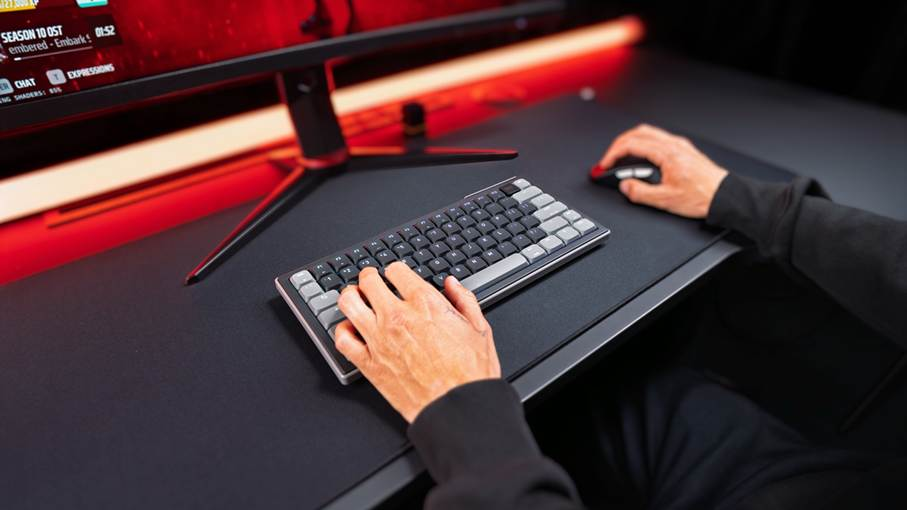
First unveiled at CES 2025, the CHERRY XTRFY MX 8.3 TKL Wireless mechanical gaming keyboard and the GP6 and GP7 mousepads are set to launch on 29 July 2025. Developed using decades of experience in keyboards, switches and esports, the latest products focus on precision, responsiveness and feel.
The MX 8.3 TKL Wireless features a gasket-mounted design in a solid aluminium casing and offers connection via USB-C, Bluetooth® or 2.4 GHz wireless dongle. It supports wireless polling rates of up to 4000 Hz and 8000 Hz via cable, reporting input as frequently as eight times per millisecond. The tenkeyless format provides more space for mouse movement, while a rotary knob and integrated display give access to RGB lighting, media control, battery status and connection management. Users can also view typing speed (APM) and save up to three custom profiles.
The keyboard uses the CHERRY MX2A switch, a refinement of the original CHERRY MX used in over 60 million keyboards. Featuring premium lubricant and a redesigned spring, the switch offers smoother actuation and improved acoustics. Switches can be changed easily thanks to hot-swap sockets requiring no technical expertise.
The GP6 and GP7 mousepads complement the keyboard setup, each measuring 460 x 400 x 4 mm. The GP7 incorporates graphene fabric, offering a robust yet smooth surface with high resistance to wear. Both pads include new cloth surfaces and a soft rubber base that enhances comfort and control. The material provides light glide under minimal pressure and increases resistance with firmer contact, supporting accuracy in micro-movements.
The CHERRY XTRFY MX 8.3 TKL Wireless will be available from 29 July 2025 at an MSRP of €299. The GP6 and GP7 mousepads will retail at €29 and €39 respectively.
Test samples for all three products are available on request. Further information is available at cherry.de/en-gb and cherryxtrfy.com

TF2 Skins and Items: Are They Still Worth Trading in 2025?

The Team Fortress 2 item economy remains active more than a decade after launch. Valve’s cosmetic system introduced wearables, weapons, unusual effects, and Australium variants. Some items sell for high real-world prices, fuelled by nostalgia and rarity. But the question still stands: are these items worth trading in 2025?

Trading routes and platforms have changed, especially with mainstream services joining the scene. If you want to trade vintage hats, limited-edition Australium weapons, or Unusual effects, understanding how value changes becomes important. Below is an in-depth look at TF2’s trading scene and what the future holds.

The Value Behind TF2’s Cosmetic Items and Rare Skins

Unlike other games where skins can affect gameplay, TF2 skins are purely for aesthetic purposes. The primary cosmetic types are weapons, hats, and skins, with some being rarer than others.

Their value is determined by several factors: rarity, demand, and aesthetics. Unusuals, which are rare hats that come with special effects, are among the most coveted items in the game. They can range in price from modest amounts to thousands of dollars, depending on the rarity and desirability of the effect.

The TF2 economy is dynamic, with prices fluctuating based on market trends and demand. While some items lose value over time, limited-edition or nostalgic skins have maintained or even increased in worth.

How TF2 Trading Works on Modern Marketplaces

In recent years, trading TF2 items has moved from in-game exchanges to specialized online marketplaces. Platforms like the Steam Community Market were pioneers in offering a streamlined way to buy, sell, and trade tf2 skins and other cosmetics. While Steam remains a popular choice, newer marketplaces have emerged with better rates, more flexibility, and access to a wider selection of items.

Modern marketplaces allow users to set their own prices and choose to accept or decline offers. The key benefit of these platforms is faster transactions, plus a broader pool of buyers and sellers.

Some platforms also offer extras like price tracking, item valuation tools, and trade history. These help traders better assess the market value of their items and make more informed buying or selling decisions.

Unusuals and Australiums: Key Milestones in TF2’s History

TF2’s items have more than just cosmetic value; some hold historical significance within the game’s community. Two such examples, Unusuals and Australiums, have played a prominent role in shaping the market.

Unusuals—The Crown Jewel of TF2 Cosmetics

Unusuals are among the most iconic and sought-after items in TF2. These hats feature special effects like floating particles or unique animations, which allow them to stand out and become ultimate status symbols.

Introduced as a novelty, Unusuals quickly became central to the game’s economy, with players willing to pay large sums for rare hats with desirable effects. The market for cosmetic items, especially Unusuals, is highly volatile, with prices fluctuating based on the rarity of the effect and the hat’s popularity.

Australiums—Rare and Nostalgic Collectibles

These rare and highly valued weapons in TF2 are known for their unique gold appearance and limited availability. They were once more common, and their scarcity today makes them highly sought after by collectors. Many view Australiums as nostalgic symbols of TF2’s early days, which has helped them retain significant value, despite the introduction of newer content in the game.

Where to Trade TF2 Items Today: DMarket

DMarket is a popular marketplace known for its multi-game support, where users can trade not only TF2 items but also skins from other popular games like CS2 and Dota 2. It provides more flexibility and a larger range of items compared to other platforms.

Here are some key features of DMarket:

  • Better rates: Competitive pricing options and fees that offer traders more value.
  • User-friendly interface: Easy-to-navigate platform for both beginners and experienced traders.
  • Secure transactions: Ensures safe and trustworthy trades with its verified marketplace system.
  • Price tracking tools: Features to track the market value of your items and help make informed trading decisions.

DMarket stands out as a comprehensive platform that meets the needs of the growing TF2 trading community, which creates a broader and more accessible marketplace.

The Niche TF2 Trading Community and Profit Potential

Throughout 2025, the TF2 trading community has remained a niche but passionate group of players. The market has seen shifts over the years, with certain items rising and falling in value, but the community’s enthusiasm for rare skins hasn’t wavered. Traders continue to find ways to make a profit, and some earn a substantial amount by buying low and selling high.

However, trading is not a foolproof method for earning money. The market can be unpredictable, with some items losing value as new skins are introduced. To make a profit, you need to stay informed about trends and understand the demands of the community. While opportunities for profit exist, there is always a risk of loss in the dynamic marketplace.