How Sports Apps Are Protecting Your Data And Safeguarding Against Security Breaches

With the new year comes the start of a new season for many of your favorite sports. Also new this year was the launching of many online Sportsbooks in a few states. Coincidentally, with the state of Massachusetts set to launch online sports betting next month, BetMGM Massachusetts will have all the best sign-up bonuses for those looking to try their luck when Ireland’s own Conor McGregor steps back into the octagon for the UFC later this year.

As such, it’s now much easier to bet on your favorite players and teams. However, for those experienced bettors who may be used to placing their physical bets at a casino or retail sports betting site, there may be a legitimate concern for the security of their personal data. The challenge now is to assure potential users that they can trust that their information is secure. 

Setting up an online account usually requires some transferring of information, at least enough to advance past its age restrictions. Alternatively, if an individual who wished to wager a sizable amount of cash were to do so at a casino, such information would not necessarily be compulsory. Also, many geo-tracking devices will prevent bettors from placing wagers outside their place of residence or registration. 

Prior to the legalization of sports betting, in many states, it has been stipulated that sensitive information should be encrypted by all applications that store personal data. This in turn helped to institute a foundation for mobile regulations relating to sports betting. 


One of the legislations stated by many of the sports betting apps is that a user’s account must only be funded through an electronic, bank-to-bank transfer only if the operator has appropriate internal controls to guard against payment frauds or breaches. Payments like these (ACH transfers) have to be processed through the Automated Clearing House.

In addition, even stricter measures have been put in place to shelter customers. As many casinos and sportsbook sites accept credit card transactions and save deposits for patrons, they are also expected to meet Payment Card Industry (PCI) compliance standards. This is an incentive so companies are encouraged to create a secure environment for credit card transactions. 

Online gaming businesses, as well as sportsbook operators, must comply with the Bank Secrecy Act and the other requirements outlined by the U.S. Department of the Treasury’s Financial Crimes Enforcement Network (FinCEN). Under federal law, all casinos must file a Currency Transaction Report on single or multiple transactions (minimum of $10,000) by any individual on a single day. 

Usually, when a customer places a bet, the supplier may only receive a reference number to identify that particular transaction and basic information such as the user’s location. The remaining personal information is gathered by the sportsbook in order to build its customer database. A few sportsbooks also provide security to guard against user liabilities. For example, MGM guarantees its customers cannot lose more than $50 if they fall victim to any unauthorized monetary transfers or upon proof of identity fraud. The claims must be made within two days of the occurrence. 

All licensed sports apps are required by law to utilize the most updated encryption techniques. Most use Secure Socket Layer (SSL) to encrypt server-to-server communication. Sports apps are not exempt from this legislation, and as such, they may use SSL encryption and sometimes even offer password security in an attempt to further secure your information. 

However, although most sportsbooks around the globe use SSL encryption certificates to prevent breaches in transaction data, mobile sportsbook applications may not always offer this same feature. Hence, users need to remain aware of the APIs (Application Programming Interfaces) on their mobile platforms, as any app utilizing this feature can restrict the possibility of a breach during information transfers. Any application lacking this authorization may be susceptible to a data breach. 

Any sports app can be the target of a cyberattack, and as a result, these security issues can affect not only the established sports industry but the online sports industry as well. Users must also be vigilant in remaining aware of security measures and the steps to be taken if a data breach is suspected. The process of creating an account, performing a cash transaction, placing a bet, and cashing out should be as seamless and simple as possible. Anything otherwise may lead to possible scams or hacks. 

One of the top priorities of online sportsbook apps is to ensure that their users’ information is kept private because the reputation of the business depends on it. Users can remain confident that their information remains secure as long as the sport application has taken the necessary steps to guard against breaches in data. 

Computer games — buy games on PC in Latvia

Every year, the gaming industry releases a huge number of PC games. It is not a surprise that gamers in Latvia want to pass a new computer game immediately as it becomes available. Official online games shopping supports the developers and provides you with amazing entertainment. Buy games online and motivate creators to develop new cool projects. 

Computers game online store for safe purchases 

In the computer game online store, you can purchase codes for different games. Online games shopping will be easy for you. The Punktid computers game online store and Steam gift cards online store do everything for their customers.

To buy a game code or a Steam card, you need to enter your email address and pay. Such online games shopping is much more convenient than any other game store may offer. 

Advantages of Punktid computers game online store 

Advantages of computers game online store:

  • A wide range of PC, Playstation, and Xbox video games in the online shop. Also, there is a Steam gift cards online store.  
  • Support of the online shop will answer your questions and help to start online games shopping.
  • The computers game online store accepts many types of payments. You can easily pay for games or Steam cards in a convenient way. 
  • The bonus system works in the Steam gift cards online store. The more active your online games shopping is, the more money you save.
  • The online shop is supplied by official channels to make your online games shopping safe.
  • Prices are lower than in any other computers game online store. The Punktid Steam gift cards online store is affordable for everyone. Buy games online to save. 

FAQ about online games shopping 

Go to the https://punktid.lv/ computers game online store FAQ section for more answers or submit a question on their official website.

Do I need to register to do online games shopping?

You don’t have to register in the Steam gift cards online store. However, if you want to receive credits with your purchase, you need to do so. 

Can I buy a computer game or a Steam card for Latvia from the Punktid computers game online store?

The computers game online store offers PC, PS4/PS5, and Xbox video games for dozens of countries. To see if the computer game is available for your region, go to the game shop, check the list of countries, and start online games shopping.

Can I find something new while doing my online games shopping?

The computers game online store adds new video games regularly. For example, you can pre-order Hogwarts Legacy, which will was released on February 10, 2023.

It’s Time to Renew Your Car Insurance: What You Should Know

When you purchase car insurance, you are purchasing a policy that provides you with protection for a set period of time. The majority of car insurance policies are for six months or a year. You’ll have to buy a new one after that because driving without car insurance is illegal and the fines are high. For example, in Alberta, Canada, the fines for first and second offenses are $10,000 and $20,000. 

So, once your policy expires, you have to renew it. When it comes time to renew your car insurance, you can select the types of coverage you need such as collision or comprehensive coverage. When your policy is about to expire, your insurance company will send you a letter or an email. The company may then automatically renew the policy, or ask you to show proof that your basic information hasn’t changed and then renew it. 

If you let your current policy lapse, you may have difficulty obtaining a new one. This is known as nonrenewal, which means that your insurance company will not provide you with a new policy. A lapse in coverage may also result in higher premiums.

The following tips will help you understand the renewal process much better. 

Work with an insurance broker 

An insurance broker acts as a liaison between the insurance companies and the clients. So, if you didn’t consult with an insurance broker previously, you should now, especially if you decide to change the policy. If you are considering purchasing a new insurance policy but are unfamiliar with its complexities, consulting with an insurance broker may be a good idea. 

When you find a policy, insurers should highlight the key facts, and your broker should explain them to you to make sure you understand what the company is proposing for you to buy. So, before you decide anything, find an insurance broker to consult with, and then decide on the type of insurance policy you want to purchase.

For example, if you live in Edmonton, Canada, it is a good idea to research the local market and find quality insurance brokers in Edmonton to get in contact with. Working with a broker is useful because they will give you unbiased, objective advice on the coverage that is best for your needs and fits your budget. Finding a broker in the area where you live is important, as they are familiar with all state laws.  

Understand the renewal process 

Even though you work with a broker, you still need to understand the process of renewal. Every insurance company has its rules. In some cases, an insurer will simply send you the renewal documents, and your policy will be renewed automatically on the corresponding date. This is common with monthly-pay auto insurance policies. If you have no problems with your updated policy or the change in premiums, you are not required to do anything. 

Your policy will automatically renew without your intervention, and your insurer will continue to deduct your monthly insurance premium directly from your account. If you have a problem with your policy and do not want to renew it, you can cancel it and ask for another offer or find another insurance company.

Learn how to change your current car insurance policy

If your car insurance is about to expire and you don’t want to keep your current coverage, you can notify your insurance company that you want to change it. Then, purchase a new policy that begins before your current one expires. You won’t be able to make property damage claims if your coverage lapses, even for a short period. Maintaining *continuous insurance* ensures you remain protected while avoiding penalties or higher premiums in the future.

If you don’t want to renew your car insurance policy, you can simply cancel it. The insurance company will have a say in this situation. Some companies will let you cancel your policy over the phone, while others will require a letter stating your intention to cancel.

Check the increase in the insurance premium rates

Insurance companies may occasionally raise the rates to reflect the current economic situation or the changes in government-mandated insurance regulations. Most often a rise in your auto insurance premium is associated with a poor driving record, a prior claim, or adding a new driver or another car to your policy. 

Even changing jobs can raise your premiums, if it increases the distance you travel to work. Whatever the cause of the increase, understand how to calculate the premiums and check each piece of information in detail.

Final thoughts

A valid car insurance policy is a must. Make sure you consult an insurance broker to discuss your options, but above all, understand the renewal process yourself. Learn the insurance procedure, so you can complete the process quickly. 

Cybersecurity in the Age of Technology: Protecting Your Business Against Digital Threats

Technology has brought significant advancements in business operations and communication in today’s digital age. With the rise of the internet and the widespread use of electronic devices, businesses now have access to new ways of reaching their customers and conducting transactions. However, this increased connectivity also comes with significant risks, as cyber threats have become more sophisticated and prevalent than ever before. As a business owner or manager, it is essential to understand these threats and take steps to protect your company’s digital assets. This article will discuss some of the most common digital threats facing businesses today and provide tips on mitigating them.

The Importance of Cybersecurity

Cybersecurity refers to the practice of safeguarding electronic devices, networks, and sensitive information from unauthorized access, theft, or damage. Businesses must prioritize cybersecurity to prevent data breaches, financial loss, and damage to their reputation. A successful cyber attack can have devastating consequences, from legal liabilities to loss of customer trust.

In today’s digital age, businesses of all sizes are vulnerable to cyber-attacks. Cybercriminals use sophisticated techniques to exploit vulnerabilities in a company’s security systems, gaining access to sensitive data and causing extensive damage. Businesses need to implement robust cybersecurity measures to protect themselves against these threats.

Data breaches and cyber attacks can result in significant financial loss for businesses, including fines, legal fees, and damage to their reputation. These attacks can also result in losing customer trust, which can be challenging to regain. Businesses must invest in cybersecurity measures that can effectively detect and prevent cyber threats.

Common Cyber Threats

  • Phishing Attacks

Phishing attacks are a type of cyber attack that is prevalent today. They often use email or social media to trick people into revealing sensitive information, such as login credentials or credit card numbers. Phishing attacks usually come in the form of a fake email that appears to be from a legitimate source, such as a bank or a social media platform.

  • Ransomware

Ransomware is another type of cyber attack that has become increasingly common. It is a type of malware that encrypts a victim’s files and demands payment in exchange for the decryption key. Ransomware attacks can be devastating, leading to permanent data loss if the victim does not pay the ransom.

  • Malware

Malware is a broad software category designed to harm or exploit computer systems. Common types of malware include viruses, Trojans, and spyware. Malware can be used to steal sensitive information, damage computer systems, or control devices remotely. Cybercriminals use malware to gain access to sensitive information, steal financial information, and cause damage to computer systems.

Phishing attacks, ransomware, and malware are serious threats that individuals and businesses must be aware of. Taking proactive steps to protect sensitive information and prevent cyber attacks is essential to safeguard against the potentially devastating consequences of these attacks. Regularly updating software and antivirus programs, being cautious of suspicious emails or messages, and having a backup system in place are all effective ways to protect against cyber threats.

Cybersecurity Best Practices

  • Implement Strong Password Policies

Implementing strong password policies is one of the most effective ways to prevent cyber attacks. A good case in implementing a strong password policy can be low deposit casino UK who also needs to ensure they have strong security measures to protect your personal and financial information. Encourage employees to use complex passwords and to change them frequently. Consider using two-factor authentication to provide an extra layer of security. In addition to implementing strong password policies, businesses should consider using password managers. Password managers can generate complex passwords and securely store them, reducing the risk of employees using weak passwords or reusing passwords across multiple accounts.

  • Keep Software Up-to-Date

Software vulnerabilities are a common entry point for cyber attacks. Ensure that all software your business uses is kept up-to-date with the latest security patches and updates. Regular software updates and security patches can help prevent cyber attacks that exploit known vulnerabilities in outdated software. Implementing automatic updates or using a patch management system can ensure that all software is updated promptly.

  • Backup Your Data Regularly

Regularly backing up your data is essential to prevent permanent data loss during a cyber attack. Make sure that backups are stored in a secure location and that they are tested regularly to ensure that they can be restored if needed. Backups should be performed periodically and stored in a secure offsite location to protect against data loss due to cyber-attacks, natural disasters, or hardware failures. It is also essential to regularly test the backups to ensure they can be restored in a disaster.

  • Train Your Employees

Employees are often the weakest link in a company’s cybersecurity defences. Make sure that all employees receive regular training on how to identify and avoid common cyber threats. Encourage employees to report any suspicious activity immediately. Employee training should be ongoing to keep employees aware of the latest cyber threats and best practices for preventing them. This should include regular phishing awareness training, as phishing attacks are becoming increasingly sophisticated and challenging to detect.

Businesses should also have an incident response plan in place in case of a cyber attack. The plan should include procedures for identifying and containing the attack, notifying stakeholders, and recovering from the attack. Regular testing and updating of the project can ensure it is effective during an attack.

Conclusion

Cybersecurity is essential for businesses of all sizes in today’s digital age. By understanding the most common cyber threats and implementing best practices to prevent them, you can protect your company’s digital assets and reputation. Remember to keep your software up-to-date, back up your data regularly, and train your employees to identify and avoid cyber threats. By taking a proactive approach to cybersecurity, you can reduce the risk of a cyber attack and ensure the long-term success of your business.

Creative Outlier Free and Outlier Free Pro bone conduction headphones – First Look

Creative recently announced two pairs of bone conduction headphones which is now becoming a popular trend and for the better we have tested quite a few pairs over the last year or so and I am looking forward to seeing how creative have done here with the latest two headsets on offer.

Today we take a first look and hands on of the new bone conduction headphones which look identical but one has more to offer hence the name Pro and if you have any questions feel free to ask below or on our YouTube channel and we will gladly answer them.

The use of bone conduction technology revolves around transducers on the headphones, which, through vibrations on the user’s cheekbones, transmit sound waves into the inner ears. With their ears freed up from in-ear or over-ear headphones, users feel safer through heightened environmental awareness while enjoying high-quality acoustics – this is especially useful for joggers or cyclists on busy streets, or gym enthusiasts who like to chat with their workout buddies.

Creative Outlier Free

The Outlier Free is equipped with a slew of handy features for wireless headphones – up to 10 hours of battery life per charge (10 minutes of quick-charging provides 2 hours of playtime), IPX5 water resistance, Bluetooth 5.3 with multipoint connectivity (up to 2 Bluetooth devices at a time), low-latency mode to minimize audio-visual lag, built-in microphone and Siri / Google Assistant support. It is constructed using lightweight silicone and titanium memory alloy for optimal comfort and fit.

BUY 

Creative Outlier Free Pro

The Outlier Free Pro stands out even more with its 8GB (stores 2,000 MP3 songs) built-in music player (also compatible with FLAC, WAV and APE file formats); it enables users to enjoy their favorite tunes without the need to carry their mobile phones. Thanks to its IPX8 rating (the highest waterproof rating for water immersion), swimmers can even swim underwater in the pool.

Bluetooth 5.3, delivering robust connections for up to 2 Bluetooth devices at a time. There is also a low-latency mode to minimize audio-visual lag for movie-watching; users have the added convenience with a built-in microphone for calls, and Siri / Google Assistant support. Lightweight silicone and titanium memory alloy are used to construct the Outlier Free Pro, translating to all-day comfort and fit.

BUY

Unboxing Video

How a strong drinking culture is not mixing well with gambling in Ireland

Ireland is known for its rich history, beautiful landscapes, and vibrant culture. However, there are also certain aspects of Irish culture that have raised concerns in recent years, namely the country’s drinking and gambling cultures. Ireland has a long-standing reputation as a nation of drinkers, with alcohol consumption deeply ingrained in the country’s social fabric. On the other hand, the gambling industry has seen a surge in popularity in Ireland over the past decade, with a growing number of people turning to betting shops, online gambling, and casinos.

While drinking and gambling are often seen as harmless forms of entertainment, the combination of the two has been linked to a number of negative consequences in Ireland. This has led to increasing concerns about the impact of the country’s drinking culture on gambling behaviors and vice versa.

In this blog article, we will delve into the issue of how a strong drinking culture is not mixing well with gambling in Ireland. We will explore the historical and cultural context of both drinking and gambling in Ireland, as well as the negative impact of the combination of the two. We will also look at the efforts being made to tackle this issue and promote responsible drinking and gambling in Ireland.

Drinking culture in Ireland

Drinking has a long history in Ireland, with a culture of pub-going dating back centuries. Pubs have traditionally served as a social center for communities, offering a place for people to gather, share stories, and enjoy a pint or two. The role of alcohol in Irish society has also been shaped by historical events such as the Great Famine and the struggle for independence from Britain. Today, alcohol remains a central part of Irish social life, with pubs and bars still playing an important role in communities across the country.

However, the downside to this culture of drinking has become increasingly apparent in recent years. Ireland has one of the highest rates of binge drinking in the world, with a large proportion of the population engaging in heavy drinking on a regular basis. This has led to a range of negative health and social consequences, including increased rates of liver disease, alcohol-related accidents and injuries, and violence.

Moreover, the strong drinking culture in Ireland is closely intertwined with the country’s gambling culture. Many people see drinking and gambling as two sides of the same coin, with the two activities often occurring in the same social contexts. It is not uncommon to find people drinking in pubs or bars before heading to a betting shop or casino. This connection between drinking and gambling has been identified as a key factor in the rise of problem gambling in Ireland.

Research has shown that people who drink heavily are more likely to engage in risky gambling behaviors, such as betting large amounts of money or chasing losses. Alcohol has been shown to impair judgment and decision-making, making people more susceptible to making impulsive and risky bets. Moreover, the combination of drinking and gambling has been linked to an increased risk of aggression and violence, both within gambling settings and in wider society.

Overall, the prevalence of binge drinking and the close connection between drinking and gambling have raised concerns about the impact of alcohol on gambling behaviors in Ireland. These issues have prompted calls for greater regulation and education to promote responsible drinking and gambling, and to address the negative consequences of the combination of the two.

Gambling culture in Ireland

The history of gambling in Ireland dates back centuries, with various forms of betting and gaming being popular in the country for many years. However, gambling was largely unregulated in Ireland until the introduction of the Gaming and Lotteries Act in 1956. Since then, various pieces of legislation have been introduced to regulate different aspects of the gambling industry, including the Betting Act 1931, the Gaming and Lotteries Act 1956, and the Gaming and Lotteries (Amendment) Act 2019.

Today, the gambling industry in Ireland is a thriving and growing sector of the economy with online casinos like ones present on this link. There are currently over 900 licensed betting shops operating in the country, as well as a growing number of online gambling sites and casinos. In addition to traditional forms of gambling, the rise of mobile technology has led to an increase in mobile betting and gaming, with many people now able to place bets or play casino games from the convenience of their own homes.

The growing popularity of gambling in Ireland has raised concerns about the impact of the industry on society. Research has shown that gambling can lead to a range of negative social and psychological consequences, including addiction, financial difficulties, and relationship breakdowns. Moreover, the close connection between drinking and gambling has been identified as a key factor in the rise of problem gambling in Ireland.

While the Irish government has introduced a range of measures to regulate and control the gambling industry, including advertising restrictions, betting limits, and self-exclusion programs, some argue that more needs to be done to address the negative consequences of gambling. For example, many advocates for responsible gambling are calling for greater public education and awareness about the risks and warning signs of problem gambling, as well as stricter regulations around online gambling. By taking a more proactive and preventative approach to gambling regulation, it is hoped that the negative impact of the industry on Irish society can be mitigated.

Negative effects of combining drinking and gambling

While drinking and gambling are often seen as harmless forms of entertainment, the combination of the two has been linked to a range of negative consequences, particularly in Ireland where both activities are deeply ingrained in the culture. Here are some of the most prominent negative effects of combining drinking and gambling:

Research has shown that drinking alcohol can increase the risk of problem gambling. People who drink heavily are more likely to engage in risky and impulsive behavior, which can lead to excessive gambling and financial loss. Moreover, alcohol can impair judgment and decision-making, making it more difficult for people to recognize and control their gambling behavior.

Alcohol can impair cognitive function, making it more difficult for people to make rational and informed decisions. This can be particularly problematic in the context of gambling, where people may be more likely to make impulsive or risky bets when under the influence of alcohol. Moreover, alcohol can affect people’s perception of risk, making them more likely to take chances and disregard the potential consequences of their actions.

The combination of drinking and gambling can also lead to increased levels of violence and aggression in gambling settings. Research has shown that people who drink heavily are more likely to engage in physical altercations, both within and outside of gambling establishments. Moreover, the stress and tension associated with gambling can be heightened by the presence of alcohol, which can exacerbate conflicts and lead to violent behavior.

Overall, the combination of drinking and gambling can be a dangerous mix, particularly for vulnerable individuals who may be at risk of developing a gambling addiction. By promoting responsible drinking and gambling, and raising awareness of the potential negative consequences of the combination of the two, it is hoped that the risks associated with this behavior can be minimized.

Conclusion

Recap of the negative impact of the combination of drinking and gambling in Ireland:

In summary, the combination of drinking and gambling in Ireland has been linked to a range of negative consequences. The prevalence of binge drinking and the close connection between drinking and gambling have raised concerns about the impact of alcohol on gambling behaviors, with increased risk of problem gambling, impaired decision-making, and violence and aggression in gambling settings.

While the Irish government has introduced a range of measures to regulate and control the gambling industry, and promote responsible drinking and gambling, there is still much work to be done. The negative impact of the combination of drinking and gambling on Irish society is a complex issue that requires a multi-faceted approach. This includes public education and awareness campaigns, stricter regulations around online gambling, and greater support for those who may be at risk of developing a gambling addiction.

In conclusion, the combination of drinking and gambling in Ireland is a serious issue that requires ongoing attention and action. While both activities are deeply ingrained in Irish culture, it is important to recognize the potential negative consequences of their combination, particularly for vulnerable individuals who may be at risk of developing a gambling addiction. By promoting responsible drinking and gambling, and raising awareness of the potential risks, we can work towards creating a safer and more sustainable gambling industry in Ireland. This includes measures such as self-exclusion programs, advertising restrictions, and betting limits, as well as greater support for those who may be struggling with gambling-related issues. Ultimately, by working together, we can build a healthier and more responsible drinking and gambling culture in Ireland, and ensure that these activities remain a source of enjoyment and entertainment for all.


How Ireland became the home to one of the largest gambling companies out there

Ireland is known as the home to one of the largest gambling companies in the world – Paddy Power. This Irish betting company has been around since 1988 and has become a household name not just in Ireland, but across the globe. Paddy Power has a strong presence in Ireland and the UK, but has also expanded its reach to other countries such as Australia and the United States.

The global gambling industry is a huge and lucrative market, with a variety of products and services offered to consumers. This includes traditional forms of gambling such as casinos and sports betting, as well as newer offerings like online and mobile betting. The industry has experienced significant growth in recent years, with some estimates putting the global gambling market at over $400 billion in value. This growth has been driven in part by advancements in technology and the increasing accessibility of gambling services.

However, the industry has also faced significant criticism and scrutiny, particularly in relation to problem gambling and the impact on individuals and society as a whole. As such, the regulation of the gambling industry has become an increasingly important issue for governments and regulators around the world. Ireland is no exception, and its own gambling laws have undergone significant changes in recent years in response to these concerns.

The Rise of Paddy Power

Paddy Power was founded in 1988 in Dublin, Ireland, by a group of three bookmakers who were looking to bring something new and innovative to the Irish gambling market. The company started out with a single betting shop, but quickly expanded to open additional locations throughout the country. Paddy Power became known for its irreverent and often controversial advertising campaigns, which helped to differentiate it from other betting companies and build a loyal following among customers.

In the early 2000s, Paddy Power made the strategic decision to launch an online platform, which helped to further fuel its growth and expand its reach beyond Ireland. The company also began to expand into new markets, including the UK and Australia. Paddy Power’s online platform was a game changer, offering a range of betting options to customers, from sports betting to casino games. Today, Paddy Power is one of the best online casinos in Ireland, offering a wide range of games and betting options to customers.

One of the key factors that contributed to Paddy Power’s success was its innovative marketing campaigns. The company became known for its bold and often provocative advertising, which helped to generate buzz and build brand awareness. Paddy Power’s marketing campaigns were often centered around current events or cultural trends, which helped the company to stay relevant and top-of-mind among customers.

Another factor that contributed to Paddy Power’s success was its focus on customer experience. The company has always placed a strong emphasis on providing a high-quality, user-friendly experience to customers, both online and in-person. This has helped to build customer loyalty and drive repeat business, while also attracting new customers who are looking for a betting company that prioritizes their needs and preferences.

Overall, Paddy Power’s rise to prominence can be attributed to a combination of factors, including its innovative marketing, focus on customer experience, and strategic expansion into new markets. Today, Paddy Power is one of the best online casinos in Ireland and a major player in the global gambling industry.

Ireland’s Gambling Regulations

Ireland’s gambling regulations have undergone significant changes over the years, in response to concerns about problem gambling and the potential negative impact of the industry on individuals and society as a whole. Currently, gambling in Ireland is regulated by the Gambling Control Bill 2013, which has yet to be fully implemented.

Under current Irish law, all gambling activities must be licensed by the Irish government. This includes both online and land-based gambling, with different types of licenses available depending on the nature of the activity. The Irish government also imposes a range of restrictions on gambling advertising and promotions, in an effort to prevent problem gambling and protect vulnerable individuals.

These regulations have had a significant impact on Paddy Power and other gambling companies operating in Ireland. For example, Paddy Power has had to navigate a complex web of regulations and licensing requirements in order to continue offering its services to Irish customers. In addition, the restrictions on advertising and promotions have limited the ways in which Paddy Power can market its services, which has forced the company to get creative in its approach.

Despite the efforts to regulate the industry, there have been criticisms and controversies surrounding Ireland’s gambling laws. Some have argued that the laws are too lenient and do not do enough to protect vulnerable individuals from the risks of problem gambling. Others have criticized the government for not doing enough to combat the rise of online gambling and the potential for fraud and other illegal activities.

There have also been concerns raised about the role of the gambling industry in Irish society, particularly in relation to its impact on low-income individuals and those with gambling addiction. Some have called for stricter regulations and greater investment in problem gambling prevention and support services.

Overall, Ireland’s gambling regulations are a complex and evolving issue, with a range of stakeholders involved. As the industry continues to grow and change, it is likely that there will be ongoing debates and discussions about the most effective ways to regulate and manage the risks associated with gambling.

Paddy Power’s Impact on Ireland’s Economy

Paddy Power’s success has had a significant impact on the Irish economy. The company is one of the largest employers in the country, with over 6,000 employees worldwide, and has made significant contributions to job creation and tax revenue. Paddy Power’s success has helped to fuel the growth of Ireland’s gambling industry and has attracted significant investment to the country.

In addition to its economic impact, Paddy Power’s success has also had broader social and cultural implications. The company has played a major role in shaping Ireland’s identity as a hub for gambling and gaming, and has helped to promote Irish culture and values on the global stage. Paddy Power has also been a leader in the development of new and innovative betting products, such as BTC poker casinos, which have helped to drive growth and innovation in the industry.

However, there have also been criticisms and concerns raised about the social and cultural impact of Paddy Power’s success. Some have argued that the company’s marketing campaigns and aggressive expansion strategies have contributed to problem gambling and other negative social and cultural trends. Others have expressed concern about the role of crypto poker casinos and other new forms of gambling in shaping the future of the industry and its impact on society.

Overall, Paddy Power’s impact on Ireland’s economy and society has been significant, with both positive and negative implications. As the industry continues to evolve and change, it will be important for stakeholders to carefully consider the potential risks and benefits of new technologies and products like poker casinos, and to work together to develop effective strategies for managing the impact of gambling on individuals and society as a whole.

Paddy Power’s Corporate Culture

Paddy Power’s corporate culture is built around a set of core values and a mission statement that emphasizes innovation, creativity, and customer focus. The company has always been known for its irreverent and bold approach to marketing, which is reflected in its corporate culture and values. Paddy Power’s culture emphasizes a willingness to take risks, a commitment to customer experience, and a desire to disrupt the status quo.

One of the key ways that Paddy Power’s culture has contributed to its success is by helping the company differentiate itself in a crowded and competitive market. By taking a bold and innovative approach to marketing and product development, Paddy Power has been able to stand out from other betting companies and build a loyal following among customers. The company’s focus on customer experience has also helped to differentiate it from competitors, by placing a strong emphasis on user-friendly interfaces, quick and easy payouts, and a range of betting options to choose from.

However, as Paddy Power has grown and evolved, it has also faced a range of challenges related to its corporate culture. For example, the company has had to navigate the tensions between its irreverent marketing campaigns and the need to operate within a heavily regulated and often contentious industry. Paddy Power has also faced criticism and backlash from some customers and stakeholders, who have argued that the company’s marketing campaigns are too provocative and can contribute to problem gambling and other negative social and cultural trends.

Despite these challenges, Paddy Power has remained committed to its corporate culture and values, and has continued to evolve and adapt to changing market conditions. By embracing new technologies and approaches to product development, and by maintaining its focus on customer experience, Paddy Power has remained a major player in the global gambling industry, and a leading provider of poker casinos and other innovative betting products.

Conclusion

In conclusion, Paddy Power’s success in Ireland and beyond is the result of a combination of factors, including its innovative marketing campaigns, focus on customer experience, and commitment to corporate culture and values. Paddy Power has had a significant impact on the Irish economy and has helped to shape Ireland’s identity as a hub for gambling and gaming.

Despite facing challenges related to regulation, marketing, and cultural implications, Paddy Power has remained committed to its core values and has continued to innovate and adapt to changing market conditions. Other companies can learn valuable lessons from Paddy Power’s success, including the importance of taking risks, prioritizing customer experience, and staying true to one’s core values and mission.

However, it is important for companies to recognize the potential risks and negative social and cultural implications associated with the gambling industry, and to work proactively to mitigate these risks and promote responsible gambling. By doing so, companies can help to build a sustainable and socially responsible industry, while also achieving success and growth in a highly competitive market.


TEKenable Downsizes its Office due to Success of Remote Working

TEKenable, the digital services company is moving to a smaller office as a result of the success of remote working.  The company has doubled in the last five years and regularly surveys employees about the culture of the organisation and to ask them about their preferred working model.  TEKenable currently employs over 160 staff and the company continues to grow.

“Prior to the pandemic, 50% of our workforce was already remote across our offices in the UK, Ireland, Hungary, Spain, UAE and the Middle East so many of our teams were set up for the format and flexible schedules were the norm”, explains Nick Connors, Group CEO, TEKenable.  “When the pandemic hit, technology was not a problem and the transition for the entire company proved so seamless that we were ready to change course and gave our employees the choice of in-house or remote working.  Remote working won out and our teams are functioning more efficiently than ever before.  It has become increasingly clear that our employees are happiest and did their best work when they had the flexibility to determine where and when they work best.”

“The requirement for attending an office was constraining growth by requiring recruitment from a specific geographic area and with Dublin in particular which meant dealing with the lack of housing or extended commute times,” adds Peter Rose, Group CTO, TEKenable.  “The biggest advantage is access to talent in places where we do not have offices and the benefit that brings.”

In the recent Great Place to Work assessment, TEKenable was recognised as the 15th Best Medium Workplace in Ireland 2023.  This is TEKenable’s first year to be named as a top Irish workplace which is based on direct feedback from employees.

“We as a company really value diversity and a people-first culture,” concludes Nick. “Our values are a part of that foundation, and things like having trust in your employees and knowing that they will make decisions that are the best balance for their life and job maximising both is part of that.”

The new, smaller office will be used as ‘conversation space’ for meetings, collaboration and events.

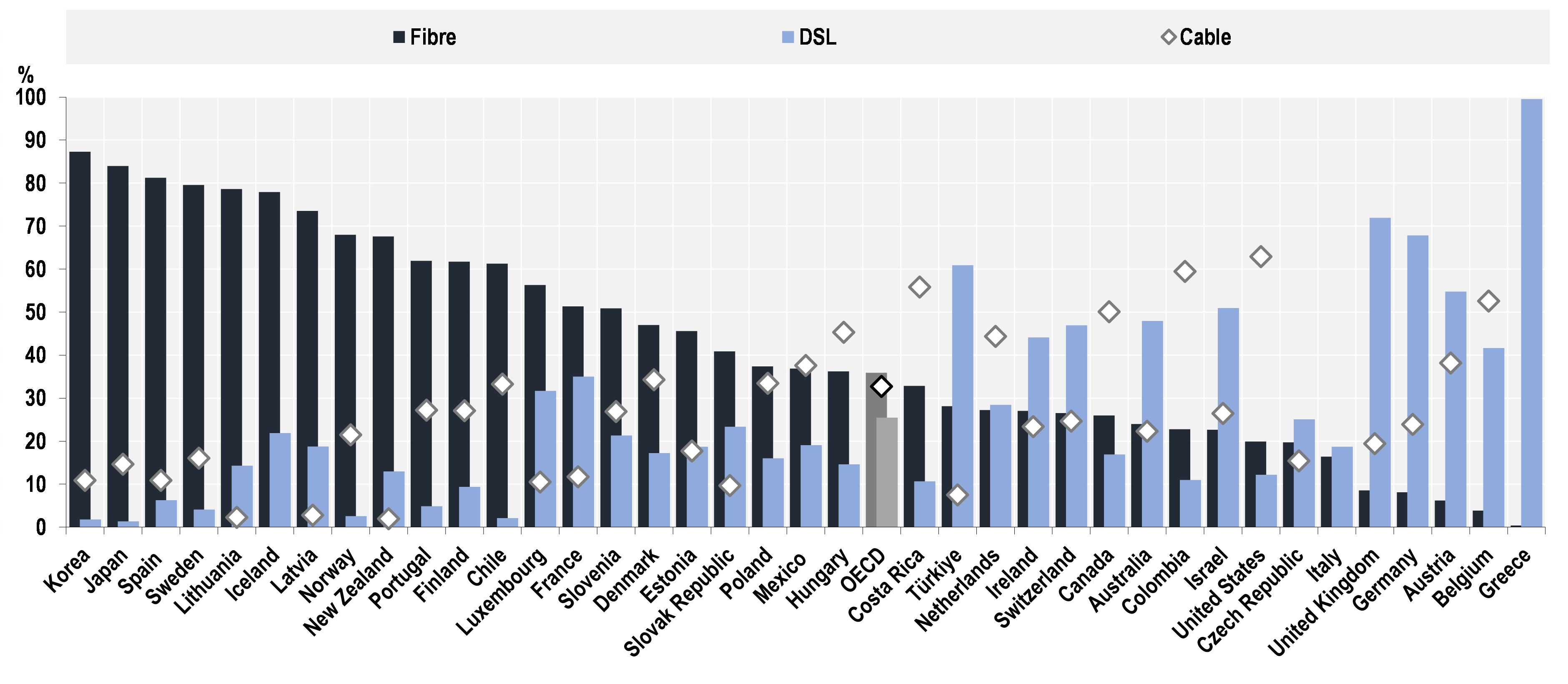
Fibre is now the dominant broadband access technology in half of all OECD countries

High-speed fibre is now the primary fixed broadband technology in 19 out of 38 OECD countries, according to the latest data. Among these countries, 15 have a share of fibre subscriptions of over 50%.

The latest update of the OECD Broadband Portal shows a 12.3% rise in fibre broadband subscriptions across OECD countries between June 2021 and June 2022, a slightly slower growth rate than the previous 12 months. The need to bolster remote working capacity has remained even as many workers physically returned to the office in 2022, driving demand for fibre connections that provide fast upload and download speeds. Overall, fibre now accounts for 36% of fixed broadband subscriptions in the 38 OECD member countries, up from 22% five years ago.

Korea, Japan and Spain have the highest fibre penetration rates in the OECD at 87%, 84% and 81%, respectively, being among the seven countries with a fibre share of total fixed broadband subscriptions of 70% or above. The highest fibre growth rates in Latin America were in Costa Rica, Chile and Colombia (51%, 35% and 32%, respectively), while in Europe they were Belgium, the United Kingdom and Ireland (87%, 47% and 40%, respectively).

The latest update of the Broadband Portal features 5G subscriptions for the first time, with 14 OECD countries now able to show 5G data as part of their overall mobile broadband data. Overall, of all 38 OECD countries, 5G services are available in 36, with the number of 5G subscriptions representing 17% of mobile broadband subscriptions (in countries with available data). Denmark (41%, 3.5 million subscriptions), Korea (28.5%, 24.6m) and Japan (21%, 51.5m) have seen the highest take-up. Mobile broadband continued to grow overall, with a 6% increase in subscriptions in the year to June 2022.

Cable grew by a more modest 2% in the year to June 2022 and is now declining in 18 countries. It remains the leading fixed broadband technology in eight OECD countries, and is dominant in North and South America, with subscriptions in the United States, Colombia and Costa Rica accounting for 63%, 59% and 56% of the total, respectively (although in Chile fibre has overtaken cable). In Europe, cable remains popular in Belgium, Hungary and the Netherlands, with 53%, 45% and 44%, respectively.

DSL subscriptions fell by 8.5% over the same period, with several OECD countries showing sharp declines. While DSL remains the main broadband technology in several countries, some saw sharp declines in subscriptions, notably Norway (-64%), Chile (-49%) and Sweden (-41%).

Fibre, DSL and cable in total fixed broadband subscriptions, June 2022

Overall, fixed broadband subscriptions in OECD countries totalled 476 million in June 2022, up from 463 million a year earlier, with an average of 34.7 subscriptions per 100 inhabitants. Mobile broadband subscriptions totalled 1.76 billion in June 2022, up from 1.66 billion a year earlier, with an average of 128 subscriptions per 100 inhabitants.

Download broadband data, charts, and penetration maps by country at http://oe.cd/broadband.